Fake Banner
A Great Year For Experiment Design

While 2025 will arguably not be remembered as a very positive year for humankind, for many reasons...

Living At The Polar Circle

Since 2022, when I got invited for a keynote talk at a Deep Learning school, I have been visiting...

Conferences Good And Bad, In A Profit-Driven Society

Nowadays researchers and scholars of all ages and specialization find themselves struggling with...
USERN: 10 Years Of Non-Profit Action Supporting Science Education And Research

The 10th congress of the USERN organization was held on November 8-10 in Campinas, Brazil. Some...

User picture.
picture for Hank Campbellpicture for Patrick Lockerbypicture for Heidi Hendersonpicture for Bente Lilja Byepicture for Sascha Vongehrpicture for Johannes Koelman
Tommaso DorigoRSS Feed of this column.

Tommaso Dorigo is an experimental particle physicist, who works for the INFN at the University of Padova, and collaborates with the CMS and the SWGO experiments. He is the president of the Read More »

Blogroll
Update: I am keeping out of this, but you may well be interested in reading what Gibbs, Woit, and Motl have to say about recent leaks on the ATLAS and CMS results. So I hope I won't be crucified for three general links now!

Update 2: And it is now public that a seminar at CERN will be given by ATLAS and CMS on December 13th. So the wait is almost over, officially...

I have not written in a while - a full week. This is uncharacteristic enough that I owe you some sort of explanation.
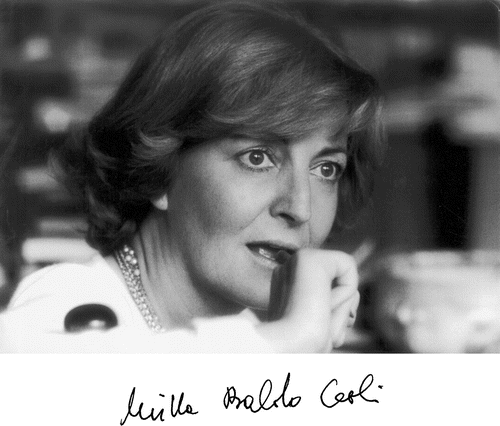
Sadly, this morning Milla Baldo Ceolin passed away.

Milla was a volcanic physicist, and a fantastic professor. I had the pleasure of following her course of "Fisica Superiore" in the late eighties, and I remember her brilliant lessons, insightful and mind-broadening.

Milla was born in 1924, and graduated in Physics in 1951. In 1963 she was the first woman to become a professor in the University of Padova. Her research encompasses fifty years of subnuclear physics, and is especially centered on weak interactions. But in Padova, especially in the last two or three decades, her name was especially associated with neutrinos, the phenomenal particles at whose study her research was mostly aimed.
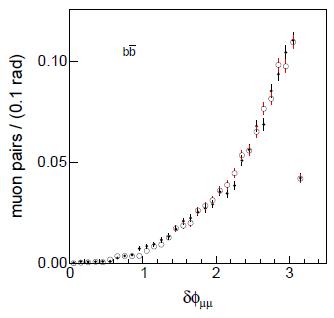
Do you remember the multi-muon anomaly in CDF ? The matter was discussed with quite some detail in a series of posts in this blog (back then at wordpress). In a nutshell, CDF could not explain their sample of events containing two muons, when these particles had a very large impact parameter (the impact parameter is the minimum distance of a trajectory from the interaction point: a large value indicates that the particle was produced elsewhere).
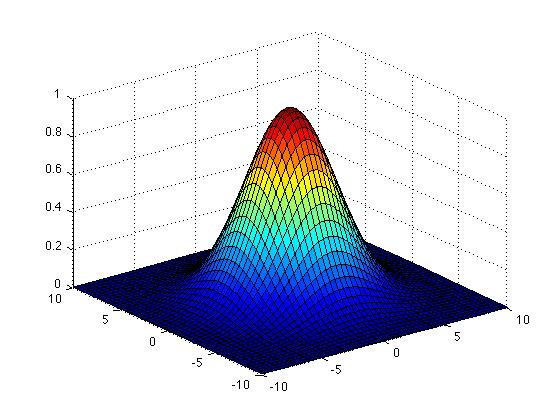
For you today here is a test of whether you shoud trust your intuition when confronted with an apparently simple problem. Incidentally, this article is the answer to the "Guess The Plot" riddle I posted a few days ago here.

Suppose you are given two measurements of the same physical quantity. Make it something easy to visualize, such as the length of a stick. They tell you that when measured with method 1 the result was x1=10 cm, with a estimated uncertainty s1=0.1 cm, and when measured with method 2 the result was x2=11 cm, with estimated uncertainty s2=0.5cm. Here is a question for you today: What is your best guess of the length of the stick ?
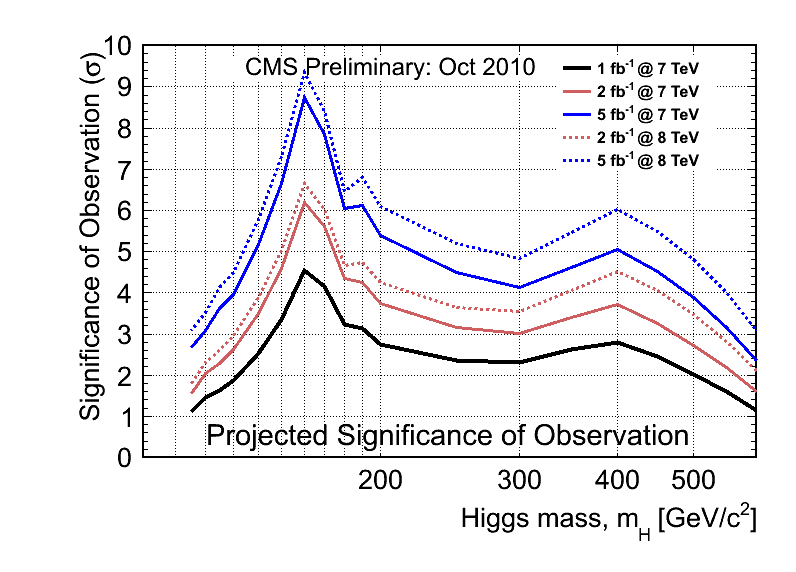
Totally overshadowed by the news of the new Opera measurement of neutrino speeds, yesterday CERN officially released the combined result of ATLAS and CMS searches for the Higgs boson. The news has been given already in two prominent particle physics blogs (Resonaances and Not Even Wrong), so I think I am not obliged to do anything more than point you to those, who cover the matter quite accurately.
After a more careful reading of the paper, the listening to a seminar on the result, and some discussions, I can share with you a few more details on the Opera measurement.