Fake Banner
A Great Year For Experiment Design

While 2025 will arguably not be remembered as a very positive year for humankind, for many reasons...

Living At The Polar Circle

Since 2022, when I got invited for a keynote talk at a Deep Learning school, I have been visiting...

Conferences Good And Bad, In A Profit-Driven Society

Nowadays researchers and scholars of all ages and specialization find themselves struggling with...
USERN: 10 Years Of Non-Profit Action Supporting Science Education And Research

The 10th congress of the USERN organization was held on November 8-10 in Campinas, Brazil. Some...

User picture.
picture for Hank Campbellpicture for Patrick Lockerbypicture for Heidi Hendersonpicture for Bente Lilja Byepicture for Sascha Vongehrpicture for Johannes Koelman
Tommaso DorigoRSS Feed of this column.

Tommaso Dorigo is an experimental particle physicist, who works for the INFN at the University of Padova, and collaborates with the CMS and the SWGO experiments. He is the president of the Read More »

Blogroll
After the disturbance created by the Higgs rumour in ATLAS, I think we can go back to normal business - in this case, keeping my word on discussing things that were left hanging.

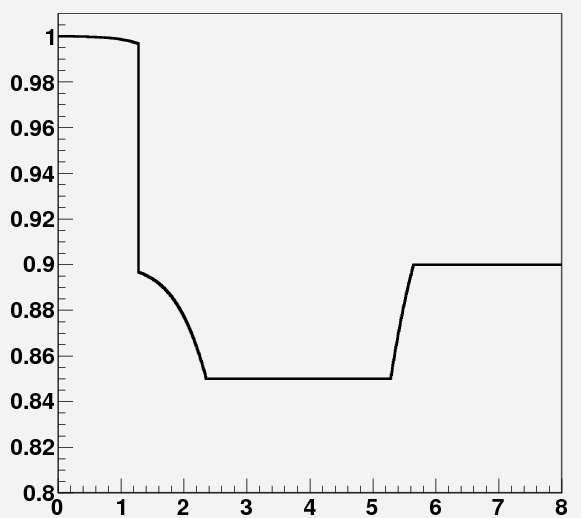
Your response to my small riddle was quite good, forcing me to provide a timely and exhaustive explanation of what is in the plot I posted a few days ago.
A picture is worth a thousand words. This is true both for photographs and for graphs, but sometimes the words are spoken to the wrong ears. I would like to offer you a very simple, visual test today: show you a picture and let you guess what it represents. Depending on the response, this might end in oblivion or be tried again with another subject.

So the question is: what does the picture below represent ?


A few hints:

- I did the graph myself, and it took me 10' of programming and a tenth of a second of CPU on my laptop.
A casual look at the Arxiv hep-ph listings this morning was enough to confirm that the feeding frenzy of theoreticians around the latest bait thrown in the waters by CDF is not showing any sign of slowing down.

The paper in question is 1104.2893, and it discusses "Weak-triplet, color-octet scalars and the CDF dijet excess". In their model, the authors (B. Dobrescu and G. Krnjaic) argue in favour of an extension of the standard model which includes rthree new coloured particles, two charged and one neutral state.
The Xenon 100 collaboration has finally released the results of their data analysis, and the results are saying that there is no Dark Matter in sight so far. Since we live in an age where time is precious, I think many of you are only interested in the bottomline. I can give it to you straight away, in the form of the plot which summarizes the results.

Xenon 100 finds three events compatible with a dark matter signal, with a background expected from more mundane sources amounting to 1.8+-0.6 events. The limit they extract on the cross section versus mass of the hypothetical particle are shown below by a thick blue curve, which cuts into the flesh of the preferred parameter space of constrained minimal supersymmetric theories (in grey), pushing them farther away.
A short post today, to mention the latest issue of the CMS Times, a online publication with news from the CMS experiment at CERN's Large Hadron Collider. The CMS Times is always informative and a good resource, but I usually forget to check it due to chronic shortage of CMS time in my agenda.
In the comments thread of one of the posts I wrote recently, where I discussed the new tentative signal of a new jet-decaying particle discovered by the CDF collaboration in their data, a reader asked me if hadronic signals of single vector bosons had been seen before by CDF.