Fake Banner
Co-Design Of Scientific Experiments

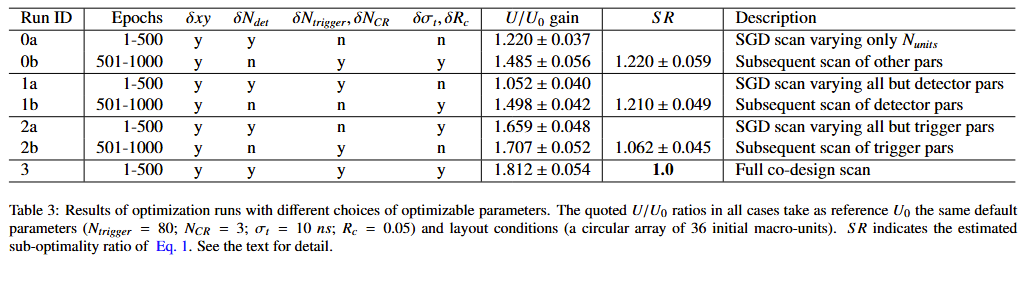
Next Monday, or Tuesday at the latest, you will find a new bulky paper in the arXiv. Titled "On...
Travel With Two Infants

The other day I traveled with Kalliopi and our two newborns to Padova from Lulea. After six full...
A Nice Little Combination

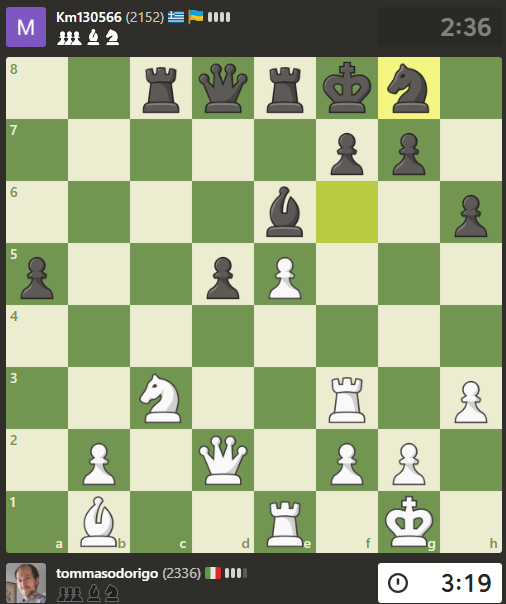
Although I have long retired from serious chess tournaments (they take too much time, a luxury...
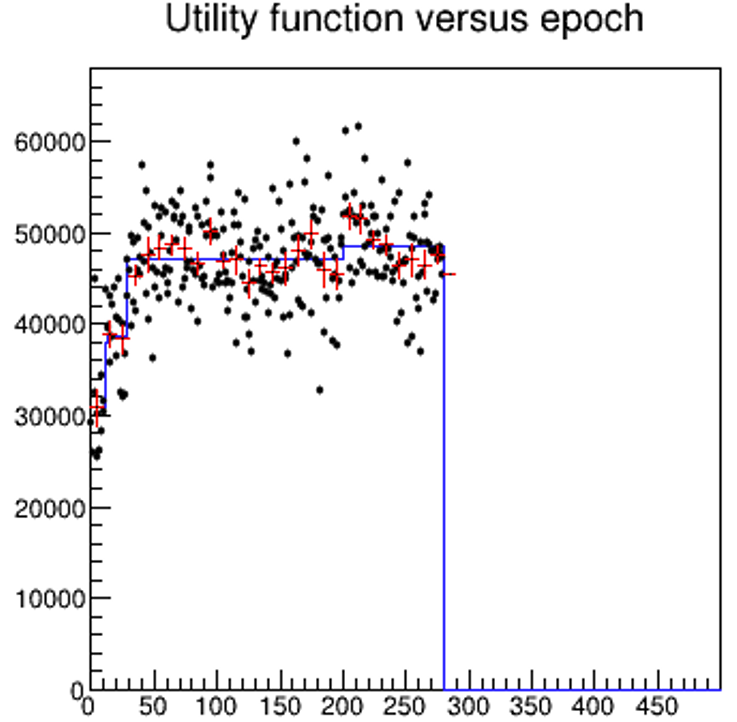
The Strange Case Of The Monotonous Running Average

These days I am putting the finishing touches on a hybrid algorithm that optimizes a system (a...

User picture.
picture for Hank Campbellpicture for Patrick Lockerbypicture for Heidi Hendersonpicture for Bente Lilja Byepicture for Sascha Vongehrpicture for Johannes Koelman
Tommaso DorigoRSS Feed of this column.

Tommaso Dorigo is an experimental particle physicist, who works for the INFN at the University of Padova, and collaborates with the CMS and the SWGO experiments. He is the president of the Read More »

Blogroll
While everybody is busy discussing the latest Tevatron results on the Higgs boson searches -is that the light-mass excess the internet was abuzz, is it consistent with a signal as we expected it, how long will it take to confirm it is not a fluke, etcetera, etcetera, etcetera- I think I have a different plot with which to enthuse you.

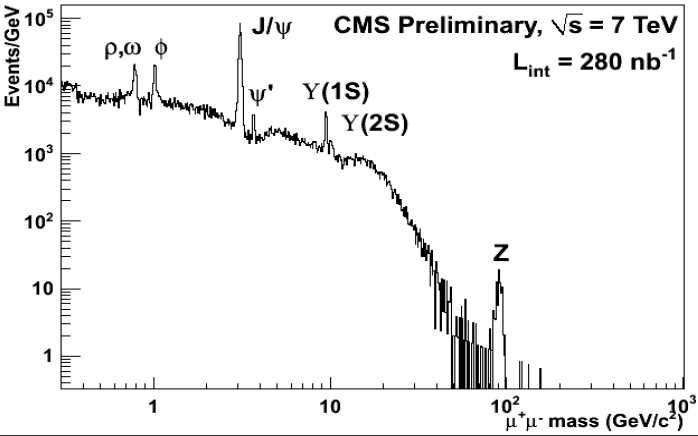
If you do not like the figure below, courtesy CMS Collaboration 2010, you are kindly requested to leave this blog and spend your time reading something else than fundamental physics. I do not know what will ever make you believe particle physics is beautiful, if not what is shown here.


The parallel sessions at the international conference on High-Energy Physics in Paris are over, and it is time for a summary of results. Of course if you are following the conference you will get it from the summary talks, but if you prefer some armchair, remote attendance of the conference, I have collected for you a few meaningful plots.

Here I wish to assemble some of the electroweak physics results produced by CMS in time for ICHEP. The CMS experiment has shown results that use up to 280 inverse nanobarns of proton-proton collisions, but for electroweak measurements -those involving W and Z signals, to be clear- the statistics used is up to 200 inverse nanobarns of well-understood data.
Ashay Dharwadker
is the founder and director of the Institute of Mathematics, Gurgaon, India.
He is interested in fundamental research in mathematics, particularly in algebra, topology, graph theory and their applications to computer science and high energy physics. Based upon the new proof of the four color theorem, he has developed a grand unified theory for the Standard Model and gravitation. In particular, this leads to a mathematically precise prediction of the Higgs boson mass.
Just a note here because I figured it is not clear - I am on vacation these days and, while I continue to post at a regular frequency, I am much more erratic than usual with answering comments in the threads. I would like this to be clear, because I usually do make a point of answering all comments that lend themselves to be answered.

With a slow connection and the need to spend as much time as possible swimming  in the blue waters of Elafonisos, this is bound to be a side effect. I will be back in regular blogging mood by August 10th.
While a thousand physicists gather in hot Paris and listen to talk after talk, I am confined in a small island of the Mediterranean, trying to relax and gather my ideas for the next few aggressive months of data analysis, a course of subnuclear physics in the fall, and of course, more reckless rumor-mongering!
The CMS collaboration at the LHC collider has just produced its very first results on the production of Upsilon particles, with 280 inverse nanobarns of proton-proton collisions at 7 TeV center-of-mass energy. I wish to discuss these results here, to explain what is interesting in these very early measurements, and what we can expect to learn in the future from them.

The production of resonances decaying to muon pairs is one of the first things one wants to study when a hadron collider starts operation. This is because these particles are extremely well known, so one immediately figures out whether the detector is working properly, what is the resolution on the momenta of the reconstructed particles, etcetera.