Fake Banner
Living At The Polar Circle

Since 2022, when I got invited for a keynote talk at a Deep Learning school, I have been visiting...

Conferences Good And Bad, In A Profit-Driven Society

Nowadays researchers and scholars of all ages and specialization find themselves struggling with...

USERN: 10 Years Of Non-Profit Action Supporting Science Education And Research

The 10th congress of the USERN organization was held on November 8-10 in Campinas, Brazil. Some...

Baby Steps In The Reinforcement Learning World

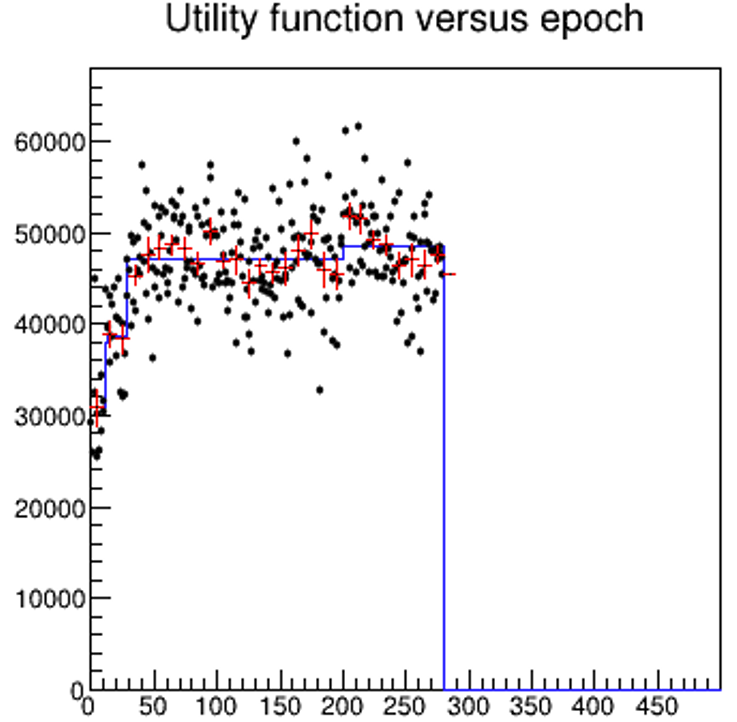
I am moving some baby steps in the direction of Reinforcement Learning (RL) these days. In machine...

User picture.
picture for Hank Campbellpicture for Patrick Lockerbypicture for Heidi Hendersonpicture for Bente Lilja Byepicture for Sascha Vongehrpicture for Johannes Koelman
Tommaso DorigoRSS Feed of this column.

Tommaso Dorigo is an experimental particle physicist, who works for the INFN at the University of Padova, and collaborates with the CMS and the SWGO experiments. He is the president of the Read More »

Blogroll
Last month the Museum of Natural History of Venice hosted, in the last room of the exhibit called "room of the cetaceans" (where a large skeleton of a whale hangs from the ceiling), an exhibit of artwork produced by high-school students from the Venice area. The event, which belongs to the "Art and Science across Italy" project, was the culminating point of a series of lectures on particle physics, on science in art, and related topics which involved the students and INFN personnel from the Padova section.
Is there a fifth force of Nature, beyond the four we know about ? This question has been around ever since it was understood that 
1 - electric charges attract and repel, and influence one another, due to the action of the electromagnetic force;


2 - hadronic matter is held together by the strong force;


3 - quarks transmute into other quarks due to the action of the weak force (and leptons do that too);


4 - bodies carrying mass feel attracted to one another, although very weakly, by the gravitational force.
Last November 12 the city of Venice was flooded by the second-highest tide in recorded history. The sea level, pushed by 60 mph SE winds and intense rainfalls, surged to +187 cm above average, a mere 7cm less than the disastrous event of November 4 1966, which put the city and its surroundings to their knees.


This year marks the 150th anniversary of the Periodic Table of Elements, whose inventor is Dmitrii Mendeleev, a Russian physicist who is famous for that achievement but who actually gave enormous contributions to Physics in a number of different areas of experimental research. It is also well known, but actually a misconception, that Mendeleev "invented" the correct recipe for the Russian national drink, vodka. In fact, he studied the mixture of water and alcohol in detail, discovering several of its interesting properties, but vodka was appreciated before him, as it did after.
Living in an organized society means we usually abide by unwritten rules of conduct, in addition to avoiding breaking state laws. We can then rely on order to prevail over chaos, kindness to overpower selfishness, and the common good to be an achievable goal. But the way each of us interprets their own script in this comedy we call life shows a significantly wide range of behaviours. The extrema of the spectrum are populated at one end by individuals who always try to game the system for their own benefit, without any consideration for the damage they cause to others; and at the other end by kind souls who enjoy giving rather than taking, and to raise a smile rather than gaining a dime. 
Every two years the Biennale, a contemporary art exhibition, opens in Venice from May to November. This is one of the most important events of its kind, and it attract millions of visitors to a garden that contains a few dozen different pavillions, each hosting artwork from a different country. Over fifty more such independent museums are scattered around the city center and are free entry - these are even more fun to visit than the main exposition at the "Giardini della Biennale", as they allow visitors to visit the spaces themselves, often old houses or palaces that are otherwise unaccessible.