Banner
    Black Hole Duality: General Relativity Without Singularities
    By Sascha Vongehr | October 29th 2010 03:52 AM | 7 comments | Print | E-mail | Track Comments
    About Sascha

    Dr. Sascha Vongehr [风洒沙] studied phil/math/chem/phys in Germany, obtained a BSc in theoretical physics (electro-mag) & MSc (stringtheory)...

    View Sascha's Profile
    In one description, an observer falls freely through empty space, in another one, she hits a surface smack on, yet both descriptions are completely equivalent. This example for a duality in modern physics was explained the last time in this series. There we saw that a black hole can also be described by a string theoretical membrane at the event horizon. The observer cannot escape the black hole because she literally gets stuck to the black hole’s event horizon, glued to it via strings.

    Now it is obvious that this second description of falling into, or here better onto a black hole has no singularity. So how can this possibly describe the exact same physics as observed by the in-falling observer? General relativity requires her to approach a singularity, so she soon must feel very uncomfortable.

    And that she will do also in the dual description: she will feel uncomfortable just the same, because in the dual description, the strings of the observer spread out all over the event horizon.

    The more massive the black hole, the larger the event horizon surface, and the longer it takes to spread the strings around. In case of a very large black hole, say a super massive one which is a thousand times the size of the black hole in the center of our galaxy, it can take a day between reaching the event horizon and being ripped apart. This is because larger black holes are colder than smaller ones. Nevertheless, at some point, the strings of the observer are spread all over the surface and start mingling with the strings already there.

    This is the so called “thermalization” of the observer. This thermalization is what feels like a singularity in the end. The observer hitting the singularity equals her strings being completely “thermalized” in the heat bath of the event horizon without there being a singularity in that description.
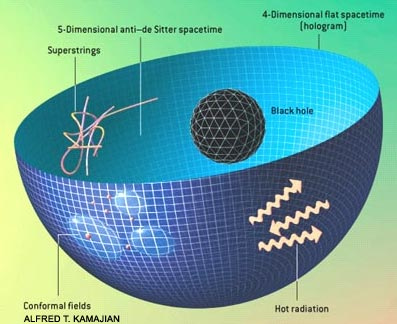


    So, here we have dual descriptions once again. They are totally different yet also the exact equivalent in terms of predicted observations. They are not relative to different observers, like inside and outside observers that look at the black hole, which is another distinction that leads to complementary rather than dual descriptions. We have here only one observer! As I wrote already about the whole universe: “There is no difference between the descriptions. Being on the surface or being inside, these totally different situations are the exact same situation!”

    This duality answers a possible reply to whether singularities exist in the universe. There are none! If they are at all, they are in some of your descriptions.

    Straw-man: “Wait, did you not say the descriptions are dual? So the answer should be that there are none and also they are some, not that there are none. At least – something like that is what you insisted on the last time around when you were ranting about whether there is a certain number of spatial dimensions!”

    Well, yes, I could be more consistent in that respect, but there is one major difference: A singularity is not observable in principle, as it would require infinite resolution (and thus infinite amounts of energy). In fact, if we look at those theories that are actually dual, i.e. where the duality is not just supported by advanced hand waving but works out mathematically, then none of the mutually dual descriptions have singularities. Take for example the AdS-CFT duality: the outside-on-membrane description without gravity on one hand is dual to a string-inside description with gravity, but the latter has also no singularity, because it is a string description. A string has always some spatial extend.

    So, yes, I cheated a little, but I did nowhere explicitly claim exact duality to orthodox general relativity; I always rather carefully made sure that it is the observations of an observer that need predicting. We only need to accept general relativity as far as it is proven by observation. There is obviously never any observer ever looking at a singularity.

    Anyways, I hope I have now, with three to four posts, finally gotten across that there are two separately interesting aspects of the duality here (the event horizon and the singularity) and that they are NOT just the same as the new fad that everybody drivels on about – no this is not just the same as black hole complementarity (again: there is only a single observer here) and it is also not necessary to drone on about holography just because it sounds good. Just the interesting by itself is as always interesting enough already.

    Previous entries in my series on duality:

    Black Hole Duality: Not Noticing Crashing with Light Speed

    Duality: The World Has No Dimensionality At all

    Black Holes Demystified

    Comments

    Bonny Bonobo alias Brat
    Sascha, you have repeatedly explained how duality let's us see how one observer can have dual descriptions that are totally different, yet be also the exact equivalent in terms of predicted observations, and how there is no difference between the descriptions of being on the surface or being inside, because these totally different situations are the exact same situation.  I understand that, but surely this duality is difficult to apply if on the one hand in past articles you have said that
    the singularity is not in the middle of the black hole, but always in the future, and so on. But today, the simple description suffices; we do not need to concern us with the details.
    and on the other hand that

    The black hole Sagittarius A* in the center of our galaxy is about a million times more massive than the sun. After passing its event horizon, an object would have up to maximally 20.05 seconds (my own calculation) before being destroyed by the singularity. The exact time depends on the initial velocity outside of the black hole.

    In one case its always in the future and yet in the other you are able to even calculate how far in the future it is, before it eventually occurs as

    ‘the so called “thermalization” of the observer’ … ‘is what feels like a singularity in the end. The observer hitting the singularity equals her strings being completely “thermalized” in the heat bath of the event horizon without there being a singularity in that description.

    even though when this happens you describe how

    A singularity is not observable in principle, as it would require infinite resolution (and thus
    infinite amounts of energy).

    So I guess I am having difficulty understanding how this can be the same predicament with dual descriptions by the same observer falling into say Saggitarius A* black hole, encountering a singularity that is always in the future until 20.05 seconds later when she is suddenly thermalized, (because this feels like a singularity in the end) and yet as she is being thermalized she can't observe this because in principle this would require infinite resolution and infinite amounts of energy.

    How can being thermalized 20.05 seconds later 'feel like a singularity in the end' to the observer, yet be the same situation that can never happen and never be observed by the same observer?  Also, how can it be the exact equivalent in terms of predicted observations when the predictions are both different?

    I know, maybe I should have slept on this before asking these questions because this article is called 'Black Hole Duality: General Relativity without Singularities', especially as I now don't even understand why you are saying it is without singularities simply because 'there is obviously never any observer ever looking at a singularity'. If you follow that logic then there will never be a lot of other phenomena that cannot be seen by an observer, including black holes and strings.


    Make love not war
    vongehr
    The singularity being in the future means it is not left or right of you, not ten miles ahead or anything like that. It is for example 20 seconds "ahead". It is not in the middle of the BH like it is in the middle of a ball, where you would have a spatial distance to it (radius). Here the distance is always time-like. And at the singularity, all processes stop (one could say misleadingly "time stops"), so it is indeed always in the future. Also, the tidal forces rip everything (all observers, measurement devices) apart near the singularity, it destroys you before you even get close to it, so you will not see it. She is not suddenly thermalized, she is torn apart by tidal forces as described by GR. Everything she feels is exactly described by orthodox GR (that is what I assumed at the beginning, so it holds by assumption), and it is dual to the dual description, her feelings are exactly the same (the physics is the same, the observations are the same, the feelings are the same, it is the exact same, just very different theoretical tools are used to model/explain the exact same physics).
    The point about singularities needing infinite resolutions has nothing to do with black holes. One just cannot ever hope to operationally justify a point particle, even if it is a normal electron in the standard model (no size, infinite field strength in the center). One can only put a yet better limit on how big it is at most, but one can never proof that it is a point. Thus, singularities are out of the realm of operational physics on principle. If you have an advanced, epistemic view on what physics actually is (rather than a naive ontological, direct realistic one), then you know that this means that there are no singularities - they won't even stay in the theory if the theory is ever going to be one of everything.
    Dear Sascha,

    I think that this version of "duality" to describe her perceptions are attractive but a little bit vague. To understand what she will feel, one first has to have an expectation and parameterize the possible alternative perceptions by some "bits" or "qubits" of information.

    In the normal picture, the right information is described as the Hilbert space of perturbations around a nearly flat background. It is this physical picture in which she feels nothing when she crosses the event horizon. And it is this description in which she approaches the Universe in finite proper time.

    There is an alternative description in which the degrees of freedom are stored "at the horizon". However, if you adopt the viewpoint that her perceptions "qualitatively change", you must completely redefine what she can perceive, what she cannot, and what it means for her to "feel" uncomfortable. Needless to say, the latter only exists in the first picture in which the arrangement of the atoms in the human being are at least approximately preserved.

    You can't say whether some differently encoded bits along the horizon are "feeling uncomfortable". So even though the bits on the event horizons are better to understand why the information is not lost and how quickly it gets out from the black hole etc., they're no good for describing the perceptions of infalling observers.

    It's somewhat nontrivial to show that in the picture in which the black hole interior doesn't exist - because all the information is stored at the horizon, or is encoded into complete chaos inside the hole - one can still have observers who "feel" the same things for a while, before they get crushed in the singularity. I've spent some time with this. It's clear that one restores the "nearly flat" background only by averaging over the microstates of the black holes - many of them or "generic ones" in some sense.

    Ideally, there should exist a description explaining why the averaging over all microstates of a black hole - imagine an asymptotically infinite black hole of the Rindler space - looks like an empty space inside the black hole. This is the real fun question that remains partly unsolved.

    But I don't think it is productive to combine concepts from two different descriptions - thermalizations of strings at the horizon; and perceptions of an infalling observer. Perceptions always refer to a description in which the black hole interior is treated "semiclassically" as a new genuine region of space. One should never combine concepts from different dual descriptions in one sentence.

    Also, I don't think that it is necessarily possible to match the intervals of time in which the observer feels "death". You know, the time and space are kind of exchanged inside the hole. There are very brutal coordinate transformations that are necessary to go from an observer who stays outside to the natural coordinates for the infalling observer. The bits on the horizons use different natural coordinates than the infalling observer. The thermalization time may end up being close to the black hole radius but it didn't have to be in this way. And for various extremal etc. black holes, the two notions may differ.

    Best wishes
    Lubos

    vongehr
    Dear Lubos, how nice to have our paths cross again after now about ten years or so. The points you make are all somewhat valid, but you forget one big thing: I assumed that the observer observes what is prescribed by orthodox GR by assumption! Why? Because this is a Science2.0 blog and so we have to be very careful what we write and why. If you want my personal opinion, I would not be surprised if GR breaks down to be a good description even shortly before the EH (i.e. outside the BH). However, since this is the internet and cracked pots a la "Einstein was wrong" are plenty, I want to stay away from anything that can be perceived as pseudo science. Hence, I first of all assume the GR description to be correct, and then show that one could still imagine a dual description that actually works without singularities. I.e.: I can accept the GR "singularity" although I fundamentally do not like it. We can contemplate there to be such a duality! That there is no such description of the simple Schwarzschild BH in any advanced theory yet - that is well understood and I made similar disclaimers in all the four posts in this series. The point that I want to get across is the philosophically interesting about duality as such, which is that the near religious discussions about how many dimensions there "really" are for example, are beside the point. Fundamental physics is going to be ever more epistemological, not some naive ontology.

    I am not so sure why you write so much about different perceptions. My point of view should be clear: The observer's perceptions are only one single set. A dual description cannot lead to different perceptions. If a theory leads to any different observation whatsoever, it is not dual, at least not in the sense of "dual" that I describe in these posts. Maybe you want to discuss some other type of duality, but I write rigidly centered on bringing one thing and only one home to my readers: Our one physics (the observations, perceptions) can have dual theoretical descriptions, so we do not need to get worked up about what the "one true description really" is. Many cannot stomach ten dimensions at all; they want to stop funding if scientists cannot even agree on whether the world is ten or two dimensional, which proves to many that we have all gone nuts. However, the truth can encompass seemingly incompatible dual descriptions. This bare fact about duality as such has not at all arrived in the philosophical academic debates. Those "philosophers" still debate "the hole argument" as the most important one in GR, as if the last thirty years of science did not happen. If they do not get such simple aspects, forget talking about Hilbert space.
    Oh, it's you, Sascha! Sweet. ;-)

    Dramatic effects even outside the event horizon - well, everything is possible. It's just very unlikely because it would require a huge amount of nonlocality. In principle, when a black hole is being formed, you can't even know in advance which point in space is eventually going to be identified as a part of the event horizon. So you shouldn't see anything special. And also, I think that string theory implies that you see nothing special over there. But there are also hints of nonlocality - its effects must be very simple.

    Do all dual descriptions have to agree with what the infalling observer actually felt? I am not as sure as you are. This reminds me of the discussion about reincarnation of the infalling observer,

    http://motls.blogspot.com/2009/01/reincarnation-of-infalling-observer.html

    The point is that what is going to be observed by the infalling observer will never get out - at least not in a meaningful way that can be decoded. Moreover, black hole complementarity says that the exterior observers and the infalling observer may de facto perform observations of mutually non-commuting observables acting on the same Hilbert space - on the same degrees of freedom. Locality etc. also seems to suggest that you shouldn't imagine that there is a collapse of information as soon as one of the two measurements is being made.

    So it looks more sensible to me to imagine that the two regions in space may use the same "initial" degrees of freedom but the outcomes of the quantum measurements may disagree with each other - because no one is going to compare them again - much like in different "parallel universes" of the many-worlds interpretation of quantum mechanics.

    These comments surely sound like crackpottery or at least science-fiction and it is conceivable that all such questions will remain undecidable because the infalling observer doesn't really have enough time to make any accurate enough measurements that would settle any of these questions in one way or another.

    I think that I can agree with your non-problematic attitude to dual descriptions - at least in cases when one speaks about degrees of freedom that are causally accessible from one to another. Exactly the black hole interior could offer a loophole from your simple interpretations of dualities. But maybe not.

    vongehr
    Again, this is not my personal "interpretation of duality". "Duality" is used in different contexts (e.g. category theory). I strictly stay with a narrowly defined duality (like T or S-duality, i.e. one spectrum (the physics) with seemingly different descriptions) and orthodox GR by assumption ("by assumption", you understand? So please, no "I am not so sure as you are ...", as I am nowhere "sure" but merely sticking to the assumption in order to get a certain point pedagogically across - of course, I failed again, but hey, at least I tried). I focus on one single observer to get a certain philosophical insight across. I am not sure why many of those who know about black holes feel the urge to tell me (you are not the first) that I necessarily ought to confuse this with holography/BH-complementarity/impossibility to copy unknown QM states and so on. It is not the subject of my posts and it only adds confusion. As I said before, if others want to talk about complementarity instead (which is not the same as duality!), good luck to them in first explaining that complementarity and the mere fact that one from the outside never sees something fall into a black hole (red shift etc) are also not trivially the same issue (what could be basically a mere optical illusion due to GR does not have to be fundamental QM!). As this is didactically impossible (I tried, but especially educated people are just not as clever as they think or one would wish), I am staying firm in refusing to mingle the different issues.
    What you want to talk about is also interesting, but I would not even approach that issue with help of black holes because people are just not able to keep the different BH aspects apart; lay people are not, and I more and more discover that people "in the know" are also somehow not capable of it. Why? That is the mystery that I would like to get my head around.
    BTW:"These comments surely sound like crackpottery or at least science-fiction" - no, they are the usual stuff. I do not see why you think them revolutionary or new to me. If you were to apply this also to cosmological horizons, OK, then it would be something revolutionary to most physicists (though also not to me!), but BH complementarity is an old hat by now.
    BLACK HOLE
    -- James Ph. Kotsybar

    Containing nothing that’s ambivalent,
    more than dark, which would only be dreary,
    death’s non-spiritual equivalent
    crushes our intellect to theory.
    Passage through is most certainly one way,
    and thus it incites our speculation.
    What would occur, if we wandered astray
    into this singular aberration?
    It’s relative to where you’ve placed your clocks.
    From outside, we’d seem to fall forever.
    Beyond that, it’s puzzling paradox.
    We only know that we’d leave it never.
    A downward orbit is how it begins,
    and nothing’s jolly when gravity wins.