

Banner
    The Voynich Manuscript : Not So Mysterious ?
    By Patrick Lockerby | July 23rd 2009 01:27 PM | 17 comments | Print | E-mail | Track Comments
    About Patrick

    Retired engineer, 60+ years young. Computer builder and programmer. Linguist specialising in language acquisition and computational linguistics....

    View Patrick's Profile
    The Voynich Manuscript part 4 : Not So Mysterious ?

    The Voynich manuscript was written in an as yet unreadable script.  It is named after Wilfrid Voynich, who acquired it as a dealer in 1912 from the library of Villa Mondragone, a Jesuit college in Frascati, Italy.  It is now in the care of Yale Library.

    In my previous articles on Yale Library's Beinebecke MS 408 I focused on its background.  I am now going to discuss some basic possibilities about its unusual script.  I am still working on an attempt to transcribe the text into modern English.  If I succeed, my readers here at scientificblogging will be the first to know.

    In my previous articles I suggested that it is a complete waste of time to try to crack a code, or read a strange script, without first obtaining some background information.  In Part #1  I gave some background information about Wilfred and Ethel Voynich.  I concluded that Wilfrid Voynich had no incentive to fake the manuscript.  In part 2: Dating An Enigma  I suggested that, from examination of some of the facts, the manuscript may date to around 1350.  In  Part #3  I gave more background information and suggested that the manuscript, when written, was perhaps intended as a genuine materia medica, a physician's recipe book.  I also suggested that it may have been written by a woman as a medieval 'midwifery manual'.

    I now give my reasons for believing that the manuscript is not written in code, but in an odd script.  The underlying language will almost certainly be found to be medieval vulgate Latin.

    Oddness Analysed

    The first thing that strikes anyone on seeing MS 408 for the first time is its overall oddness.  Nothing seems to make sense.  Quite apart from the script, which matches no known alphabet, the pictures seem to be just a fantasy.  Nobody has, as yet, positively identified even a single plant from its picture.
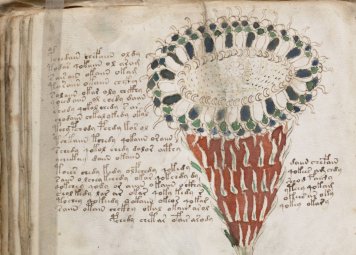
    In medieval times, a physician would carry a materia medica, for three reasons I suggest.  Firstly, ownership of such a book was in itself a mark of erudition, a medieval equivalent of a degree or a license to practice medicine.  Secondly, the book could be shown to the - presumably illiterate - patient to illustrate some points about illness or medicine.  Thirdly, the physician could consult the book for recipes and ingredients rather than memorize them.

    I suggest that this particular materia medica would have served those purposes well enough and would not have appeared fanciful to a majority of people when it was written.  Per contra, it would have seemed to be little out of the ordinary.  I suggest that MS 408 contains a synthesis of  ideas and beliefs know to most people in medieval England, France and neighbouring countries.  Those ideas and beliefs were transmitted across the known world an across the centuries, losing much information in the process.  It is not just in language, but also in art that we can see how ideas change and can be corrupted through the years and centuries.

    In the Voynich ms is a fold-out which is often described as the 'rosettes' page.  It looks very mysterious to us at first. 
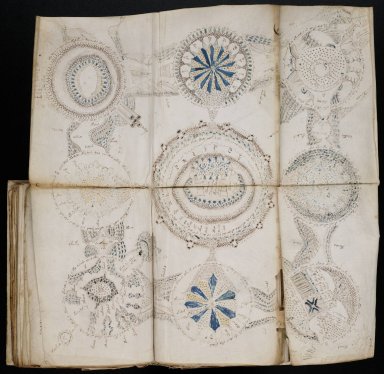
    I suggest that any average British person of about the year 1350 would recognise it immediately for what it purported to be when drawn: a map of Baghdad.  In the top left and bottom right are faint images of the sun - a convention in map-making for showing east and west.  My suggestion of Baghdad, and the orientation, are supported by clues in the centre panel.
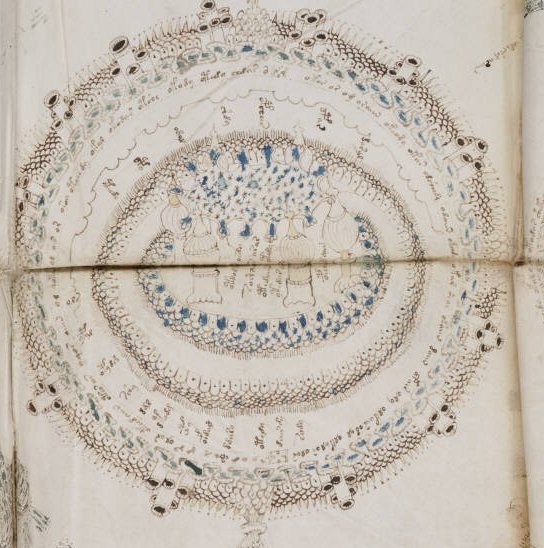
    The onion domes could be representative of any country influenced by Islam.  But the only circular city recorded in medieval times, as far as I can discover, is Baghdad.  This Voynich panel fits a description of early Baghdad in 'History of Baghdad' by al-Khatib al-Baghdadi.  The city was built to a circular plan by Abu Ja'far.  Later, Al-Mansur built a surrounding wall with four gates.  He added two walls, the inner wall being higher than the middle wall.  Between the walls were two fasils, empty defensive areas.

    There were 18 towers between each gate.  The artist shows these as clusters of 6.  One wall had an extra tower - shown here as an extra cluster of 6.  The four gates at the north, south, east and west were domed.  There was a great dome in the city, a major landmark for about 180 years, which collapsed due to heavy rain about 941 CE.  Baghdad was sacked and burned in 1258.

    There were defensive moats and ditches.  The central palace was noted for its fine draperies.  In the top left panel is a tower.  This has been described by some observers as being 'in a hole'.  I suggest that the inexpert drawing leads to an optical illusion: the representation is of a tower on a mound.  There was such a tower in the fields outside medieval Baghdad.

    I suggest that acceptance of the Baghdad theory does not automatically mean that any part of the Voynich script is Arabic or any related language.  My initial assessment is that it is mainly Latin, with influences from other European languages.  It was most probably written in England.  There are two proofs that Baghdad was famed in England long before the Voynich ms came to be compiled.
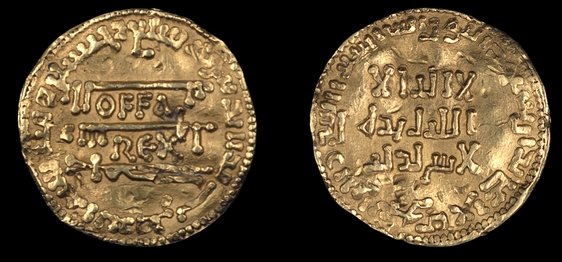

    Gold imitation dinar of Offa, King of Mercia, England, 773 - 796
    Image courtesy of British Museum.

    This coin was made for King Offa in imitation of a dinar of Al-Mansur, Caliph of Baghdad!

    In medieval England the story of Loris and Blanchefleur was very popular between about 1200 and 1350.  It is a typical European 'take' on a story of a man entering the sultan's harem by subterfuge.  It is a European adaptation of a story from the Arabian Nights.  From knowing this story, and from travelers' tales, the average British peasant would have heard of Baghdad, its strange onion domes, its baths and its library - called the House of Wisdom.  It is said that at the sack of Baghdad, the waters of the Tigris ran black with the ink from the books dumped into it.

    Now imagine a traveling physician or midwife in medieval England carrying the Voynich ms.  There are many pictures of herbs, an apothecary section dealing with leaf and root preparations and aromatherapy, a balneology section and an astrological section charting the best times for conception and birth.  This 'proof' that the bearer had studied medicine at the House of Wisdom in Baghdad and that they had once attended the Caliph's harem would surely increase the client fees payable!

    In my next article I briefly discuss the evolution of the materia medica from its source via Europe and from its source via the islamic countries.  I also show further information suggesting that the 'rosettes' part describes places and features from medieval Baghdad. The wierdness of the plants, I suggest, is a further clue pointing to the likelihood that the language beneath the Voynich text is medieval Latin.

    Continued in The Voynich Manuscript part 5 : The Baghdad Connection

    Comments

    Gerhard Adam
    Very interesting, Patrick.  Good luck with your work on this.
    Hi Patrick,

    You're a third of the way there, in that there were actually three medieval cities renowned for their circularity:
    * Baghdad (as you point out)
    * Milan
    * Jerusalem (but only as a symbol of its perfection, not as a literal cartographic truth as far as I understand)

    Chapter 3 of The Curse of the Voynich details why the top-right rosette could well depict Milan (and why the central rosette seems to depict St Mark's Basilica in Venice viewed from the top of the Campanile). You should read it! :-)

    Cheers, ....Nick Pelling.... // Cipher Mysteries

    PS: thanks for the back-link in the earlier installment of the post. ;-)

    logicman
    Hi Nick!

    Thanks for your interest.  I'll be linking to your blog in the list of recommended resources in my next article.  I guess its about time I bought a copy of The Curse of the Voynich, it's not as if I need to take out a mortgage for it.

    I've been using my linguistics skills on the Voynich script.  I am confident that it isn't a cypher and that it isn't an ordinary alphabet.  I don't want to reveal too much until I have had a good stab at finding cribs.  I will just say that if I make some linguistic assumptions then a pattern of intonation appears.

    btw, I liked your home page so much that I decided to link it.
    Hi Patrick,

    Well... good luck, I guess. Here is a short list of things to think about:-

    (1) As per the EVA transcription, are the Voynichese letters 'a', 'o', 'e' and 'i' vowels? If you think Voynichese is a language (rather than a cipher), I suspect you almost certainly have to conclude that that they are vowels.
    (2) If you agree with (1), how do you then account for all the "aiiiv" and "aiiir" groups? They're very unlikely to be linguistic, so suspect that you have to conclude that these are manuscript page references (a = quire reference, iii = folio index, r/v = recto/verso).
    (3) If you agree with (2), why is it that there are only page references to the first ('a') quire, and that verso references outnumber recto references significantly?

    Just some food for thought! :-)

    Cheers, ....Nick Pelling....

    logicman
    Nick:  it isn't safe to assume that any Voynich character represents a letter in any modern alphabet.  There have been a few comments about the frequency split between vowels and consonants, and about the words seeming to have their letters in alphabetical order.  These are unwarranted conclusions.

    To assume a specific correspondence between any arbitrarily chosen alphabet and the Voynich script, and then conclude anything about the letter distribution isn't science.  As to the aiiv / aiiir groups, these could be any number of things.  One example might be that iv = n and iiv = m.  It may equally be the case that aiiv = ation.  Since all such assumptions are equally valid, no assumptions should be made.  We need cribs.  I'm working hard on that approach.

    btw, if you register here, I'll put you on my friends list to enable private chat. :)
    nickpelling

    Hi Patrick,

    Well... having studied the VMs for the best part of a decade, it's not quite as simple as you think. For nearly a millennium, people have used "aiir" to refer to "(quire) a, (folio) ii, r(ecto)": and it is that precise pattern which appears on nearly every line of every page of this manuscript. If you don't stick with the 'obvious' vowel correspondences, then you'd have to admit that this is a highly unlikely coincidence.

    Yes, a dispassionate observer would indeed point out that vowel correspondences should not be assumed. However, this should also be informed by the many statistical studies that have been carried out of the years which (taken at face value) suggest that the EVA letters 'o', 'a', and 'e' are very probably vowels. Furthermore, many of the words (particularly labels, such in the 'otolal' in the centre of the Pisces page) makes the CVCVCV structure (that so convinced those statistical studies) quite apparent.

    The problem comes when you put this history and this science together: why should Voynichese statistically resemble medieval language so much but without actually being one?

    Cheers, ....Nick Pelling....

    logicman
    Nick:  the sequence aiii (without dots) appears in some 12th century manuscripts as shorthand for 'also known as'.  In others, it appears, always with volume numbers, as a citation to an earlier work.  In the Voynich I see no evidence in the overall layout of there being any citations to earlier works.   The sequence which is interpreted as aiiv etc. is, I suggest, neither a folio reference nor an abbreviation for alias.  If I wanted to create a private shorthand system, I would choose symbols that look like xyz, but have them mean qrp in my private code.  This would keep cryptologists and paleographers scratching their heads for at least 600 years, I would say.

    As a linguist and computer programmer I am, naturally, using methods designed to seek significant patterns.  However, I am using methods designed to find semantic rather than syntactic patterns.  Not to give away too much, but an encrypted workshop manual for a car ought to contain the words 'nut' 'bolt' and 'washer' a statistically plausible number of times.  If an encrypted book of 50,000 words contains 5,000 references to those three terms combined then either the crib is false or the book isn't a workshop manual.  On that basis the idea of a folio reference as a crib is false.
    nickpelling
    Hi Patrick,

    The minute you start saying things like "I would choose symbols that look like xyz", you're not talking linguistics but cryptography. And linking with any kind of shorthand has to sit squarely with the history of shorthand, which the letters in the Voynich Manuscript don't.

    The easiest trap to fall in is to assemble an explanation out of things that make sense circa 2009, rather than things that actually did make sense circa 1450-1500. But good luck regardless (and, yes, I'm a computer programmer too).

    Cheers, ....Nick Pelling....
    logicman
    The easiest trap to fall in is to assemble an explanation out of things that make sense circa 2009, rather than things that actually did make sense circa 1450-1500.

    I agree, Nick, except that I would use an earliest plausible date of 1350.  My point about the Voynich is precisely that it would not have appeared as outlandish to a medieval peasant as it does to us, and did 100 years ago.  However, the history of writing is itself a history of shorthand - in the sense that complex symbols got replaced by simpler ones in all known writing systems.  If we limit the topic to what most people would accept today as shorthand, then that was invented in the Roman era - by a slave if the history books are to be believed.

    I am suspicious of any claim of a cypher much more sophisticated than a Caesar shift.  I am using a working assumption that whoever wrote the ms could sight-read it.  The only plausible alternative is that the ms is a bogus herbal created to impress would-be clients.  In the latter case it a case of overkill - an illiterate peasant would be impressed by a much smaller codex.

    An important point about medieval era writing is that it was inconsistent.  Even manuscripts written to a high standard contain spelling and abbreviation variations.  There was no orthographic standard, and medieval scribes were as prone to error with the quill as you or I with a keyboard - perhaps more so.

    I'm sincerely grateful for your input.  This is a science site, so feel as free to critique my approach here as you would critique any theory in your own blog.

    btw, my score on the Voynich bs test was a mere 13, subject to generous application of error bars. :-)
    Hi Patrick,

    Can you point me at any reference for your interesting note that "the sequence aiii (without dots) appears in some 12th century manuscripts as shorthand for 'also known as'."? I've looked for this but without any success. Presumably "aiii" are the initial letters of a medieval scribal Latin phrase meaning "also known as"?

    Thanks, ....Nick Pelling....

    logicman
    Hi Nick!  Thanks for the question.

    I have'nt blogged for about 3 months due to illness, so I will have to wade through my copious notes to find the reference.  From memory, I seem to recall that lower case A/// is to be read as ALII - preceding a list of names. 'Aliases', if you prefer.

    I shall be writing my next articles on the VM very soon.  Spoiler: my linguistic analysis shows a distribution of semantic categories of words strikingly similar to that in a vehicle workshop manual.  That is: the word distributions are similar in the VM and a workshop manual - the distributions  match the illustrations and presumed topics within and across topics.

    edit:  just after posting my reply to your comment, I found this very useful URL -
    http://www.ualberta.ca/~sreimer/ms-course/course/abbrevtn.htm
    It doesn't appear to have been updated since 1998, but considering the source data - medieval Latin - there can be very little to update!
    Hi Patrick,

    Sorry to hear about your illness, but hope (from your talk of blogging once again) that you're now on the mend. :-)

    Hmmm... "alii" from alius/alia/aliud "other things" might indeed make sense for "aiii" (though not for the other "aiii" family patterns). Thanks for replying so quickly!

    Cheers, ....Nick Pelling....

    logicman
    Nick: thanks for your good wishes!

    As an afterthought: in general, 'AL-' references 'other', so we have 'alibi' = other place, etc.
    sequences which look like vi vii viii IF LATIN could mean, depending on context:
    other name / s
    other place - as e.g. 'this was referenced elsewhere'.
    otherwise - 'in another manner'
    etc.
    nickpelling
    The presence of parallel hatching in quite a few of the Voynich drawings gives an earliest date of 1440 if Florence, or 1450 if elsewhere. I'm currently working on a blog post that makes this completely clear.

    Voynichese is almost entirely written using 20-22 symbols (depending on how you count them): it is neither classically tachygraphic, nor Tironian, nor stroke-based (i.e. Bright's Characterie), nor even obviously Quattrocento macron-contraction based. As I said, it doesn't fit into the history of shorthand at all.

    Also, if you haven't studied the tricky ciphers devised in the Sforza Chancellery circa 1450-1480, then you probably have a very limited view of the complexity attained by code-makers during that period.

    Good luck with raising your VBI! :-)
    Hfarmer
    Hello Patrick,  When I looked at the center panel it reminded me not of Bagdad but of the Masijd Al-Haram in Mecca.  There are figures in the drawing which seem to me to be people.  People facing the center.  As you know Muslims face Mecca to pray.  The only place where Muslims all face in a circle like that is in Mecca, inside the Masijd Al-haram, where the Kaaba is located.  Perhaps it was some kind of a reference to Mecca, and hence islamic learning in general.  Which in the 1300's could have come from Bagdad, Egypt, or closer to england Moorish Spain.   Moorish Spain was past it's heyday but it was not yet dead.  Granada was still quite strong, and the Morracans were still a force to reckon with, they even invaded spain in 1340 and were crushed.  Or it could be that this is an indirect reference to the fact that some of the medical knowledge in the book came from Islamic sources originally.  
    Think about that.  If this was a book with knowledge from the Islamic world back then, it could get one in trouble in a very pious country.  Just a thought.  

    Good luck with decipering it.   
    Science advances as much by mistakes as by plans.
    logicman
    Thanks for the comment, Hontas. 

    In a sense, you are ahead of me.  I have been researching this, but didn't write it up yet.  If you check out the history of the Masjid Al-Haram you will find that the mosque, Ka'abah and Zamzam have all been rebuilt over the centuries.  Here's the bottom right panel, inverted to highlight some features:

    In one version of the history of the Zamzam Well it started flowing when the archangel Gabriel (Jabreel) hit the ground with a wingtip.  The detail at top left might be interpreted as a wing.

    The well was covered by drapes over pillars with a domed top.  The water flowed from one corner for the pilgrims to drink.  Water flowed from the back for ablutions.  The Ka'aba was not always cube shaped.  At one time it was rectangular.  Today the Zamzam building is away from the Ka'aba.  It was moved in modern times - previously it was close to the Ka'aba.  In the 13th century the Ka'aba was surrounded (encircled?) by a stone wall.  The two areas filled with what look like stars: do they represent Safa and Marwah, perhaps?

    There are other details which I am still checking out.  For example, does the top right panel represent Basra?  That looks like an attempt to represent breaking waves to me.

    Any theory about the origin and purpose of the Voynich ms has to be internally consistent, else it is probably wrong.  I'm building a picture of the knowledge put into the VM as passing from place to place, often with lost information being filled in from imagination.  In some cases, information was lost when copying Latin books.  During medieval times knowledge of Greek was lost.  Scribes, instead of translating, would write: Graeca sunt, non leguntur.  That's the origin of the phrase "it's all Greek to me."

    Thanks for stimulating these old grey cells.  If you have any more ideas, keep them coming.
    Hfarmer
    Yes, The masijd was rebuilt, attacked (by other muslims), rebuilt again in the Islamic era.  Either way it was just an observation.  I am likely wrong.  But I am sure you are right about the Islamic reference in that picture.  
    Science advances as much by mistakes as by plans.

    Add a comment

    The content of this field is kept private and will not be shown publicly.
    • Allowed HTML tags: <sup> <sub> <a> <em> <strong> <center> <cite><TH><ul> <ol> <li> <dl> <dt> <dd> <img> <br> <p> <blockquote> <strike> <object> <param> <embed> <del> <pre> <b> <i> <table> <tbody> <div> <tr> <td> <h1> <h2> <h3> <h4> <h5> <h6> <hr> <iframe><u><font>
    • Web page addresses and e-mail addresses turn into links automatically.
    CAPTCHA
    If you register, you will never be bothered to prove you are human again. And you get a real editor toolbar to use instead of this HTML thing that wards off spam bots.


