

Banner
By Johannes Koelman | July 6th 2010 12:21 PM | 70 comments | Print | E-mail | Track Comments
About Johannes

I am a Dutchman, currently living in the US. Following a PhD in theoretical physics (spin-polarized quantum systems*) I entered a Global Fortune...

View Johannes's Profile
Which country does not belong in the following list: Burma, Liberia, Somalia, United States?

OK, that was not too difficult. As astute Scientific Blogging reader you got that right. Somalia has made the step to metric (SI) units already half a century ago, and therefore does not belong in one list together with the three remaining countries that haven't embraced the metric system yet. 

The word 'yet' seems appropriate, as with 95% of the world population adhering to metric units, it seems it will just be a matter of time for the remaining tiny fraction to go metric. The more so as the 5% BUL minority (Birma, US, Liberia) is divided amongst themselves with Birma and the US each adhering to their own customary systems of units, and Liberia not having made up their mind between SI and Imperial units. 
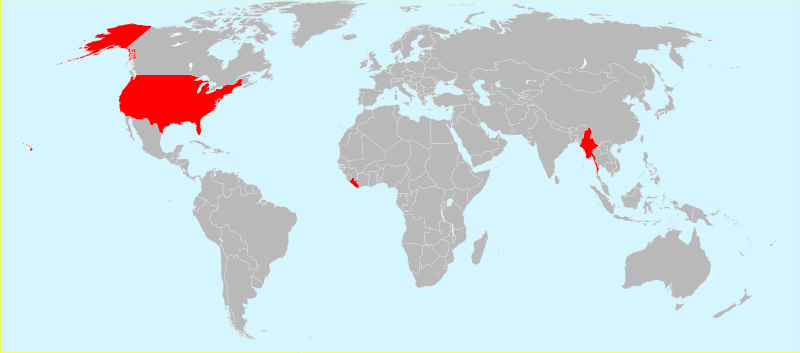
BUL nations (red)
The BUL gang: the rogue nations (Birma, US, Liberia) that stubbornly refuse to accept international standards on measurements. 


So give it a few years, and the world has unanimously embraced metric?

Well, don't hold your breath. Liberia will no doubt at some stage make the transition, and Burma might do the same, but the US appears to be an anti-metric stronghold. Judged solely upon the 'metrication battles' raging at internet fora, the opposition against the 'European socialist metric plot' sneaking 'commie units' into God's own country, seems deeply rooted in American society and has unmistakingly acquired distinct political and moral angles. US columnist Dave Barry clarified these sentiments in a hyperbole that might not be too far from true feelings:  

"[..] my belief, as an American, is that if I have to start understanding the metric system, then the terrorists have won."

It should not come as a surprise that, to again quote Dave Berry:

"The metric system is not going to catch on in the States, unless you count the increasing popularity of the nine-millimeter bullet."


A physicist's perspective
I don't think that you will be surprised to hear that, like any physicist, I hold a strong opinion on the matter. It goes without saying that metric SI units outperform non-metric units such as the Burmese and the US units in terms of reduced ambiguity and ease of use. Anyone capable of shifting decimal points can work with metric units. Working with non-metric systems is a much more elaborate undertaking.

Let's take a simple example. How large a cube do you need to build for it to contain 1 liter? That's easy. One liter is a decimeter cubed, so a cube with sides of 1 decimeter (0.1 m) a side will do.

Now the same problem in US customary units. How large a cube should you build for it to contain a gallon?  
Ehhm, that depends: do you mean a liquid gallon or a dry gallon? 
Hmmm, don't see why that should matter, but let's say the cube is to contain water. I guess that should make it liquid gallons? 
Right, liquid gallons it is. Let's see, if I remember correctly, 77 cubic feet equals 576 liquid gallons. So that would make one gallon equal to 77/576 cu ft. To get such a volume you need a cube with edges in feet that are equal to the third root of 77/576 which is... ehhh... got a pocket calculator?

Metric opponents often object that Burmese and US units, being based on the old British imperial system of units, are more convenient when it comes to calculations that involve division by three.* This is a nice example of the tail wagging the dog. If indeed the ease of division by three is so overwhelmingly important, one should not attempt to introduce these artificially into the measurement system, but rather work in a base six (or base twelve) numeral system, and adopt corresponding metric units. Such metric units will take shape as a senary (or duodecimal) metric system of units. 

Clearly, as the world has unanimously opted for base ten rather than base six (or twelve), the ease of division by three is not all too important.    

However, it is not just the calculational clumsiness of BUL units that make these inferior. More importantly, BUL units confuse matters by creating distinctions where these are not warranted (liquid volume versus dry volume), and by failing to make proper explicit distinction where such is required (pound for force versus pound for weight). The international system of units handles this much more rationally. This metric system fully recognizes dependencies between units and contains the key notion of base units from which other units are derived. For instance, volume is length cubed. Therefore, volume does not need a new unit (gallon) if one already has decided on a unit for length (foot). In SI units length is measured in meters, and volume therefore in meters cubed. Given the meter (foot) as unit for measuring length, there is no other rational choice for measuring volume than cubic meters (cubic foot).   

So SI units are simply more rational than Burmese or US units. It is for this reason that no self-respecting physicist will ever utilise non-metric units.** And it doesn't matter whether she is from Birma, the US or any other part in the world.

So, should the BUL nations change over to SI? 

Such a change would definitely be an improvement. However, I do not recommend this change. Yes, you read that well. I do not recommend the BUL countries to adopt metric units. Reason being that there is a much better alternative. An alternative in the form of fixing the imperial system. Overhauling imperial units to the extend that a hyper-rational system originates outperforming SI. 


SI: the halfway metric system
The international system of units is broken in two aspect. Firstly, it quite arbitrarily defines the second as time unit, where a milliday (or any other decimal fraction of a day) would be more appropriate. The result is a system of units that allows derived units involving time to be non-metric. Have you ever seen a road sign indicating a maximum speed of 25 m/s? Probably not. But you will have seen traffic signs indicating values such as 90 km/h. With km/h units being used alongside m/s units, SI imports imperial-like conversion problems (with 5 m/s equating to 18 km/h) into the system.
  
The second aspect in which SI is broken is more subtle. To clarify the issue, we need to digress a bit.


Albert the seafarer

In a distant part of the Milky Way a nation of seafarers lives on a planet covered entirely by water. Over the course of many generations, these seafarers have perfected the art of measurement, which resulted in a system of metric units. Distance is measured in seameter (sm) and time in seaseconds (ss). Whilst they are skilled in the art of measuring horizontal distances, for a long time the word 'depth' did not enter their vocabulary. There was no such thing as 'depth' as measuring depth remained beyond their capabilities: the sea they sail simply happened to be way too deep to measure. Recently, however, the seafarers technology progressed such that by utilising acoustic echo technology they now can measure a quantity referred to as 'subsea depth. This subsea depth remains somewhat enigmatic to the seafarers as, quite naturally, they measure subsea depth as an echo time recorded in units of seaseconds. 

Soon after the invention of acoustic echo technology, one clever seafarer, let's call him Albert, discovers that subsea depth is not an absolute quantity. Total depth (D) to a certain spot at the sea bottom is dependent on the position at sea, and attains a minimal value (Do) at one specific position. Albert works out a relation between both depths that involves the horizontal distance (H) between both measurement position:

D2 = Do2 + H2/c2   

with the parameter c being a constant being measured in sm/ss and related to the speed of sound subsea. The discovery of this distorted Pythagorean relationship makes Albert instantly famous. 

Subsequently, the seafarers make lots of efforts to measure the constant c in Albert's equation with ever increasing precision. They also successfully check c to be independent of the position at sea. The result is that c is measured to be very close to 299792458 sm/ss. A committee of wise seafarers discusses the situation, and decides that with c being a constant known to such a high precision, there is no longer the need to define the seasecond and the seameter separately. One might as well define the seameter as the distance that gives an acoustic echo in 1/299792458th of a seasecond. In doing so, c gets defined as being exactly equal to 299792458 sm/ss. 

Everyone is happy with this simplification, but something keeps nagging a few seafarers. If c is defined to be a specific value, why can it not be defined to be equal to a more convenient value? Why not define c equal to unity? They discover that this can be accomplished by changing the unit of time in 1/299792458th of a seasecond. It is no coincidence that this very value happens to be the value that defines the seameter. In other words, defining c = 1 forces the seafarers to measure depth in the same unit they use for measuring horizontal distances. The choice c = 1 enforces upon the seafarers the true nature of the depth dimension: subsea depth is no different from the horizontal dimensions. The enlightened seafarers from now on no longer live in a flat world defined by the sea surface: their world has become three-dimensional, with Albert's relationship (with c = 1) simply describing the Pythagorean theorem applied to subsea distances.


Space-time seafarers
Like the seafarers in above story, we complicate things unnecessarily. Depending on the direction of measurement we use different units for measuring distance. Going from imperial-based units to metric units has not helped us simplifying things. All common units including SI fail to recognize the fact that we live in a four-dimensional world. As a result, we measure one dimension (the temporal or time dimension) differently from the other three (spatial) dimensions. 

Can we elevate ourselves from the narrow perspective of three-dimensional seafarers sailing a four-dimensional sea of space-time?

Yes we can, but SI units are not the right starting point. We can achieve this goal more easily starting from imperial-based systems of units. Two key observation reveal that imperial units are much better suited to attain a relativistic perspective:

1) In a day, light happens to travel a distance very close to 1015 inches. 

2) According to Einstein's E = m c2, a mass of one pound corresponds to an energy of about 1016 calories.

Based on these happy coincidences, I propose the post-imperial (PI) system of units. This system is based on the pound and the inch. The pound is the common (Avoirdupois) pound, and the inch, in PI defined as the distance traveled by light in a femto day, is about 2% larger than the common imperial inch.***  This post-imperial pound-inch system fixes both problems hampering SI units: time measurement becomes fully metric, and all four space-time dimensions are measured by the same unit.

How does this work in practice?


Space-time measurements in PI
Times and distances are measured in inches (or femtodays) a unit representing both a length and a duration. Depending on the quantity to be measured, powers of ten multiples of the inch can be used: a peta-inch equals a day, and a tera-inch is a milliday or a beat. A meeting that used to be scheduled for an hour, in post-imperial units is listed as a 40 beats meeting**** and the distance to the sun is close to 6 beats. A tick is a micro-day or giga-inch, slightly less than 0.1 seconds, or a distance twice the diameter of the earth. A marathon equals a flash or a mega-inch, and the fastest PCs operate at frequencies close to a third of a cycle per inch. Speed (spatial distance over temporal distance) works out to be a dimensionless quantity conveniently measured in nano speeds, which can be converted in mph readings simply by inflating them by 50% (with a nano speed of 90 corresponding to 60 mph).    

Post imperial units do not need yards, feet, miles or any other non-metric derived units (such as parsecs or lightyears). The whole range of distances ranging from sub-atomic to astronomical is covered by decimal powers of the pinch:     
 
Gigaday (yotta-inch):
 distance to Andromeda galaxy, time since start of ice ages
Megaday (zetta-inch):  thickness of Milky Way, time since first Olympiad (700 BC?)
Kiloday (exa-inch):     2/3rd of distance to nearest star, life expectancy of sparrow hawk 
Day (peta-inch):        furthest a manmade object (Voyager 1) has travelled               
Beat (milliday or tera-inch):  1/6th of the distance to the sun, one-and-a-half minute
Tick (microday or giga-inch):  twice earth's diameter, fastest human reaction time 
Flash (nanoday or mega-inch): 2/3rd of a marathon, cycle time for highest human audible tones
Kilo-inch (picoday):   height of an eight storey building, bit lag for P-code GPS systems 
Inch (femtoday):   width of human thumb, cycle time for a 10 GHz processor   
Milli-inch (attoday): quarter of the width of a human hair
Micro-inch (zeptoday):  size of a small virus  
Nano-inch (yoctoday):  radius of hydrogen atom
   

Mass-energy measurements in PI
In the PI system, mass and energy are also measured using a common scale. This scale is based on the pound. A convenient decimal multiple of the pound, the post imperial calorie, is defined as the energy contained in 10-16 pound of matter. This makes the PI calorie about 2.5 % smaller than the common calorie.*****    

As a result we can measure mass and energy ona common scale:

One micropound or ten gigacalories:  energy released by burning one ton of oil
One nanopound or ten megacalories: mass of a small grain of sand, human metabolic energy consumption over a working week
One picopound or ten kilocalories: metabolic energy in one gram of fat
One femtopound or ten calories:    highly energetic cosmic ray

Temperature units can be integrated into this mass energy scale by defining a post-imperial 'millidegree' as corresponding to an average molecular kinetic energy of  10^-24 calorie (10^-40 pound). As a result, room temperature is 1000 millidegree, and zero millidegree corresponds to absolute zero temperature, as it should.

  
Outlook
Main advantage of the PI system is that children learning the basics of PI and growing up with these units will build an intuition of space and time (and also energy and mass) being one and the same thing. Later, when they get exposed to relativity theory in science classes, math will be considerably simplified. For instance, E = m c2 simplifies into the much more insightful (and almost trivial) result E = m. The more general energy-momentum relationship  E2 - c2 p2 = c4 m2 reduces to the simple Pythagorean result  E2 - p2 = m2, etc. Using PI units, new generations will grow up as enlightened four-dimensional 'seafarers'. 

Being a metric system based on the inch and the pound, PI provides a compromise between the gang of three and the rest of the world.  Will the PI system therefore stand a chance of getting accepted? 

Well, again I have to advise you not to hold your breath. And if you do, don't do it much longer than a few hundred giga-inch. 
  

More reading

The unfortunate saga of Joseph Dombey


Notes
* Burmese units actually seem optimised for ease of division by seven.
** Most physicists employ natural units. These take the idea of SI units one step further.  
*** More precisely, and in direct analogy to the definition of the meter in the international system, the inch (or femtoday) can defined as the length (or duration) of 0.794243385 periods of the radiation corresponding to the transition between the two hyperfine levels of the ground state of the caesium 133 atom.
**** Notice that this in itself implies a 4% efficiency increase. The post-imperial world contains many of these added benefits!
***** Another distinct advantage: when adopting the PI system, your daily calorie intake can increase by 2.5% without increasing the risk of getting obese.


Comments

There is big problem with defining the basic unit of time as a fraction of a day: the rotation of Earth is slowing, so the length of the mean solar day is increasing. This is a problem for both SI and PI today (resulting in leap seconds), and a much bigger problem in the long term.

Let us once and for all divorce our time (and therefore also length) unit from the particulars of our cradle planet, and get ready for our interstellar future!

Johannes Koelman
Ulrik -- you must have missed the footnote. The proposal is to define the femtoday as the duration of 0.794243385 periods of the radiation corresponding to the transition between the two hyperfine levels of the ground state of the caesium 133 atom.

I did in fact skip the footnote, sorry about that! However, I still think it's better to have new terms not bound to the current rotation of Earth. As I said, the SI has exactly the same problem, because an SI day (86400 SI seconds) will in the long term not match a day as we experience it. Even the Swatch Internet Time was based on the mean solar day.

There is no "day" unit in SI. "Day" may be one of those units accepted for use along with SI but it is not a part of SI. SI has only one time unit and that is the second.

You're right: technically, in SI-terms a "day" is a non-SI unit accepted for use with SI (as 86400 SI seconds). So in this sense, with the second "divorced" from its connection to the changing solar day, the SI works out.

I'd be happier with the proposed PI if the phrase "the inch, in PI defined as the distance traveled by light in a femto day", was altered to include the actual definition, and delegate the relation to the current solar day as a footnote. But I'm sure NIST will have a more formal proposal out any day with this and similar corrections (smile).

Another point entirely: what is the exact proposed definition of the pound in PI? As 0.45359237 times the mass of the International Prototype Kilogram? Can't we do better?

Johannes Koelman
I'd be happier with the proposed PI if the phrase "the inch, in PI defined as the distance traveled by light in a femto day", was altered to include the actual definition, and delegate the relation to the current solar day as a footnote.

Keep in mind this is a blog, not a technical paper. When I have to make a choice between readibility for a larger audience, and explaining things in a strict technical correct way, the technical correctness gets demoted into a footnote.
But I'm sure NIST will have a more formal proposal out any day with this and similar corrections (smile).

Surprisingly, they have not contacted me yet... ;)
Another point entirely: what is the exact proposed definition of the pound in PI? As 0.45359237 times the mass of the International Prototype Kilogram? Can't we do better?

We can do better.

Give this futile effort up! It will only make the US a laughing stock. Or is that your attempt?

No standards organization, NIST included, is making any attempt to create a new system or a reshaped imperial/USC that is designed either to compete with SI or replace it. Any effort is futile. It seems that all of these strange efforts are coming from the US. No person in a metric country is coming up with such nonsensical proposals.

It is almost as if Americans in their infinite frustration over being on the outside are doing this in the form of throwing a tantrum in an attempt to spite the world for going metric instead of USC.

BTW...America does not use imperial. The American version is different than imperial. Same names, different unit values. Neither actually comprise a system.

The world is happy with the metric system and is prospering from it. America being on the outside is not prospering and is in a state of decline. There are times it is good to lead the world and times to join the world. If America wants to be a true leader it will recognize that joining the world on the metric issue would be in its best interests. But they won't and the world will soon have a new leader.

rholley
As I say on the front of my University Web Page:
The Metric System is easy:
A metre is one yard and ten barleycorns, there's five furlongs to a kilometre, and the speed of light is one foot per nanosecond.
But the weights? Now that's a different matter entirely ...


However, that refers to the present yard, which came about through the imposition of a French-speaking king's smelly foot.  The old Saxon Yard was very little different to the present metre.

Metrication is logical, convenient, you name it ... but it should never, never, never have been left to the French.


Robert H. Olley
Physics Department
University of Reading
England

Hank
I admire any country who snootily declares they shall create a system to be an alternative to anglo-saxon hegemony ... and then gets the measurement wrong.

A shame the French Revolution or Napoleon couldn't have made their alternative week stick as well as their metric system did.

rholley
(1) What was their alternative week?

(2) Just as well they didn’t get away with putting 400 degrees in the circle.  Elementary trigonometry is so-o-o much easier because one can integrally divide the right angle into thirds.

Robert H. Olley
Physics Department
University of Reading
England

Hank
It's good to be autocratic, they managed to force people in France to use it for 12 years.   It had twelve months, each divided into three ten-day weeks called décades. The tenth day, décadi, replaced Sunday as the day of rest and festivity. The 5 (or 6, every 4 years) extra days needed to approximate the solar year were placed after the months at the end of each year.

rholley
ten-day weeks called décades. The tenth day, décadi,


Why does the word "decadence" come to mind?  But I did find your Wikipedia link interesting, especially the following:
In Britain, people mocked the Republican Calendar by calling the months: Wheezy, Sneezy and Freezy; Slippy, Drippy and Nippy; Showery, Flowery and Bowery; Wheaty, Heaty and Sweety.


But it appears that only seven of them got jobs looking after Snow White.

Robert H. Olley
Physics Department
University of Reading
England

Don't hold on, keep the French jokes coming :-) Snooty, moi?

rholley
Snooty, moi?


As opposed to "naïf, moi?", which Julius Caesar was provoked into saying by Tullius Detritus.

Robert H. Olley
Physics Department
University of Reading
England

rholley
I had just written more on this subject, but now Science 2.0 only accepts my input if I post (using Google Chrome) from the Plain Editor.

I'm not going over that all again now, too close to Pet Zeep time, but regarding the use of the pinch as a spatial and temporal measure, I can only shout approvingly:

Minkowski vindicated!

Robert H. Olley
Physics Department
University of Reading
England

Johannes Koelman
Minkowski vindicated!

I expected the message to resonate with you... :) Probably you agree that I should have called the bright seafarer 'Hermann' rather than 'Albert'?
Science 2.0 only accepts my input if I post (using Google Chrome) from the Plain Editor.

Experience the same problem with Safari on my iPad. Thought it was related to Apple's decision not to support flash. If the problem also occurs with Google chrome, flash content might not be the issue.

Yah, yah, furlongs per fortnight and all that. I just need to point out several facts here! First of all, Canada belongs at least partly on your list. Canadian football games are measured in yards and Canadian gasoline is sold in Imperial gallons.
Secondly, even we physicists are not completely metric, measuring long distances in light years (ly) and parsecs (pc) instead of petameters (Pm) and exameters (Em).
Thirdly, the US system of measurement is not the same as Imperial. And speaking in its defense, the measurement of volume while not decimal is quite nicely based on binary: two pints in a quart, four quarts in a gallon, and so on, extending this way to gills and fluid ounces too. (And -- a pint's a pound the world around!)

Johannes Koelman
even we physicists are not completely metric, measuring long distances
in light years (ly) and parsecs (pc) instead of petameters (Pm) and
exameters (Em).

Exactly. The SI system failed to rationalize space-time measurements. It is particularly in astronomy and cosmology where this hits us.
And -- a pint's a pound the world around!

That seems questionable. On the other hand, a kilogram is a liter wherever you meet 'er...


How can a pint be a pound the world around?

A US pint is 473 mL; a UK pint is 568 mL; a pound is 454 g.

By definition a 1 mL of water at 4°C has a mass of 1 g. Thus 473 mL will have a mass of 473 g and 568 mL a mass of 568 g. Neither equal 454 g. They aren't even close.

Factor in the reality that the world does not use pints or pounds the entire statement is false.

Of course a 500 mL "pint" does have a mass of a 500 g "pound". But that only works when defining pints and pounds with rounded metric definitions in mind.

How can a pint be a pound the world around?

LOL. No one got the joke.

Pound = Unit of Currency
Pint = Unit of Beer

Amateur Astronomer
The US congress thought about switching to Metric about the same time the UK converted. The cost was too high for a fast change. Congress decided to let the change occur slowly. Now almost every new thing has both Metric and English dimensions.

Thirty years ago France was exporting a lot of US standard equipment. USA was exporting a lot of metric standard equipment. Now most manufactured goods are coming from Asia - Pacific and Latin America.

To convert now would not be very costly, but there is no compelling reason to do it, unless the US is going to start manufacturing equipment for export again.

When the Auto industry converted in the '70s they found that the cost to convert was far outweighed by the yearly cost savings. It didn't take long for the costs to become profits.

Now that American companies can have their products designed and built in any number of metric countries, why would there ever be a need to metricate the US? Why waste huge sums of money to change only to see the American workforce rebel and possibly sabotage the efforts? Isn't it much more cost effective to have your products built to metric standards simply by closing the domestic factory and moving the production to a metric country and then importing the finished metric products back into the US? This way everyone is happy. The business because it was able to find an inexpensive way to make products that are usable by 95 % of the world's people and the American worker is happy because he/she isn't forced to use the metric system on the job. Of course such a move assures the American worker of fewer good paying jobs. Is it any wonder unemployment is over 20 % (in real terms) in the US and there is no sign it will get better?

Is it any wonder America is in debt to the world and the US living standard is decreasing while those in developing metric countries is expanding?

Dave Barry's comment:

"[..] my belief, as an American, is that if I have to start understanding the metric system, then the terrorists have won."

is somewhat strange as it is the opposite of the truth. No terrorist would ever want to see America metricate. What better way is there to damage or destroy the American economy to the fullest by simply keeping the metric system out? By keeping it out, you assure the unsellability of American products on the world market and at the same time you flood the American market with metric goods. Only in America must you own a dual set of tools, one to deal with legacy inch parts and a metric set for anything modern and at what cost? How many costly errors are made mixing units? Maybe we will never know but it sure has to be high and adds to our debts.

I believe it is too late to metricate America. Maybe long after the US economy completely crashes and America becomes the new Zimbabwe. Then foreigners will see America as a land of cheap labour and will set up shop in the US. They will also have the power to offer jobs only to those who can work in the metric system.

Who would ever think that a measurement system could bring down a mighty nation?

Johannes Koelman
Who would ever think that a measurement system could bring down a mighty nation?

Jeremiah -- aren't you exaggerating a wee bit? On the other hand, you haven't even mentioned the - in my opinion - largest progressive cost of sticking to imperial-based units: the cost of mis-educating whole generations with irrational measurement systems.

There is no exaggeration. And yes, educating whole generations in useless and obsolete measurement units (only SI is a true system) is foolish as it assures that these generations will not be worthy to be given jobs in engineering and manufacturing. But that is OK, the Asians and Europeans are more than happy to do the work Americans are willing to give up.

I really hope Jeremiah is joking here. I would be very sad to know that anyone of at least moderate intelligence would think a country's economic fate was so closely tied to units of measurement. America's unit of measurement is not the primary reason we've lost manufacturing jobs (I really don't think our workers would revolt at the idea of manufacturing things that used SI). Jeremiah seems to think that Americans have some kind of bigoted hatred toward SI and every country that uses it. if this were true, wouldn't more of us buy American cars? If we would be so unwilling to use SI in our workplace, then why don't we care about buying Japanese cars that require metric toolkits to work on? I know people that lack high school diplomas capabale of working on japanese cars, so USING metric tools really isn't that hard for us.

It really isn't that important what system of measurement we use outside of learning/doing science. If holding on to an antiquated system (or "non-system" or whatever Jeremiah would refer to it as) were enough to tank an economy, then why is Myanmar/Burma's GDP over ten times that of Somalia's? I mean, with Somalia converting to SI way back in 1960, by Jeremiah's logic they should be way outperforming deluded old Myanmar who still hold on to the old Imperial way. Maybe, just maybe, there are other, far more important, determining factors at work.

(Somalia does beat Liberia in GDP, of course, but only barely when calculates it as gdp per capita, and liberia beats somalia if you calculate it as gdp over area [wolfram alpha is fun])

Very serious. It is really sad to know that anyone with moderate intelligence would see where the US has been and where it is heading. It is no secret that Ronald Reagan opened the doors for American products to be made in metric countries at the very same time he abolish metrication in the US. It was American industry that wanted to metricate in the first place so they could have a world-wide market for their products. Since Americans didn't want the metric system, industry had no choice but to get the governments blessing to produce their goods in metric elsewhere. America's loss became someone Else's gain.

Americans do have a strong anti-metric attitude. Claiming to be able to use metric tools is a far cry from being able to use the metric system completely and as first choice. Very few in America can function in either metric or obsolete units.

Your car analogy is way off. First of all American cars (that is those made by GM, Ford and Chrysler) are also metric made and have been since the '70s. It was their choice to change and they didn't care if others didn't or were opposed. So switching from Japanese to American based on the metric issue would gain nothing.

I realize that most Americans are probably oblivious and think Americans cars are still made in obsolete units. They may also think that Japanese cars built or sold in the US are the same. They may be fooled by what they see on the dashboard instead of seeing what appears on the company's engineering drawings. They may not even know (or care) that metric fasteners hold their cars together.

It may not matter to you what units are used, but it matters to industry. The wrong choice of units can limit a products appeal and legal sale in many parts of the world and even the local economy. Those who produce inch fasteners in the US obviously don't have any auto company customers.

It is not true that Burma and Liberia don't use the metric system. Neither made an official commitment but visitors to these countries have discovered metrication very advanced. They are too poor to dictate to trading partners a particular set of units and have no choice but to use the metric system used by their neighbors and those they import from.

A nations wealth and well being depends on its ability to manufacture. The more one manufactures the wealthier the nation and its people will be. No prosperous country today manufactures using non-metric units. Doing so would be economic suicide. Whereas the US continues to decline economically, due to having exported its manufacturing base to metric countries, other nations are growing and beginning to enjoy the life Americans are losing. Again, your loss, their gain.

I made the "mistake" once of taking A4 paper handouts (where AX paper has dimensions 2^((1-2X)/4) * 2^((-1-2X)/4) meters) to California. One of the participants picked up a piece of paper from the very corner with his fingertips and said with disdain, "What is this Eurotrash?" -- I don't think the USA will ever go metric - reciprocally neither will the French ever learn English. Though the French and the USA both disagreed with London and drove on the right.

I'm assuming this happened at a trade show.

Funny how an ignorant person would call A4 paper Eurotrash when it is in fact used by the whole world. When it comes to comments like that it is best to remark that the only trash is the piece standing in front of me. You wouldn't want their business anyway.

This is obviously a disgruntled person whose company is losing business to progressive European firms. This person may have been on the verge of becoming unemployed and took out his frustration on things metric and European. It is a symptom of Americas increasing impotence.

Actually he was a New York Jew living out his hippy lifestyle with with artist girlfriend in Venice Beach, LA - and a really cool guy!

Johannes Koelman
AX paper has dimensions 2(1-2X)/4 * 2(-1-2X)/4 meters

Nice geeky way to summarize A-sizes.

Your story reminds me of the time when scientific papers were still submitted in the form of hard copies. Living in Europe, each time I sent a manuscript to Physical Review, I was reminded by my thesis adviser to cut off 18 mm from the A4 format. Apparently, he once got his manuscript sent back as unacceptable because of wrong format. The shortened A4 'narrow letter format' somehow always got accepted.

Stellare
Metric! :-)

Bente Lilja Bye is the author of Lilja - A bouquet of stories about the Earth

rholley
Somalia has made the step to metric (SI) units already half a century ago

Somalia must have been quick off the mark, because as the Wikipedia article on SI Units says
The SI was developed in 1960 from the old metre-kilogram-second system, rather than the centimetre-gram-second system,

I absolutely detested the old cgs system, especially when it came to electromagnetism with its emu-s and esu-s.  This part of physics became so much clearer when SI units took over, but by that time I was well on my way to becoming a chemist.  The differences are explained here.


From my point of view, French and Taylor ruined their Introduction to Quantum Physics by sticking to cgs units when they were already well past their use-by date.


Robert H. Olley
Physics Department
University of Reading
England

Johannes Koelman
Well spotted. In the blogpost I haven't attempted to make the distinction between SI and metric. Somalia went metric in 1960 ( http://lamar.colostate.edu/~hillger/internat.htm).

Somalia was a territory that was ruled by both the Italians and the British. The British took over the Italian portions after WWII. Somalia may have used a mix of measuring units (their own, British and metric).

Somalia became independent of British rule in 1960. They may have not technically converted in that year but upon independence established the metric system as the legal standard for the country. Over time and facilitated by trade with metric countries the old non-metric units vanished from use.

The years that are listed for a country that was once a colony as having metricated might also be the year they became independent.

rholley
This also gives quantification to expressions like "back in a flash, back in a tick".  Could we also use tens and hundreds to define "jif" and "mo"?

Although I am practiced in languages European and Oriental, I would avoid the stops and talk of "yottapinch" and "zeptopinch".  Then going to cubic measure, we would have precise definition of "a pinch of salt", although some pedantic fellow might ask if this included the air space between the crystals or not.  But that's rather a lot of salt to add to a plate of fish and chips, and might invite the unwelcome attentions of the Food Fascists who would send one to prison along with the consumers of trans fats, etc.

However, if we contact or are contacted by the inhabitants of another universe, we might encounter an EU (Extra-Universal) Ulrik accusing us of being parochial by defining our units in terms of the spacetime of our own universe.

Robert H. Olley
Physics Department
University of Reading
England

I have glanced through above 'comments' and some arguments. Most people, to me appear, are NOT clear: What Metric System is about? Please DO NOT confuse *Decimal distribution of measures with Unikts related with SI Metric System of Units i.e. in relation to METRE. Every thing decimally divided need not be CONFUSED with Metric system of units.
Please see some among my views that started way back during 1971-73 on METRIC NORMS & the calendar to be - as then projected: . My posts to USMA & Calendar-L are archieved through NABBLE. The calendar that I now propose caters to:
based on my considerations spelled at:
.
Should you have any need for further clarifing, feel free to send me an E-mail: metricvij@hotmail.com with any questions needing elucidation.
Brij Bhushan Vij
20100708H14:74

Quentin Rowe
Personally, Ive always considered that the British left the imperial system of measurement in the US as a spiteful act of sabotage...

I was attending a Society of Manufacturing Engineers conference in Seattle back in 2001. It was hosted by Boeing. During a question and answer session with a Boeing representative, a Californian fellow stood and asked when Boeing was going metric. He quickly answered: "Never".
I flew all the way back across the Pacific ocean to New Zealand on a Boeing jet, safe in the knowledge my life depended on such a decisive and emphatic attitude.

The supersonic Concorde was built as an Anglo-French cooperative project. The French built their half (the rear?) of the plane in metric units, the British built their half in inches. They joined it somewhere along the middle and it flew successfully for many years.

Alternatively, if the Concorde project had shared the half's long-ways, (each team building a mirror image of the other) the project would have been far less successful. The aircraft would have spun in to a barrel roll on take-off due to uneven lift from the different pressure units used with each wing. Mixing units is an art that must be executed carefully! ;-)

"I flew all the way back across the Pacific ocean to New Zealand on a Boeing jet, safe in the knowledge my life depended on such a decisive and emphatic attitude."

They've got their entire company set up for Imperial. All their engineers have been working in Imperial and are probably pretty used to thinking in Imperial. All the maintenance equipment out in the field is Imperial. Would *you* want to fly on the new Boeing plane right after they'd switched to metric?

Then fly on an Airbus, they are metric, so are those small regional planes made in Brasil and Canada. The newer Boeing planes are a mixture of metric and USC, metric when the parts are made outside of the US and USC when they are made in the US. Talk about another disaster waiting to happen.

Quentin Rowe
Actually, I was only pretending to be sarcastic... I really did feel safe!

On metric units again, my main wish, from an engineers perspective, is that one inch was designated to be precisely 25.0mm, rather than 25.4mm. This would have made most conversions at the scales I work at a great deal simpler.

Amateur Astronomer
I lived over seas for many years with metric units and no long lasting ill effects. European countries didn’t completely abandon their favorite units. Butter in the Netherlands can be bought by the Pond, officially 450 grams, not 454 grams. It is real butter without a lot of extra salt in it, and the cost is less than Beef Steak.

The USA lost 30 million manufacturing jobs during a time of increasing world wide industrial out put. Manufacturing workers didn’t object to metric units. USA exported metric equipment for many years. If manufacturing returns to USA, most of the new factories will be making metric goods.

Officially in countries outside the US the non-metric units have no legal status. However when units like ponds, punts, pfund; livre; etc are used they are always 500 g. If you go to a shop and ask for a "pound" it will be weighed out on a metric scale as 500 g. If you got less than 500 g and paid for 500 g, then you were cheated.

rholley
I've hinted at this already, but ...

The metric foot = 30 cm is the nearest reasonable rational (in the mathematical sense) approximation to the the geometric mean of 1 mm and 1 m.  If that isn't enough, it is, as I have said before, very close to the distance light travels in 1 nanosecond.


Robert H. Olley
Physics Department
University of Reading
England

The speed of light in SI units is an exact value. 299 792 458 m/s. In obsolete units it is a number with no end.

I assume you already know this, but.... Nobody cares about the speed of light. Basing things off of it is awesome and wonderful and great and convenient... for like 3 people.

But what do people care about? This could be the key to US transitions to SI units.

One of the things people care about most is probably cars. It's also an excellent starting point. The nicest thing about the kilometer is that on a typical freeway, you can go about 100km in 1 hour. (Imperial is kinda cool in that you go about 1 mile in 1 minute... or close enough to be practical.) Road signs and speed limits are the natural first step for going metric. (No one does enough conversion between distances on the household level in feet and miles/kilometers). Technology may supersede these speeds someday when we have driverless cars, but by then we'll be more used to it.

The next thing we care about is liquid volume, for two applications. For beverages, we already have the 2-liter soda, so that's cool. We can relate to that. The milk industry may take a while to adapt container sizes, but whatever. Gas will be trickier, since you usually don't *see* it. I recommend switching gas measurements when the average price of gas is about $3.78/gallon, to make things easier. (If we can move that quickly.) 25mpg (some SUV) ~= 10 km/L. 35mpg (a decent car) ~= 15 km/L. 50mpg (crazy hybrid) ~= 20 km/L. It could work.

Next thing to worry about is mass... mostly in terms of meat/vegetable prices and bathroom scales. An eyeball figure of "double it to get pounds" is close enough, double + 10% for people who need accuracy.

*Now* you can worry about everyday length units and small volume measures (for baking/etc). Take your time; I won't hold my breath. =b

The penultimate thing is temperature. Now, I gotta hand it to Celsius for having freezing at 0 degrees, which is handy, but few people could care less about having boiling water at 100 degrees. Who the heck uses a thermometer when boiling water in their daily life? Fahrenheit's best virtue is a nice approximation for the range of temperatures at which human civilization operates. (If it's much below 0 or above 100F then you know it's pretty serious out there and should consider staying home.) I don't see much that people are going to gain from switching to Celsius, mostly since temperature doesn't interact with other measures very much so it won't matter. Besides, don't you think Kelvin has more moral authority? :b

The last thing to worry about is probably caloric intake.... no one ever converts to that, ever.

rholley
Nobody cares about the speed of light


Not now, maybe.  But what if a corporation, on the advice of Bandarji (the Honourable Monkey), decides to set up a call centre on Mars because the labour is cheaper there?

Robert H. Olley
Physics Department
University of Reading
England

I came up with a rather more terrible idea (http://blog.quaddmg.com/2009/07/14/the-speed-of-light). I initially read this as the same thing as my idea, but yours is clearly much better.

Until we're all living on a different planet and a day is no longer the same :(

I believe your subtitle says it all:
I create a new unit of measurement to ruin people's lives

Why is it only in the US & UK, the two earth nations that were once great powers but now in accelerated decline, are the only ones trying desperately to save or resurrect their ancient measures which are the laughing stock of the world?

I have yet to see one person from a progressive metric country ever come up with an attempt to replace the metric system, either with something brand new or a with some spiffed up ancient collection of units long dead.

err.. I'm from Australia. Also, I'm not some imperial apologist, just noticed an interesting connection and an opportunity for some consensus.

Johannes Koelman
Same here. I'm from the Netherlands, the first country to follow France in adopting the metric system. Indeed, it is nice to discuss the connections/coincidences, and a great opportunity to bring often ignored key measurement system requirements and issues to the foreground...

rholley
I am for peace,
   but when I speak, they are for war!

                Psalm 120:7

Some people simply don't want consensus.  But, referring to a comment on the site you recommended, inches, feet, furlongs, though historical, are not eine große Scheiße.  Theu were perfectly reasonable measuring units in their time.

I see Admiral Grace Hopper beat me to the foot and nanosecond bit.  To a good approximation, an inch can be 2.5 cm, a foot 30 cm, and a furlong 200m, so we can keep cultural continuity.  Do you really want to do away with
Five foot two, eyes of blue ...

However, I also noticed your remarks about radians.  Getting rid of degrees might suit mathematicians, but it would be torture for children learning elementary trigonometry.  The connection with geometry would be quite lost.


I hope you are not following the example of Edmund Landau, the analyst extraordinary.  He regarded geometry and trigonometry, and any applications of mathematics, as "Schmieröl" (lubricating grease.)  Here is a storyboard from a PowerPoint presentation I did about him.


Robert H. Olley
Physics Department
University of Reading
England

Mr Olley, you make your point(s) strongly. I agree that imperial units were perfectly reasonable in their time. Like a lot of relics, though, they came with a bunch of assumptions (or lack of knowledge), similar to how the ancient Egyptians believed in the Sun God. Perfectly reasonable in their time, but these are ideas to be dropped, forgotten, only to be studied as minor curiosities or in history lessons.

I'm not about to say anything bad about Landau as a mathematician. As someone who already knows trig, I think the concise definitions are quite beautiful, and as a reminder they function a lot better than a trig textbook. However, as you say, it's a bit silly to *teach* with this as your only source. Having said that, I still don't understand what good it does to keep degrees around. I mean, it's defined as 1 / 360th of a circle. Why that particularly? Why not... I dunno, a thousand?

As a kid, you spend an awful long time converting units (effectively). To measure the length of a 45 degree arc you might go do: 45/360*pi*d, where really all you want to do for a 1.3 radian arc you just go 1.3*d. So tell me how it's easier to describe things in degrees?

rholley
So tell me how it's easier to describe things in degrees?

If you were a navigator or an astronomer, would you care for a terrestrial globe or a celestial sphere measured in radians?

Think about it.


Robert H. Olley
Physics Department
University of Reading
England

I was a little unclear on my reply, but I did concede that you wouldn't necessarily want *only* radians to measure angles. However, there's no reason that the number has to be 360 specifically. We could just as easily use 1000 for the measurement. For the globe in particular, I'd use something like 65536, because you can bifurcate it repeatedly and still get a whole number; and it's suitably big that relatively small distances can be measured. So, is 360 a superior number to 64ki in any case?

I suppose it's a good things to teach kids both units (one where the circle is a whole number, and one where angles are measured in radians), and have them choose a particular unit to work with given the circumstance.

rholley
So, is 360 a superior number to 64ki in any case?

Yes, much superior.  So much elementary geometry and trigonometry links in with facts such as the angles of an equilateral triangle being 60°.  It is not such a hard number to work with, if one uses decimal notation.

It is quite likely that the 360 number arose because of being close to the number of days in a year (and getting closer, as the Earth's rotation slows down owing to tidal friction.)  The French revolutionaries may therefore have taken against it, because it has roots in history, but anyone who works with a globe (terrestrial or celestial) appreciates its virtues.  It makes trig tables so much more pattern-full, and therefore easier to use.


Robert H. Olley
Physics Department
University of Reading
England

I think another country on your list might be in doubt - last time I looked there is no such country as "Birma" - at least none spelled as such in English (we use "Burma" - "Birma" being a Dutch variation) ... so if the States ever does migrate to SI units, perhaps you could also consider migrating to the English spelling of the English language as well!

There is a certain sense of virtue or even honour to be had when your written dialogue analysing and passing judgement, whether criticising or in defence of some logicians intellectual manoeuvres, actually reads correctly to the rest of the world! :oD

Whoops - I just saw you are Dutch yourself! All is forgiven! :)

As a machinist, tool and die maker and a non-degreed engineer, I prefer the metric system.

The metric bolt thread is in the middle of the US fine and coarse threads. It is the best of both and can meet the standards of both needs. One bolt, two applications.

Also, designing and building machines, it is so much easier with metric. Especially when it comes to volume.

I recently built a supplemental hydrogen fuel cell (It boosted the 6 cylinder cars engine to mpg to 48 hwy). Designing involved working with both sizes and volumes. The numbers were so easy to work with the design time was much faster than had I used the US measurement system.

OK... what does ...to mpg to 48 hwy mean?

My car used to get 28 to 31 at the absolute best highway mileage using regular gas. The ROI (return on investment) using Premium was not there and do not remember the numbers. It was not much better.

So, adding made on demand supplemental HHO or Oxy-hydrogen or Browns Gas, the mpg increased. The HHO is oxygen and hydrogen but rather than being separated into their monatomic states, they are bound together in a diatomic state. This is just added to the air intake and outside the air filter as a safety precaution but also causes a dissipation.

There are a number of benefits and problems.

Problem is that it turns into water when burned (read: rust out anything but a stainless steel exhaust system). I have a SS exhaust system. It also has to be filled every two weeks with water and an electrolyte (potassium hydroxide or a much safer, sodium bicarbonate.

The benefit is that, when supplementing gasoline burning engines, it will make the gasoline burn more efficiently.

So, supplementing my car with this gas which is made on demand using the energy from the car, my car now gets at the best, 48 MPG. This is not anything new. It has been around for a number of years.

My system is a third generation design. These started out being made out of Ball Glass jars and stainless steel electric box cover plates.

My design is an air cooled dry cell. I used more exotic metals like chrome molly stainless steel. My design predates the recent finding by MIT regarding the properties of chrome molly and the production of hydrogen.

Anyway, hope this answers your question.

Again, this is not a new concept. I have known about the properties since the mid 1970's. The technology actually dates back far beyond that although it was not as well understood.

My goal is to get to 70 mpg supplementing the gas with HHO. Once there, my next goal will be to build a car to run entirely on HHO much the same as propane cars do. It will still need gas to start and warm up but otherwise, it will run entirely on HHO. At least that is the end goal.

Oh yea, one liter of water produces over 1860 liters of Browns Gas. So a car running entirely on HHO should be able to go from New York to Los Angles on 8 to 10 gallons of water and not much more than a gallon of gas, just to start the engine.

When you say 48 mpg or 70 mpg, I, like 95 % of the world, can't relate to those numbers. I have no idea if that is suppose to be bad or good. If you told me in units of litres per 100 kilometres, then it would have meaning, not only to me but to the whole world.

Why tell me that 1 L of water produces 1860 L of Browns Gas then in mid stream switch to an obsolete term? Stick with litres all the way in order for continuity and comprehension. There are multiple meanings to the word gallon, which meaning did you intend? By using an ambiguous term such as gallons you have destroyed your coherency and made your essay confusing and not worth reading.

This is the type of non-sense that questions the credibility of American research. No wonder Americans score low on international science and math tests.

Hey,

You got me. I am not an English major. I am not a great writer. Hey, I am a stupid inventor, scientist, and engineer, artist and Nurse. Oh yea, I am a lousy speller too. Seems that there was a fascinating study about people who are lousy at spelling. Now that I think about it, I got a C in math in High School although I did get 100% in nursing school math.

Funny but I used to be able to multiply 3 digit numbers by three digit numbers in my head but could not do it on paper to save my life or should I say grade. Once I even did a 6 digit number by a three digit number in my head and got it right.

You should be proud of yourself for outing me. Great job. I am truly impressed with your talent and wit. Yes, you should truly be proud of yourself for being so smart. You may enjoy doing some research of the psychological implications or reasons why people belittle others. It is fascinating reading.

Sorry for not understanding your question too. Again, I am a stupid inventor and did not understand what exactly you were asking. I am, after all, only in the 5% of the world population.

But wait, isn't that the point of this article. Although you are correct about the 95 percent not knowing what MPG is, there is one factor your missing. The number of internet users in the US is very close to that of the rest of the world combined.

So, based on what your saying, I disagree. About half of the people reading this are aware of and only think in terms of MPG which means miles per gallon. So, half of the people reading this do know what MPG means with one exception. There is a British MPG as well. Of course, they use UK Gallons.

Hey, you are using the UK spelling of some of the words in your vocabluary. So you must have known about the UK Gallon. Or are you just fooling with me?

Again, I am so sorry, I did not understand your question. Please forgive my ignorance.

Ooops, the British internet user number really throws the mix off. I believe it takes the internet user number well over the 5o percentile.

Hey, you said, "If you told me in units of litres per 100 kilometres, then it would have meaning." So you must have understood that there was a correlation.

Oh, you really did know what it meant. Is it that you do not know how to do conversions? There are a number of applications on the web that will help you with this. Oh, I get it, you were just fooling with me. What a sense of humor you have.

Since about 50% of internet users are in the US or UK or countries that still use gallons and do not understand what KPL is, perhaps I should explain that in my ignorance, I was speaking to them. Please forgive me if it seemed insensitive to half of the users and to UK readers.

Hey, this is the very reason we need to be having the discussion about changing to metric.

Science 2.0 is, in my understanding, designed to enhance the communication and participation in science. The purpose of this site is not for subjective speculations that disparage national group with regard to intelligence. It is arrogance against any people that breeds the problems that cause people to separate.

Me, I rather enjoy the various differences of the many countries. I have been to and worked in several, as a volunteer. My work has included construction, speaking, teaching and engineering. I was even comissioned to do some art work on an Island Nation. Of all the people I have met, friends made and work done, It is the differences that make this world such an incredibly wonderful place. And yes, when I am speaking in another country, I speak all in the same measurement at least so far, as everywhere I go, they only have metric.

In the US, however, like someone who is bilingual and switches back and forth from both languages, I have to constantly use both measurements. Both in the hospital, in teaching, engineering and machine design. The exception, If at all possible, the machines, devices and equipment I design are all metric.

Sometimes it is even necessary to use certain metric threads on machines built with National Unified Coarse and Fine Threads. An example is when the threads serve as part of the system of measuring. I digress...

You said," This is the type of non-sense that questions the credibility of American research. No wonder Americans score low on international science and math tests." it sounds like you have a problem with Americans. Of course, you probably well know that it is a logical fallacy to judge everyone by the wrong doing of a few. Even worse, to judge a society based on statistics.

It is because of my travels and working with metric that I prefer the metric system and feel this is what we should be discussing and not whether or not someone switched measurements and the credibility of research from a national group.

To assert that someone is credible because of their nationality is somewhat bigoted...( Just in case you were not aware, I looked up the definition. It means obstinately convinced of the superiority of correctness of one's own opinions and prejudiced against those who hold different opinions per the New Oxford American Dictionary.

So, I will assume that you were in good nature, having fun with me.

Otherwise, as per the Terms of Service of this site, I could easily feel you were not only getting off topic and speaking abusively of both me (hey, you don't know where I am from, the US or UK or any of a number of places where MPG is still used around the world) as well as speaking disparagingly of those in the US.

Again, thanks for pointing out to me the discrepancy.

Quentin Rowe
Relax Jonathan! :-)

I enjoyed your article, and found it refreshing to read of an engine modification using hydrogen that doesn't claim "free energy", "car runs on water" etc.

I'm a toolmaker too, and find many toolmakers end up building or modifying engines. Seems to be what we would rather be doing.

Keep it up!

Whoa! Where did all of this come from? Did you comprehend what I wrote? Where is there any criticism of grammar or spelling? I asked you to be consistent and coherent in unit usage as any "good" scientist and engineer would.

Just because I recognize that miles per gallon is some type of obsolete fuel usage measurement doesn't mean I understand or comprehend it, nor can you assume that anyone else in the world does either. Only the US and UK still use this term and both use different gallons so the numbers are not the same.

Now, can you just tell us what those numbers mean in real units?

I think we can all agree that The Register has the only true and correct units of measurement.

http://www.theregister.co.uk/2007/08/24/vulture_central_standards/

Fred Phillips
Be patient, we Americans are inching toward metric conversion.

See? The foot-pound-second system is so embedded in our language that conversion seems to make little sense.
no self-respecting physicist will ever utilise non-metric units

Actually I've met several scientists who take geeky joy in calculating in furlong-stone-fortnight units.

There is no problem with seconds being a SI unit YET. The problem is that while there are milliseconds, nanoseconds, there are no kiloseconds, megaseconds.

And as for light, many things in science do not interact with each other to the power of 10. What is pi divided by the speed of light? What is natural over mol?

I am freakn tired of being forced to have two sets of incompatible tools and hardware. Why, because Congress do not have the balls to just go Metric! Then then they expect us to compete against others in a Free World Trade BS....Right. I do not freakn care any more what the suck-in-the-mud fifty years olds want, they can all die off tomorrow, as far as I care, and I am trying to be nice (language) about that. I am embarrass to be an American. And this just after they sent 5000+ solders to the other world for what? I can now say the democrats are as full of shit as the republicans. President Obama, where is my Metric? No Presidential Mandate/Executive Order? All that freakn stimulus money did what, exactly? It sure did not bring America into the Twenty-First Century, at least, if had he spent the money on Metric you would have seen the effect everywhere. What a waste.

Add a comment

The content of this field is kept private and will not be shown publicly.
  • Allowed HTML tags: <sup> <sub> <a> <em> <strong> <center> <cite><TH><ul> <ol> <li> <dl> <dt> <dd> <img> <br> <p> <blockquote> <strike> <object> <param> <embed> <del> <pre> <b> <i> <table> <tbody> <div> <tr> <td> <h1> <h2> <h3> <h4> <h5> <h6> <hr> <iframe><u><span>
  • Lines and paragraphs break automatically.
  • Web page addresses and e-mail addresses turn into links automatically.
CAPTCHA
If you register, you will never be bothered to prove you are human again. And you get a real editor toolbar to use instead of this HTML thing that wards off spam bots.
