Banner
Pilot Study: Fibromyalgia Fatigue Improved By TENS Therapy

Fibromyalgia is the term for a poorly-understood condition where people experience pain and fatigue...

High Meat Consumption Linked To Lower Dementia Risk

Older people who eat large amounts of meat have a lower risk of dementia and cognitive decline...

Long Before The Inca Colonized Peru, Natives Had A Thriving Trade Network

A new DNA analysis reveals that long before the Incan Empire took over Peru, animals were...

Mesolithic People Had Meals With More Tradition Than You Thought

The common imagery of prehistoric people is either rooting through dirt for grubs and picking berries...

User picture.
News StaffRSS Feed of this column.

News Releases From All Over The World, Right To You... Read More »

Blogroll

From medicine to make-up, plastics to paper - hardly a day goes by when we don't use titanium dioxide.

Now researchers at the University of Leeds have developed a simpler, cheaper and greener method of extracting higher yields of one of this most useful and versatile of minerals.

In powder form titanium dioxide (TiO2) is widely used as an intensely white pigment to brighten everyday products such as paint, paper, plastics, food, medicines, ceramics, cosmetics - and even toothpaste. Its excellent UV ray absorption qualities make it perfect for sunscreen lotions too.

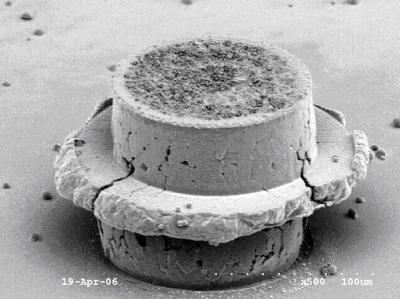
As computers become more complex, the demand increases for more connections between computer chips and external circuitry such as a motherboard or wireless card. And as the integrated circuits become more advanced, maximizing their performance requires better connections that operate at higher frequencies with less loss.

Improving these two types of connections will increase the amount and speed of information that can be sent throughout a computer, according to Paul Kohl, Thomas L. Gossage chair and Regents’ professor in Georgia Tech’s School of Chemical and Biomolecular Engineering.

Arsenic poisoning did not kill Napoleon in Saint Helena, as affirmed by a new meticulous examination performed at the laboratories of the Italian National Institute of Nuclear Physics (INFN) in Milano-Bicocca and Pavia, together with the University of Milano-Bicocca and the University of Pavia.

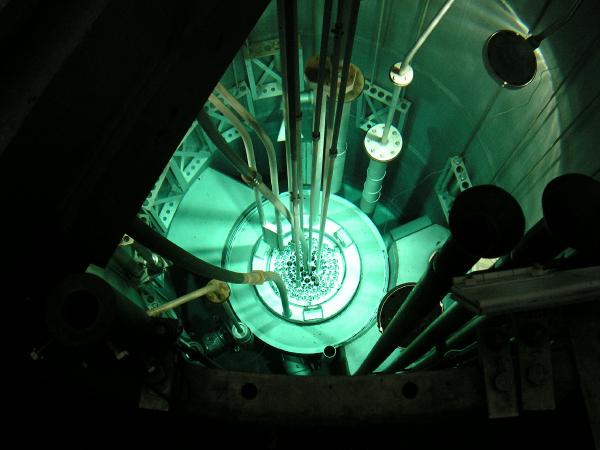
The physicists performing the study used a small nuclear reactor used exclusively for research purposes at the University of Pavia, applying techniques that were created for the project known as “Cuore” (“Heart”), which is being developed at the INFN’s national laboratories in Gran Sasso.

The research, published in the journal “Il Nuovo Saggiatore”, was performed on hair samples that had been taken during different periods of Napoleon Bonaparte’s life, from when he was a boy in Corsica, during

Wool skirts and silk ties may avoid those pricey trips to the dry-cleaner in the future and clean themselves, researchers in Australia and China suggest. They are reporting development of a nanoparticle coating that could lead to “self-cleaning” wool and silk fabrics.

Wool and silk, which are composed of natural proteins called keratins, are among the most prized and widely used fabrics in the clothing industry. However, they are difficult fabrics to keep clean and are easily damaged by conventional cleaning agents. A better way to fight stains in these and other protein-based fabrics is needed, scientists say.


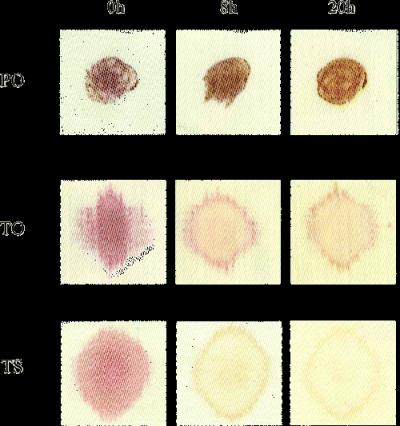
In a recent laboratory study, wool treated with a new nanoparticle coating (bottom row) removed red wine stains more effectively than plain wool (top row) and wool coated with another stain-fighting chemical (middle row), scientists say. Credit: Courtesy of the American Chemical Society

Scientists are reporting new evidence that natural pigments responsible for the beautiful blue/purple/reddish color of certain fruits and vegetables may help prevent obesity. Their animal study, published in the Feb. 13 issue of Journal of Agricultural and Food Chemistry, reports one odd qualification - eating the whole fruit containing these pigments seems to be less effective than eating an extract of the berry.

Ronald L. Prior and colleagues, who did the new study, note that past research has shown that the pigments — called anthocyanins — prevent obesity in laboratory mice fed a high-fat diet. Anthocyanins are found in grape skins, blueberries, blackberries, purple corn, and other foods. The mice also had other healthful changes in disease-related substances found in the blood.


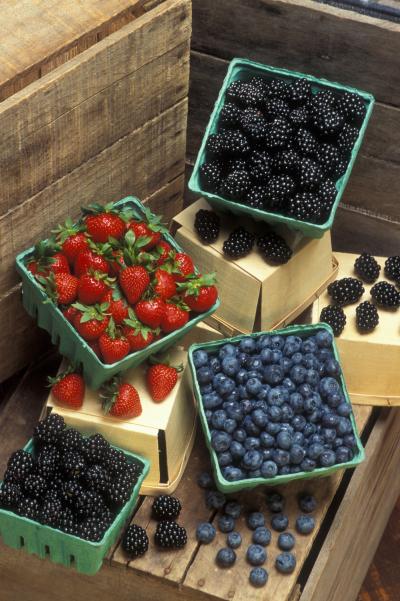
Mmmmm, lose weight. Colorful pigments found in the skin of blueberries, strawberries and other fruits and vegetables may help prevent obesity, according to recent animal studies. Credit: Courtesy of USDA Agricultural Research Service

Can a machine taste coffee? Scientists have been working on it for decades. Researchers in Switzerland published a study on their coffee-tasting machine is scheduled for the March 1 issue of Analytical Chemistry.

For the food industry, “electronic tasters” could prove useful as quality control devices to monitor food production and processing. Christian Lindinger and colleagues at Nestlé Research pointed out that coffee scientists have long been searching for instrumental approaches to complement and eventually replace human sensory profiling.

However, the multisensory experience from drinking a cup of coffee makes it a particular challenge for flavor scientists trying to replicate these sensations on a machine. More than 1,000 substances may contribute to the complex aroma of coffee.