Banner
Pilot Study: Fibromyalgia Fatigue Improved By TENS Therapy

Fibromyalgia is the term for a poorly-understood condition where people experience pain and fatigue...

High Meat Consumption Linked To Lower Dementia Risk

Older people who eat large amounts of meat have a lower risk of dementia and cognitive decline...

Long Before The Inca Colonized Peru, Natives Had A Thriving Trade Network

A new DNA analysis reveals that long before the Incan Empire took over Peru, animals were...

Mesolithic People Had Meals With More Tradition Than You Thought

The common imagery of prehistoric people is either rooting through dirt for grubs and picking berries...

User picture.
News StaffRSS Feed of this column.

News Releases From All Over The World, Right To You... Read More »

Blogroll

In the science world, media and our daily lives, the debate continues over how carbon in the atmosphere is affecting global climate change. In a study of how organic carbon is processed in rivers, a research team including an engineer, ecologists and microbiologists has determined that carbon processing in rivers is a bigger component of global carbon cycling than previously thought.

Aaron Packman, Northwestern University associate professor of civil and environmental engineering, is collaborating with ecologists and microbiologists from around the world to study how organic carbon is processed in rivers.

Packman, who specializes in studying how particles and sediment move around in rivers, is co-author of a paper on the topic published in Nature Geoscience.

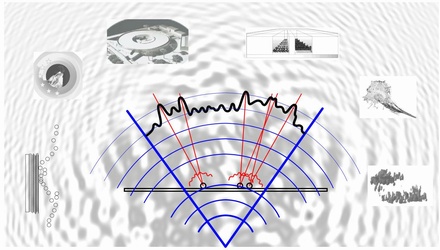
Black holes are massive gravitational fields in the universe that result from the collapse of giant stars. Because black holes absorb light, they cannot be studied using telescopes or other instruments that rely on light waves. However, scientists believe they can learn more about black holes by listening for their gravitational waves.

Scientists hope that a new supercomputer being built by Syracuse University's Department of Physics may help them identify the sound of a celestial black hole. The supercomputer, dubbed SUGAR (SU Gravitational and Relativity Cluster), will soon receive massive amounts of data from the California Institute of Technology (Caltech) that was collected over a two-year period at the Laser Interferometer Gravitational-Wave Observatory (LIGO).

Gravitational waves are produced by violent events in the distant universe, such as the collision of black holes or explosions of supernovas. The waves radiate across the universe at the speed of light. While Albert Einstein predicted the existence of these waves in 1916 in his general theory of relativity, it has taken decades to develop the technology to detect them.

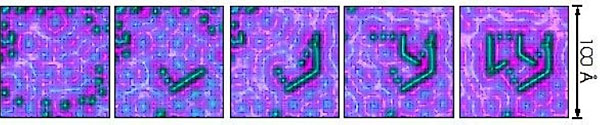
The two atoms of an oxygen molecule severed by a metal catalyst usually behave identically, but new research reveals that on a particular catalyst, one oxygen atom plants itself while the other moves away, probably with energy partially stolen from the stationary one.

Scientists from the Pacific Northwest National Laboratory found this unanticipated behavior while studying how oxygen interacts with reduced titanium oxide surfaces. The chemists are trying to understand how molecular oxygen -- the stuff we breathe -- interacts with metals and metal oxides, which are used as catalysts in a variety of environmental and energy applications.

Forty years ago, mathematician Mark Kac asked the theoretical question, "Can one hear the shape of a drum?"

If drums of different shapes always produce their own unique sound spectrum, then it should be possible to identify the shape of a specific drum merely by studying its spectrum, thus "hearing" the drum's shape (a procedure analogous to spectroscopy, the way scientists detect the composition of a faraway star by studying its light spectrum).

But what if two drums of different shapes could emit exactly the same sound?

The February issue of Geotimes takes a look at the complicated issues surrounding Iraq’s oil exploration and production.

Though oil prices have doubled and Iraq boasts the largest untapped oil reserves in the world, the instability that comes with war, attacks on infrastructure and outdated technology in Iraq have led to the lowest reserve-to-production ratio of all oil-producing countries.

Currently Iraq produces 2.0 million barrels per day (bpd), down from an average of 2.6 million prior to the invasion in 2003. Exploration and development in Northern Iraq could easily increase production by 100,000 bpd.

A report published in BMC Public Health states that socio-economics and neighborhood have a more powerful influence on sexual activity among 15- and 16-year-olds than the classroom.

A team of researchers analyzed data on nearly 5,000 pupils from 24 different Scottish Schools. They found that overall 42% of girls and 33% of boys reported experience of sexual intercourse, but the rates between schools ranged widely, from 23% to 61%.

Commenting on the value of sex education in schools, lead author Dr. Marion Henderson said, "It would be over-simplifying to interpret these results as suggesting that sex education isn't valuable. The study was looking at effects of school beyond the sex education curricula."