




Lessons From Fact And Fiction.
It is widely stated that those who do not learn from the mistakes of the past are doomed to repeat them. This is true of lessons from both real life and from works of fiction. Lessons from real life show that over-reliance on technology can leave pilots with no way of saving their plane from disaster. Lessons from fiction show that the people who design, build and maintain planes need to read more books and watch more movies. Time and again authors of fiction show possibilities for accidents. And time and again these entirely predictable accidents happen. A case in point was the 1898 book Futility, by Morgan Robinson, in which the ship Titan1, with far too few lifeboats for its 3,000 passengers, sank after striking an iceberg.
Fate Is The Hunter
Ernest K Gann, in his 1961 book Fate Is The Hunter2, showed how a number of seemingly random factors can align to cause a fatal accident. He likened this to fate hunting pilots.
There is a point, ever varying and always frivolous in appearance, when diligently acquired scientific understanding is suddenly blinded and the medieval mind returns to dominate. This mixture of the mystical and factual produces quick confusion followed by a needling sense of peril. This moment of realization and discovery is verbally identified as luck, or fate to the more elegant. Whatever the label, it presupposes a firm belief in powers supernatural. Therefore, partly in shame and partly in hopeless lack of understanding, the factor of luck is officially ignored among those engaged in any endeavor dependent upon science and machinery.The Swiss Cheese Model3
Ernest K Gann, Fate Is The Hunter, Prologue
These days people often speak of the 'Swiss cheese' model, where an accident can happen if all the holes align in a stack of slices. It is certainly true that a chain of circumstances can cause an accident. It is, accordingly, incumbent on those who design, build, maintain or fly planes to do their best to seek out and eliminate the links in such chains. This requires much ingenuity because modern planes are too complex for any one person to understand the sum of their parts.
A modern airplane is a labyrinth of electrical and hydraulic and mechanical combinations, all of which must function with scientific reliability. The multitude of devices conceived by man in his restless efforts to increase his mobility sometimes overwhelms those inheriting the final Machiavellian assembly. Hence, there are experts on hydraulics, electronics, plumbing, radio, and engines, and each is so absorbed and confined that he is nearly blind to the provenances of the others. No man can master all of these thingsErnest K Gann was speaking of planes such as the DC-4 when he wrote that nobody could fully comprehend their workings. How much less, then, may any one person understand the complexities of a modern airliner controlled mainly by electronics and computers, with pilot controls added almost as an afterthought?
...
Ernest K Gann, Fate Is The Hunter, Chapter 14
Occam's Razor4
Occam's Razor states that, where there are many explanations for a thing, the simplest explanation is more likely to be correct than more complex ones. In the case of Air India 171 this boils down to a choice between the exceeding complexity of the human behavioural psychology needed to explain pilot malice versus the exceedingly simple idea that pilots instinctively try to avoid crashing.
If either Air India 171 pilot was trying to crash the plane we would have seen some degree of yaw, bank or phugoid style pitch variations as the pilots fought each other for control. We did not. The airport surveillance video shows that, apart from obvious loss of thrust, the plane was flown in a smoothly controlled manner. Pilot malice can accordingly be ruled out as a factor.
It has been suggested that spilled water shifting as the plane pitched up may have triggered the engine rollback. In his book, Ernest K Gann described how a DC3 nearly crashed when steel girders shifted aft during the takeoff roll. Even allowing for the fact that a DC3 is a tail-dragger, if G forces can shift girders in a DC3 then the greater G forces in a 787 can surely shift water long before liftoff. Sudden water damage to electronics at liftoff is accordingly unlikely.
Those frigging steel radio towers! They should have been tied down. When you jammed on take-off power, they all just naturally slid to the tail! Must have been a couple of tons of 'em. I dragged the pieces forward fast as I could. Summers helped.
Ernest K Gann, Fate Is The Hunter, Chapter 8
Blaming The Pilots
The history of aviation shows that the first instinct of the airline owners, aircraft builders and the press is to blame the pilots for any incident or accident. The book Fate Is The Hunter is riddled with remarks about this, and how convenient it is that dead pilots can't defend themselves. The 1964 movie is only loosely based on the book, but it demonstrates the Swiss cheese model rather well and begins with an accident which the airline and press are keen to blame on the pilot.
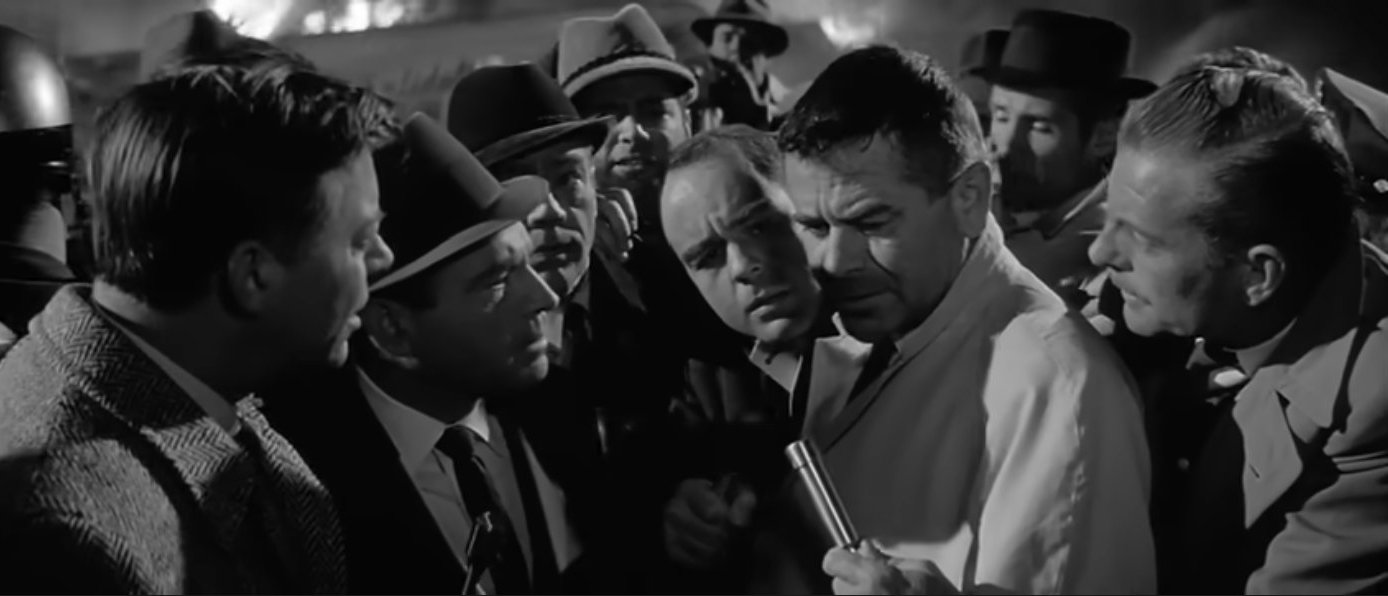
The press clamours to blame the pilot.
Lessons not learned
At the end of the movie a pilot remarks to a stewardess that the FAA will make sure that such an accident never happens again. That part turned out to be the purest fiction.
Barriers To Safety
The accident in the movie should have been survivable. Following a bird strike and the loss of one engine the remaining engine's fire alarm was triggered and that engine was also shut down. With no power the plane made a controlled gliding descent to a long beach. The belly landing was as good as they get. Unfortunately, an obstruction caused a disaster from which only one person escaped. Although this was a fictional beach landing it showed in 1964 that a plane performing a belly landing needs more stopping distance than if the gear were down and brakes could be used. One might think that airport planners would do their utmost to ensure that fiction did not become a reality. Unfortunately, it took a real-life incident in 2024 to make airport planners sit up and take notice. Jeju Air Flight 22165 after suffering a bird strike performed a belly landing which would have been successful but for the presence of a berm, which turned a landing into a fatal crash.
Spilled Drinks
In the 1964 movie the plane should have been able to fly on one engine. The second engine was shut down because of a false fire alarm. The radio was disabled at the same time. The problem was traced to spillage leaking down to the electrical system. The captain had used the center console as a makeshift table.

Wet Wires From A Coffee Spill
This lesson not learned could have had tragic consequences. In late 2019 an Airbus A350-900 was forced to divert due to a single engine shutdown caused by drinks being spilt onto the centre console of the cockpit. This happened again in early 2020. These incidents6 led to a redesign of the defective cover.
Simplicity In Complexity - Cascade Failure.
The failure of a simple component can trigger a chain of failures which, on first appearance, seems complex. The seeming complexity of the chain of events should not detract from the Occam-compliant simplicity of the initial failure. Among the many suggestions as to the primary cause of the Air India 171 tragedy there is one that certainly merits consideration. Youtuber Jeremy John Thompson7 has suggested a scenario in which the failure of a single diode could trigger dual engine shutdown while sending false switch movement signals to the FDR. His latest video8 on that topic is linked below.
Sources
1 - Futility - Titan before the Titanic
https://www.historyonthenet.com/the-titanic-futility
2 - Fate Is The Hunter
https://archive.org/details/fate-is-the-hunter
3 - Swiss cheese model
https://en.wikipedia.org/wiki/Swiss_cheese_model
4 - Occam's Razor
https://en.wikipedia.org/wiki/Occam%27s_Razor
5 - Jeju Air Flight 2216
https://en.wikipedia.org/wiki/Jeju_Air_Flight_2216
6 - Airbus Redesigns Console Panel
https://www.businessinsider.com/airbus-a350-coffee-spill-engine-shutdown...
7 - Jeremy John Thompson
https://www.youtube.com/@jeremyjohnthompson5187
8 - How did the B787 Kill 242 Innocent People?
https://youtu.be/_IKfEHtKv_k?si=Ax9_N4iVIkX3L-4A
Previous Air India Articles
Air India Crash: When 2 + 2 Does Not Compute
Air India Crash: Update #1
Air India Crash: Update #2 - The AAIB Report Revisited
Air India Crash: Update #3





Comments