

Banner
By Tommaso Dorigo | January 18th 2010 04:36 PM | 20 comments | Print | E-mail | Track Comments
About Tommaso

I am an experimental particle physicist working with the CMS experiment at CERN and the CDF experiment at Fermilab. In my spare time I play chess...

View Tommaso's Profile
2010 has just started with the best auspices to bring us exciting new science, and there comes a pledge to forecast what will happen in 2020. Oh, well - rest is not what I became a scientist for.

Making non-trivial predictions today for how will basic research be in subnuclear physics ten years down the line is highly non-trivial. For exactly the opposite reason that it is equally hard in several other fields of research.

Usually, in basic research long-term forecasts are complicated by the rapidity of the evolution of the field: one sits on the steeply rising slope of a curve describing our technological capabilities and amassed knowledge, and there is no way to have a glance of the summit from there. Nevertheless, the goals of the research are in most instances clear, and it is on the rapidity of the development of the proper means of investigation that one places one's riskiest wagers.
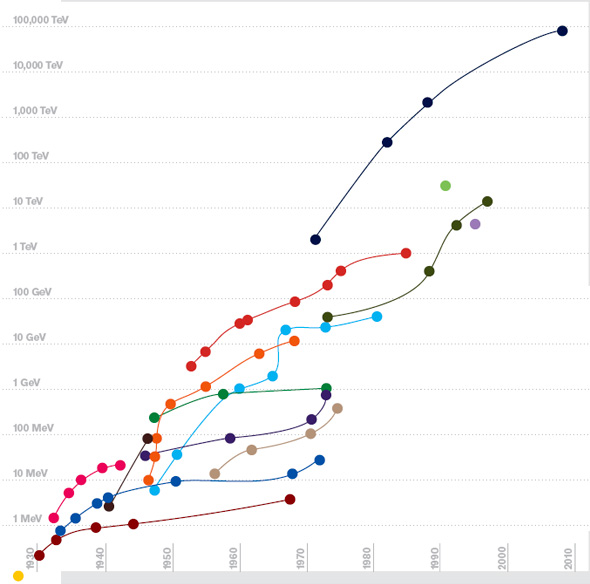
But in subnuclear physics we are in a different situation today. While the technological progress and the development of more and more sophisticated instruments has not slowed down, we have means to gauge pretty well what we will be able to do in ten years from now. One tool, although not the only one, is Moore's law -the observation that computing power doubles every two years, with direct consequences on our capability to study more collisions and dig deeper in the structure of matter. Another is the long history of progress in the energy of our particle beams (see figure on the right, from Symmetry magazine), which is obviously correlated with the discoveries we have been capable of making with them.

The complication arises from the fact that we come from forty years of dullness, and we do not know in the least where we are going: the goals are much fuzzier than in any other field of basic research. Or if you will, subnuclear physics is "more fundamental" than other Sciences, and thus its boundaries and its goals are less well defined. In the last forty years the standard model of electroweak interactions, formulated by Glashow, Salam, and Weinberg toward the end of the sixties, has been confirmed to a great level of precision, and so has the theory of Quantum Chromodynamics, which explains the strong interaction binding quarks and gluons inside hadrons and nuclei. Particle physicists have been lulled into believing that the simple doubling of power of their toys would bring new wonders in sight, but unfortunately, the paradigm is shifting.

Whatever is left to discover, apart from the Higgs boson, is not contained in our pretty picture of today's organization of the subnuclear world - and guessing it is as wild a bet as any. I might be criticized for writing this, but in my opinion there is not a theory that we should marry confidently, or one which is sufficiently based on hard facts to give us guidance; I do not even see a definite theory on which to place my money with a non-ridiculous chance of winning the bet.

[To put this in perspective: four years ago I placed a 1000$ wager which said that the LHC would not discover new particles except the Higgs boson, with Jacques Distler and Gordon Watts taking me on for respectively 750$ and 250$. The fact that I had originally proposed to bet against supersymmetry alone, but was later steered toward a much broader "any new particle" stipulation before anybody accepted it, should show you that it is really hard to marry any specific theory nowadays.]

Instead, all I see is a multitude of proposed augmentations of the particle spectrum, often solely motivated by the fact that present-day experimental observations leave a corner of phase space where to stuff them. The list is long: new Z' bosons, leptophilic or leptophobic, universal or not; particles disappearing in one, two, up to seven other dimensions (for some reason even theorists do not seem to have the guts to offer two-digit numbers of extra dimensions); first, second, or third-generation leptoquarks; fourth-generation quarks and leptons; mini-black holes. And I am leaving as last item a host of supersymmetric particles, belonging to a wide variety of possible models, quite different from one another: R-parity-conserved, or R-parity-violated Susy; split or unsplit Susy; minimal or non-minimal Susy Higgs sectors; SUGRA-ready, or SUGRA-don't care models; universal, quasi-univesal, or not nearly so extended Higgs sectors; dark-matter-allowed, dark-matter-disfavoured parameter space points; funnel regions, focus points, or coannihilation zones. What a mighty mess, my friends!

Now, the fact that I am a die-hard skeptic and that I do not believe in Supersymmetry is no news, nor is it worth a post on the physics we will face in 2020. So, being unable to put together a straight face and place a cheap bet on this or that model of the new physics we will be finding in the next ten years, I hereby renounce the cheap shot -knowing that the odds that my superior vision and foreseeing get sanctified in ten years' time by a lucky coincidence are basically zero. Instead, let me take on the issue from a different perspective: where will we be on the map on the experimental point of view, in ten years' time ?

The experimental landscape in 2020

In 2020, the field of particle physics will not be as different from now as we might think. Let me give here my very own predictions for what will happen.

The Tevatron collider will by then be long gone. The CDF and DZERO collaborations will be dismantled in 2013 -a quite sad, but unavoidable, outcome. A trickling of papers describing late analyses of the huge bounty of proton-antiproton collisions acquired by CDF and DZERO until September 2012 will continue to make it through to Physical Review Letters well into the late 10's, but by 2020 even CDF die-hards like Paolo Giromini or Giorgio Bellettini will have decided it is better to retire and enjoy the warmer weather of the Tuscan coast than to wrestle over yet another anomaly or another tenth of a GeV improvement in the top quark mass measurement.

[And let me add here that I sincerely hope that Professor Giorgio Bellettini will be awarded the 2013 Nobel Prize in Physics, for the discovery of the top quark!]

The CDF experiment will become a historic endeavour cited in textbooks, to praise a successful collaboration of physicists from all around the globe which lasted well over thirty years, produced over a thousand scientific papers, and produced the discovery of the top quark. Textbooks, however, will neglect to mention the huge fights and the scientific controversies that provided the necessary core pressure and kept the experiment from imploding, but ex-collaborators (guess who) will write about it in detail, finally free to recount dozens of as-of-yet untold stories and the human dramas that took place within the flimsy walls of the trailer complex sitting east of the CDF assembly building.

Having paid tribute to the older brother, the Large Hadron Collider will be alone in the field of the high-energy frontier. In 2020 the LHC will be a mature facility, having undergone a two-phase surgery to boost its power and endow its detectors of improved capabilities to cope with the increased proton collision rate. It will still be going strong and delivering data at a fantastic pace. The CMS and ATLAS experiments, along with ALICE and LHCb, will be producing exquisite science. New physics or not -most likely, not-, the measurement of quarks, leptons, and their interactions at 14 TeV of energy will indeed dig deep in the foundations of the standard model and will let us finally understand the details of electroweak unification and the origin of mass.

If, as I believe, the Higgs boson exists and it is a unique, neutral scalar field, the LHC experiments will measure its branching fractions, its exclusive production modes, its couplings to top and bottom quarks, and they will confirm that our picture of subnuclear physics, albeit grievously incomplete, is beautifully precise. By 2020 particle physics might then be facing the spectre of foreclosure: if no new physics is seen beyond the standard model at the scale of 14 TeV, no expensive new project may be able to justify its existence. But physicists may have managed to out-run that spectre, getting close enough to completing a new project before it becomes clear that it is not scientifically justified.

So, while other experiments will make important discoveries in the course of the next ten years -particularly in the neutrino sector-, at the high-energy frontier we might be able to see zero, or at most only one new facility in the process of being built. This new machine might be a new high-energy linear collider for electrons and positrons, o a more exciting muon collider (see the proposed layout on the left). Either way, such a machine will probably not see the light of its own collisions in ten years' time. These things are complicated to design, and because of their scale and complexity they are almost impossible to put together! A muon collider at Fermilab would be a wonderful opportunity for particle physics in the United States, but I do not see it taking data in 2020.

And after all I hope I am wrong. Who cares about those 1000 dollars I bet against new discoveries ? It was an insurance bet against the dullness of a desert stretching beyond the standard model all the way through to our visible horizon. No: I hope that the LHC -i.e. ATLAS and CMS, including myself together with the other 2500 collaborators in my experiment- will indeed soon stumble in a host of new particles, magically turning on our detectors as a Christmas tree. Wouldn't it be beautiful ? Just turn the master knob anti-clockwise by half a turn, increasing the beam energy from 2 to 14 TeV, and wham!, a whole new world rains from the sky in flying colours. Experimentalists will lose their sleep, theorists will go nuts, careers will be made overnight. Nobel prizes will pop up....

...Nah. Sorry, but I do not buy it. It just looks too good to be true. I think the fantastic years for particle physics were the fifties and the seventies of the XXth century. I also think that in the next ten years we will learn much more about the world, about the universe, and about fundamental science by studying astrophysics and cosmology. But on that matter, my dear readers, I feel unqualified to pontificate!


Comments

Hi Tommaso,

Thanks for the insightful & somewhat humorous blog! I was just wondering though, as you believe we will discover no new particles/physics other than a SM Higgs, does this imply that you are a "Dark Matter" sceptic? ie do you think DM will be explained by a modified gravity theory for instance rather than a new particle sector? Or do you think a DM sector may still be hidden within a more complete mathematical representation of the SM gauge groups?

Cheers

Roy

How pesimestic. Are all those papers saying the Higgs boson mass, and Weak scale need stablising by TeV physics just wishful thinking? And Even if the LHC find nothing but a Higgs, all those dark matter astronomers might well
find something. They're will be impressive statistics from beefed up dark matter experiments by then, plus plenty data on the early universe. That will be plenty for theorists to work with.
...

P.S. In your beam energy diagram, what the heck, are those black dots at 100,000 TeV around 2010? Cosmic ray
experiments?

dorigo
Hi BDO,
yes, I am quite pessimistic!
I know that the higgs mass appears ummotivated and fine-tuned. But while in cosmology we have a fine-tuning of dark energy which is really hinting at discoveries yet to come, in HEP I just don't see it likely. That is my very own feeling, that's all...
As for dark matter, there are so many possible solutions that the right one needs not be a elementary particle... If somebody tells me of a cosmic coincidence between the required neutralino mass and its cross section to tine its abundance at decoupling, I retort that it is no less a coincidence that we are just about to reach that mass range with accelerators.
The energy in the graph is the equivalent one for a fixed-target experiment, asI forgot to mention in the post!
Cheers,
T.

Being on the "astronomy and astrophysics" side of this, I realize that the majority of cosmological questions now rest with the particle physicists at CERN and Fermilab. I can read the papers, but in the final analysis all I can do is wait and see. We'll all just have to wait and see. ; )

Best,
Eric

dorigo
Hi Eric,

yes, time will tell. I think that we will get more answers from astrophysics than particle physics, but that is only because I am such a pessimist!

Cheers,
T.

Despite the fact my physics is 50 years old, I have some "general" questions that come from the many specific posts I read here.

1) If mass is introduced into particles by the Higgs field, then is the Higgs field still "here" doing its job of adding mass to newly created particles? If so, since the Higgs boson decayed immediately after the BB, how is it's field still around?

2) What is it about some particles like the photon that keeps it free from getting mass via the Higgs field? And, what is it about the various particles that explains why they get different values of mass from the same field?

3) Other than the maths and the experimental findings -- is there any "logic" to why there would be 16 particles in the Standard Model? (It seems so much like circumnabulating a Hindu temple 3 times. There's always a set of sacred numbers in a religion!) And, any rational why these 16 particles would be so truly weird?

4) Given the 16 -- is there an order to their appearance during the BB? Was the Higgs the first or last? If it were first, would the others have been created into an existing Higgs field and thus take on their mass.

5) Given these 16 -- from what could they have "come from?" One particle? Or, yet more and more even weirder particles? How does physics get back to the the first 'thing?" Does it even assume there was only one first thing? Maybe all 16 "appeared" at the same instant. (I'm thinking about what the LHC could be expected to find "before" the Higgs boson?)

6) As I understand it, string theory is "needed" because the 4th FORCE (gravity) can't be fit into the SM. But, as posted, "Erik Verlinde [has] proposed a ... that gravity has all the characteristics of an entropic effect, and presents clear arguments that gravitational attraction between massive bodies can be considered as resulting from nothing more than a growth in number of bits required to describe the system of massive bodies." Am I reading this correctly that gravity may not be a FORCE? And, if it's not -- then is there any reason to have string theory?

7) As a cognitive psychologist i'm aware of information theory (IT) used to deal with INFORMATION. But, other than the fact that IT math can be fit with other math to yield a math definition of gravity -- do folks really think there are "sphere's" around particles holding "bits?" And, if so -- what makes up a BIT? What makes up a sphere? I have to assume these are concepts that rationalize the use of certain equations verses others. But, having done a lot of math modeling -- just finding an equation that "fit" was never enough -- at least for me. I wanted one that made sense in terms of how the brain worked.

8) And where do dark matter and dark energy fit since I understand that they don't fall-out from the SM. So even if the LHC finds the Higgs boson and "confirms" the SM -- is there yet another "model" that is need and does the LHC play any role in working on it?

9) Vibrating strings give rise to our needed particles. OK. So now we have opened yet another Chinese box. What are strings made up of? (To vibrate they would seems to need mass and tension.) How many of the them would there need to be? One for each of the 16 particles? One that vibrates creating all 16? If we are going to explain particles by strings aren't we then forced to explain strings -- in someway beyond the math works.

10) If we need string theory -- do folks really imagine there are 11 dimensions just because the equations work out nicely when we make this assumption? Or, is it the case that once one assumes that from "nothing" the BB produced "everything"-- we have already made such an improbable non-common sense leap of faith that anything that works-out mathematically is seen as "reasonable."

Let me have a quick go at answering some of these:

1. The Higgs field has a constant non-zero "vacuum expectation value", or VEV, and this is what gives rise to particle masses in the standard model (SM). Particles on the other hand are interpreted as (quantised) oscillations of the corresponding field.

2. This can really only be answered by the mathematics of the Higgs mechanism. Gauge bosons get mass if the corresponding symmetry rotations don't leave the Higgs VEV invariant. In the SM there is always a one-parameter family of symmetries which do leave the Higgs VEV invariant. The corresponding gauge boson is therefore massless, and we identify it with the photon.

3. There is no good answer to this. There are restrictions on what sets of particles one can introduce in a gauge theory like the standard model, but they are nowhere near strong enough to predict the spectrum we observe.

4. Doesn't make sense. Sorry.

5. Similar to 4. Particles did not "appear" in a certain order. In fact sort of the opposite happened. In the early universe it was hot enough that all the SM particles were constantly being pair produced (and annihilated of course). As the universe cooled, the more massive particles could no longer be created, and since most of them are unstable, they quickly decayed.

6. I haven't read Verlinde's paper.

7. Can't answer.

8. You're right that the SM doesn't explain dark matter. Certain supersymmetric models on the other hand naturally contain particles with the right properties to be dark matter. Some of these models can be tested at the LHC, but there are (many) other experiments which offer more hope for unravelling some of the properties of dark matter.

9. If our universe is described by a certain string theory, then all the different particles are different states of *one* type of string.

10. Your second sentence is rather foolish. The big bang model is simply that the universe was once very hot and dense, and has since been expanding and cooling. This beautifully explains a wide variety of data, and is one of the great successes of twentieth century science. As for your string theory question, it is not just that the equations are "nicer" in 10D, but that the theory only makes sense in 10D.
(There are subtleties, but this is not the forum in which to discuss them.)

dorigo
Rhys, thank you for your answers to the 10 questions above. You ease my job considerably!
I will now try to give some more answers myself to a few of the questions.
Cheers,
T.

dorigo
Hello Steve,

you received already detailed answers from Rhys below, but let me do my share to help you here.

1. Perhaps it is worth explaining that particles are everywhere as fluctuations of the vacuum. In some sense, a particle-antiparticle pair may "pop out" of the vacuum for a brief instant of time, "borrowing" energy that it yields back immediately. This is limited basically by two things: the uncertainty principle, which explains that the energy of a quantum system cannot be defined to an accuracy superior to Delta(E)<h/(4 pi t) (where E is energy, t is time, h is Planck's constant, and pi is 3.14); and by the need to obey all locally conserved quantum numbers of the theory (so, for instance, you cannot pop out of the vacuum a single electron, because that would violate charge conservation).

Note that the idea of "borrowing" energy from the vacuum is somewhat improper - but I find its didactic value overrides the inaccuracy.

I think this answer also pertains to your doubts about particles created "earlier" and "later" after the BB. All where there together!

2. Particles have different characteristics. While the photon's zero mass, as explained by Rhys, is a result of the Higgs mechanism, all particles have a different mass. Their exact value is a mystery, but we think we know how it arises.

6. string theory is not needed "to explain gravity". In fact, string theory is a long way from explaining gravity. It is a beautiful, abstract theory which has not been able to produce falsifiable predictions so far. The inclusion of gravity -and its quantization- is a unsolved problem that is being tackled in many ways, none of which I can speak about for manifest ignorance.

Cheers,
T.

I think question 4 does make sense (in fact I liked all the first five questions!); Steve probably refers to force carriers appearing at an earlier or later time in the history of universe as a result of symmetries breaking and new ones popping up. He may also be relating it to particles coming into existence because of higher available energies (only that in this case it worked opposite than in lhc :).

dorigo
Yeah, you may be right. Not a meaningless question after all :)
Cheers,
T.

Tommaso,

Not sure I understand your statement....."If somebody tells me of a cosmic coincidence between the required neutralino mass and its cross section to tine its abundance at decoupling, I retort that it is no less a coincidence that we are just about to reach that mass range with accelerators." Could you clarify? (I assume "tine" is *tune*?)

Also, with DM, if not an elementary particle, isn't the only other option a scale dependant "G"?

Now, a hypothetical. If the LHC does not find a Higgs in the SM predicted range, what will be your reaction and would you convert to searching for SUSY as a priority in your experiment?

Cheers

dorigo
Hi Roy,

yes, its "tune" :) I will change the text. So the admittedly a bit obscure statement addresses the often cited "cosmic coincidence" that the lightest neutralino of Supersymmetric theories allowed by present-day searches and compatible with the most natural requirements of a meaningful Supersymmetry has to have a mass in the hundred GeV range; and such a mass (and characteristics thereby) would make such a neutralino the perfect candidate to explain away the observed abundance of dark matter in the universe, because its stability and mass and production rate would make it just right in abundance and contribution to the mass budget of the universe. So it is a cosmic coincidence because two completely unrelated (apparently) "predictions" -the most likely mass of the lightest neutral particle of Supersymmetry, and the mass and cross section required for a weak interacting massive particle to explain by itself dark matter- point to the same place. Will we find such a particle ? If we do, it would be killing two birds with one stone, and probably it would be the discovery of the century, worth Nobel prizes in physics for a decade in close succession.

I counter the cosmic coincidence argument by noting that theoretical predictions appear to always predict something to occur at a energy higher than the one now at reach, at a cross section a bit too small to be investigated today, or both. I can live with the fact that theories cannot meaningfully predict phenomena we have already ruled out, but I am more comfortable if I see predictions that are a bit more readily falsifiable. This "coincidence" -the fact that new physics appears to be always a little bit beyond arm's reach- is no less cosmic :)

Cheers,
T.

dorigo
... and if we find no SM Higgs, for sure we will have the priority to study Susy! But we do nonetheless. Actually, we search for the Higgs without being picky on the tag it has attached to the fold -because the lightest SUSY Higgs and the SM Higgs are almost indistinguishable in most of the parameter space of the former.

Cheers,
T.

There is something wrong in the units of the plot, is there?

dorigo
No, Alejandro, the energy is the one equivalent to a fixed target collision, i.e. E'=sqrt(2mE).
Cheers,
T.

Hi Tommaso,

I don't quite understand the plot.
It looks as if we already reached beams of 100PeV?

Cheers,
F.

Rhys posted, "Your second sentence is rather foolish." It was intended to be "foolish" because I was "pulling the blog's leg." I was summarizing BB in a saterical way as I might summarize an explanation of "creation" by a Catholic priest. I say Catholic, because the Church has put thousands of man hours into producing a set of INTERNALLY consistent concepts. The Church might well say, "Our theology beautifully explains a wide variety of phenomena, and is one of the great successes of religion." Yet, to me, not one bit of it can be believed.

Since I can't follow discussion of the specifics of Tommaso's post (my Quantum Mechanics course was in 1961) I was, in the spirit of Tommaso's post, thinking aloud about the enterprise itself. I think the answer I got was -- if a set of equations are shown to be internally correct AND match current experimental data -- then, it's a "great successes" even if it is very weird.

When folks first saw E=MC2 -- they saw an equation that matched the physical world, AND they also received a powerfully AND EASY TO UNDERSTAND insight about mass and energy. Thus, some of my questions were about today's theories and the insights they yield.

1) Does modern physics use math and data to support the validity of concepts such as a reality with 10-dimensions? If so, it implies that reality as described by current models is truly so complicated and bizarre that almost everyone else has no direct way of coming to understand reality on their own and therefore must come to their beliefs because the priests -- sorry, a group of perhaps several hundred people on the whole planet -- are able to follow the maths.

2) Or, are the concepts like "10D" what we in psychology call "hypothetical constructs" that either made a model easier to explain to those that couldn't follow the math OR, for those of us who did simulations, we would borrow concepts that had properties we understood to make our programming simpler. I used a "diffusion membrane" hypothetical construct in a learning simulation because it was obvious how to program it -- and it predicted my data. In this view of current theory, "10D" is a way to make something very abstract more concrete. "Everyone understands 4D -- so just imagine 6 more dimensions."

To those who answered my specific questions -- thank you. It's clear the many hours of programming that the layman watches in an effort to keep-up, have -- as I have long suspected -- simplified the BB to the point that even the most recent programs on the LHC skip over so much detail that most, but not all, of your answers flew right over my head.

Steve

Tommaso, why do you hold such hope for astrophysics and cosmology providing new results? In particle physics we can at least in principle calculate backgrounds for the experiments that we run. This is because we have the beautiful standard model at our disposal and controlled experiments. With astrophysics and cosmology our understanding of the backgrounds are infantile at best, and there aren't experiments we can even do to test most hypotheses. Take for instance the DM craze of last year. While I certainly share your skepticism that particle physics experiments might not find anything new, I highly doubt we will see any new physics in the skies that can't be explained away! Do you think your enthusiasm is just because you are not actively working in that field?

dorigo
Hi anon,

perhaps.

I think there are answers that will find a possible solution in the next decade in astrophysics, because we have deployed instruments that might give us answers, like Planck, or Lisa, or still others, but more importantly, because I do believe that there is new physics to discover there. The fact that we have such a beautiful standard model in particle physics is our damnation in particle physics, while cosmological theories are still much more liable to be falsified or improved.

Cheers,
T.

Add a comment

The content of this field is kept private and will not be shown publicly.
  • Allowed HTML tags: <sup> <sub> <a> <em> <strong> <center> <cite><TH><ul> <ol> <li> <dl> <dt> <dd> <img> <br> <p> <blockquote> <strike> <object> <param> <embed> <del> <pre> <b> <i> <table> <tbody> <div> <tr> <td> <h1> <h2> <h3> <h4> <h5> <h6> <hr> <iframe><u><span>
  • Lines and paragraphs break automatically.
  • Web page addresses and e-mail addresses turn into links automatically.
CAPTCHA
If you register, you will never be bothered to prove you are human again. And you get a real editor toolbar to use instead of this HTML thing that wards off spam bots.

