Fake Banner
A Research Position In Neuromorphic Computing And Nanophotonics Open In Padova, Italy

Five days are left to apply to a 2-year research position at INFN-Padova, to work in the context...

Apply For The USERN Prize, Win Cash, And Get A Keynote Talk In Astana

Nowadays it has become exceedingly hard to distinguish legitimate academic endeavours from scam...

A Record Of Past Activities

Every now and then, for one reason or another, an academic will have to update one's own CV. This...

Surviving Queues: 2 - On The Road

[For the first part of this two-part post, see here]...

User picture.
picture for Hank Campbellpicture for Heidi Hendersonpicture for Patrick Lockerbypicture for Bente Lilja Byepicture for Sascha Vongehrpicture for Johannes Koelman
Tommaso DorigoRSS Feed of this column.

Tommaso Dorigo is an experimental particle physicist, who works for the INFN at the University of Padova, and collaborates with a number of exxperiments in physics and astrophysics, including the... Read More »

Blogroll
In the last few days I described in some detail (here and here) the six searches for the Standard Model Higgs boson just produced by CMS, the experiment at the CERN Large Hadron Collider to which I proudly belong.
In my short summary of analyses recently published by CMS, yesterday I left out one which had not yet been released. It is the search for the "golden channel" of Higgs decay, the one which motivated the construction of detectors with large acceptance to energetic leptons: the decay to two Z bosons, with a subsequent decay of the Z's to two charged leptons each.
An orgy of new results has started. Let me just show a few of them concerning Higgs searches in CMS - I am on vacation after all, and I have little time left to comment these interesting new papers and plots after all the sunbathing and restaurants.

Let us start with the Higgs search in the diphoton decay mode by CMS (paper here). With 1.09 inverse femtobarns of data, CMS has a pretty good reach even to this very rare decay mode of the Higgs boson. Let me remind you that only a handful every thousand Higgs particles decay into two photons, in the most favourable circumstances.
Impressive. If you had been seeking for top quarks in 4-inverse-picobarns datasets since 1992 as I have, and then rejoiced at the 7-event signal from which CDF extracted in 1994 mass and cross section of the long-sought sixth quark, you would now also be looking for adjectives upon having a look at the figures in the new CMS paper, which uses over one inverse femtobarn of proton-proton collisions to measure the tiny asymmetric kinematics of top quark pairs produced at the LHC.
This afternoon (2.30 PM Chicago time) Pat Lukens, an old-timer of the CDF experiment, will give a "wine and cheese" seminar at Fermilab on the new observation of a heavy baryon, of the family of baryons containing bottom quarks, which was still at large.

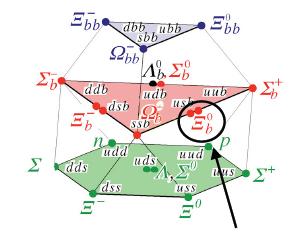
The new particle, called "Xi_b^0", fits a hole in the group representation graph of ground-state baryons with J=1/2. You can see it in the graph on the right. Of all states in the middle level (ones containing one bottom quark) only the Xi_b^0 was still missing. By the way: none of the baryons of the top level have yet been observed.
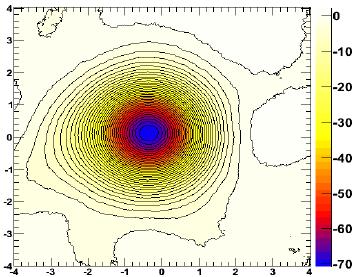
Today I casually ran into a very nice figure which is perfect for an entry as "guess the plot", both because of its mysterious appearance, and because of the interesting physics it hides. It is a two-dimensional "surface" and its shape should tell you something. For the moment, I will just say it is something which has to do with both particle physics and astrophysics, and that it is quite cool, being a new way of looking at something we know well.