Fake Banner
A Research Position In Neuromorphic Computing And Nanophotonics Open In Padova, Italy

Five days are left to apply to a 2-year research position at INFN-Padova, to work in the context...

Apply For The USERN Prize, Win Cash, And Get A Keynote Talk In Astana

Nowadays it has become exceedingly hard to distinguish legitimate academic endeavours from scam...

A Record Of Past Activities

Every now and then, for one reason or another, an academic will have to update one's own CV. This...

Surviving Queues: 2 - On The Road

[For the first part of this two-part post, see here]...

User picture.
picture for Hank Campbellpicture for Heidi Hendersonpicture for Patrick Lockerbypicture for Bente Lilja Byepicture for Sascha Vongehrpicture for Johannes Koelman
Tommaso DorigoRSS Feed of this column.

Tommaso Dorigo is an experimental particle physicist, who works for the INFN at the University of Padova, and collaborates with a number of exxperiments in physics and astrophysics, including the... Read More »

Blogroll
The measurement of the production rate of top quark pairs at the Tevatron is by now a very well developed technology, where it is hard to invent anything new. Eight years ago, however, there was still the chance to develop new techniques and explore new land.
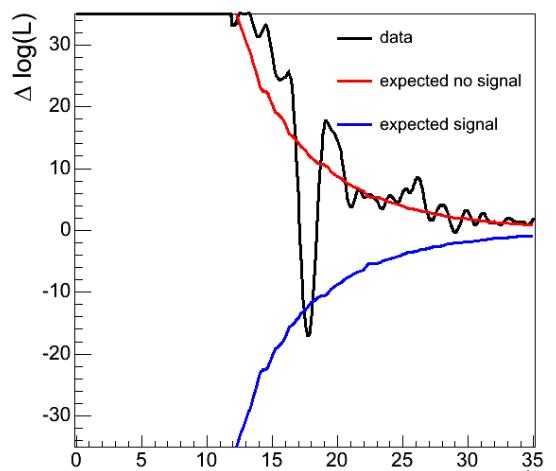
Okay, the riddle I posted two days ago  was indeed solved by theorists - albeit ones with good internet connections and smart search engines.

The figure, pasted below for your convenience, is from the CDF collaboration, and it refers to a "famous" analysis - one of the few important measurements for which Run II at the Tevatron was considered a good idea (thank god that one sold with the funding agencies, because there were sooo many others that eventually paid off!).


In a display of nonchalance that should teach us a thing or two, the ATLAS collaboration has put an end to the Easter Higgs Rumour (EHR), which brought the blogosphere in an excited state for at least a week, and experimentalists and theorists for even more time. They did so by publishing a very narrow-focused document, totaling less than five pages, where they discuss the backgrounds to Higgs boson decays in the diphoton final state.
My attempt at stimulating your curiosity with a scientific graph last time worked quite well, and I want to try it again. This time, however, you should not consider yourself eligible to participate if you are an experimental particle physicist (or in the process of becoming one). That's because I want to "lower the bar" a little, allowing non-experts in the game, and an experimentalist in HEP should recognize what this figure is quite easily. If you are a theorist, I am not sure -today's plot might be instantaneous for you to recognize, or not easy, depending on what you work on. I'll take Lubos as a testing ground. Lubos ?
As many of you know, I expressed here my strong doubts that the rumoured Higgs signal found by members of the ATLAS collaboration in the two-photon final state was due to a real particle, and went as far as to bet 2:1 against it (you can take the bet by just writing in the comments thread, but you must be a well-known individual who has a reputation in physics if you want to be taken seriously).
"There are 10^11 stars in the galaxy. That used to be a huge number. But it's only a hundred billion. It's less than the national deficit! We used to call them astronomical numbers. Now we should call them economical numbers."

R. Feynman