In order to be able to perform unescorted access to areas where ionizing radiations are present, and to work with and use radioactive materials, workers at Fermilab have to pass a specific training which enables them to recognize the dangers and work safely, minimizing the radiation dose they get by performing their activities, and reducing the spread of contamination to the environment.
"There is, in my opinion, no doubt that by the time we are ready to announce the discovery of the Higgs boson, the whole world will know it".
James Gillies, Head of Communications at CERN, interviewed by Physics World's Matin Durrani -
video available here.
Fermilab is a wonderful place to travel to in the late summer or fall. The site of the laboratory is a wide chunk of land just east of the Fox river, 30 miles west of Chicago. It is home to not just physicists and engineers, but to a wide variety of animals. Geese on their way South stop yearly in the lake in front of Fermilab's Wilson Hall, and many of them decide to spend the winter there, to benefit from the warm waters; deer are copious, but will not be easily seen around, save for the occasional one at times seen standing in the middle of the road at night; buffalos roam within large lots of land outside and inside the ring. Woods, trees with widely varied colours, and prairie make one feel it is a privilege to do Science there.
Today I wish to bring to your attention a figure recently obtained by the CDF collaboration, one which really tells a thousand words. Before I describe it to you, however, I would like to discuss at an elementary level a few basic concepts of particle theory which the figure well summarizes.
A Crash Course on Feynman Graphs
Let us start with a few elements on Feynman graphs -the diagrams that physicists use to draw on their blackboards to picture what really happens when particles react, and that actually enable the computation of the probability of those processes.
"The emission or absorption of a quantum by a nucleus bound in a crystal leads in general to an alteration of the vibrational state of the crystal lattice, which takes up the recoil momentum. On account of the quantization of the internal energy, the crystal can absorb the recoil energy only in discrete amounts. With decreasing temperature the probability of excitation of the internal states decreases more and more, so that for soft gamma rays for a part in the quantum transitions the crystal as a whole takes up the recoil momentum. The quanta emitted or absorbed in this situation undergo practically no energy loss because of the large mass of the crystal, and ideally satisfy the resonance condition".
Rudolf Mossbauer
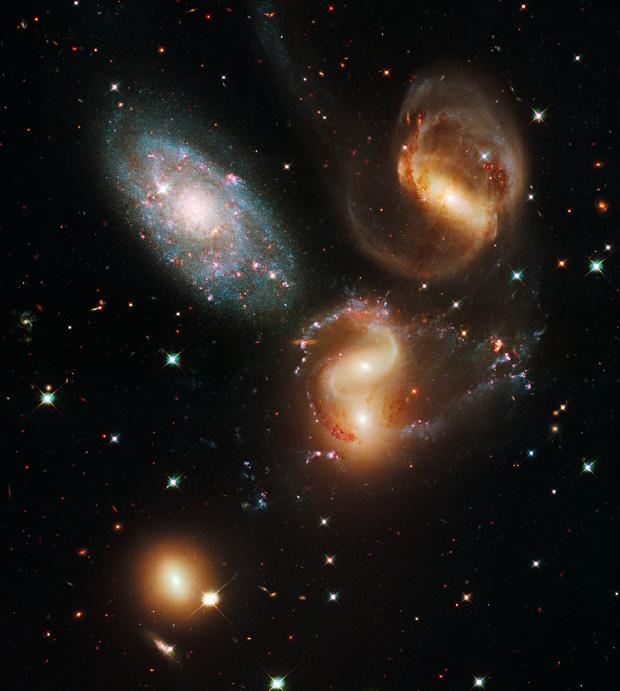
New beautiful images from the Hubble Space Telescope (HST) have been released recently, and they are, as always, a pleasure to behold. The HST was serviced in a mission by the Space Shuttle Atlantis crew last May, to replace some broken gyroscopes and drained batteries, and perform a number of additional important tasks that will allow operation to continue for many years to come.
Among the new installed instruments the new HST sports an improved wide field camera, WFC3, which promises a significant improvement of the quality of telescope's imaging capabilities.


 A Research Position In Neuromorphic Computing And Nanophotonics Open In Padova, Italy