Sometimes I forget that my time constraints force me to make a choice between writing on my blog and reading other people's, and so I start reading random stuff in physics blogs I am acquainted with, to then find myself listlessly drifting from a site to the next in a uninterrupted chain, often circular. It is a walk on the wild side, fortunately a typically short one.
A few days ago I produced a summary of a poster I presented at Physics in Collisions this week, which dealt with the searches for the Standard Model Higgs boson that CMS will undertake, and the results it can obtain in a scenario when a certain amount of data is collected at the full design energy of the LHC.
Here, instead, I wish to summarize the other poster I presented at the same venue, which concerned the combination of the most sensitive search channels, the sensitivity of CMS with a given amount of data, and the derating of its significance reach or observation power entailed by the running of LHC at a smaller-than-design beam energy. But I will do this only as a way of introducing a more interesting discussion, as you will see below.
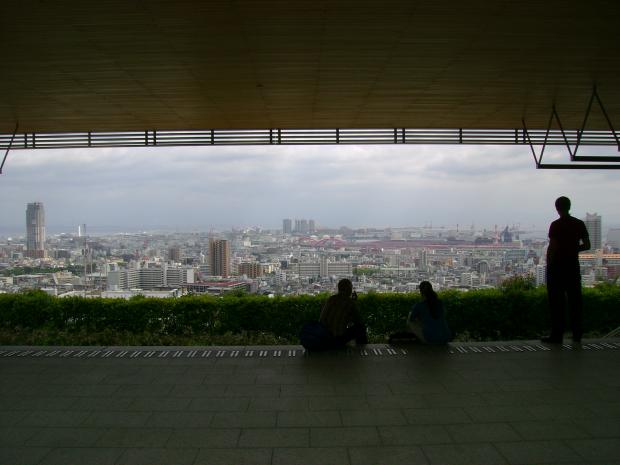
The Physics in Collisions conference in Kobe is over, and I am packing up. Tomorrow morning I will leave from KIX to FRA, and later FRA to VCE, hopefully making it home for dinner.
I learned a few interesting things on physics at the conference, and I hope I will share some of the highlights with you in a post tomorrow. But I also learned quite a few things about Japanese culture, which probably was a more valuable experience for me.
For now, I will just offer you the picture below, which portrays a rather overaged student in front of his two posters. Regulars of this site will not fail to notice that despite the suit (jacket not shown), I am wearing a Scientific Blogging shirt (blue logo near the pocket).
This morning I attended the first session of the Physics in Collisions conference in Kobe, which dealt with Electroweak Physics. The four talks I could listen to were all of very good quality, and I am not ashamed to say that I did learn a thing or two, despite this is a field of investigations on which I have focused for over a decade. Also, I decided that conferences featuring few, long talks are definitely better than ones which try to cram dozens of small contributions in tight schedules: at least, the session conveners are not required to play the watchdog and struggle to keep people within their allotted time, and post-talk questions and comments are actually encouraged rather than suppressed.
My most visible contribution to particle physics after my death might well one sad day turn out to be the sketching of W and Z boson identification diagrams I made in 1999 for a talk I was to attend at Moriond QCD. I must have been on a bright day when I set out to make those graphs, because everywhere I turn I see somebody using them -without paying any recognition to me of course. I
noticed the trend two years ago, and I get reminded of it periodically.
Today I wish to offer you the preview of a poster which I am going to show on September 1st in Kobe, Japan, at a session of the
29th edition of the Physics in Collisions conference.


 A Research Position In Neuromorphic Computing And Nanophotonics Open In Padova, Italy