As silly as it may look, I am going to start this post by publishing for the third time in a row the same figure. That is because I want to keep the promise I made earlier that I would explain in terms as simple as possible (although not simpler) the details hidden behind the coloured curves and functions pictured there. I will also take this chance to come down a little from the level of technicality of the recent posts: after all, this blog is supposedly for everybody, and not just for Ph.D. students and recipients.

Simos beach is one of the best beaches of Greece, and arguably of the whole European continent. It is located at the southern tip of the small island of Elafonissos, a four-mile-wide rock dangling off the eastern of the three fingers shaping the Peloponnese. I chose this place for three weeks of sun, snorkeling, and rest with my family; and to rearrange my thoughts in view of September, when several interesting occupations await me: a conference in Japan, a couple of articles to produce, a course of Subnuclear Physics to hold.
Yesterday I posted a short article whose main purpose was to show a figure I had received from Sven Heinemeyer, a phenomenologist who specializes in the study of Minimal Supersymmetric extensions of the Standard Model (MSSM).
Besides predicting a mirror copy of Standard Model (SM) particles, MSSM models are characterized by containing not just one, but five distinct Higgs bosons; over much of the space of possible parameters of these theories, one of the five Higgs bosons is quite similar to the one and only SM Higgs, so that one can discuss the SM Higgs and the lightest neutral scalar of the MSSM together without generating confusion.
...waiting for a piece I will post tomorrow, to stimulate your curiosity -and allow me to travel from Venice to Patras by ship, with no internet connection.
The subject is not only the Higgs mass, but the top quark mass. Which top mass ? The "pole" mass -the real part of the pole in the perturbative top-quark propagator. Have I lost you ? Ok, do not worry -definitions are for theorists. Let us just say that the top quark, being a complicated coloured object which thus cannot live free of the influence of strong interactions,
is measurable at a hadron collider like the Tevatron only within uncertainties of the order of a constant called "Lambda QCD", which is of the order of 200 MeV.
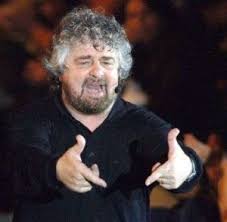
Beppe Grillo, one of the most successful bloggers in the world (last time I checked
his blog was number 11 in the world by traffic) descends in Italy's confusing political arena.
A new public document has been made available on the CMS public web page yesterday morning. It reports on a study of the reach of the CMS detector, with data collectable in 2010, for a signal of large extra dimensions, using the very distinctive signature of a high-energy jet recoiling against -well, recoiling against nothing; or better, something which left our world and entered into another dimension of space.


 A Research Position In Neuromorphic Computing And Nanophotonics Open In Padova, Italy










