Fake Banner
A Research Position In Neuromorphic Computing And Nanophotonics Open In Padova, Italy

Five days are left to apply to a 2-year research position at INFN-Padova, to work in the context...

Apply For The USERN Prize, Win Cash, And Get A Keynote Talk In Astana

Nowadays it has become exceedingly hard to distinguish legitimate academic endeavours from scam...

A Record Of Past Activities

Every now and then, for one reason or another, an academic will have to update one's own CV. This...

Surviving Queues: 2 - On The Road

[For the first part of this two-part post, see here]...

User picture.
picture for Hank Campbellpicture for Heidi Hendersonpicture for Patrick Lockerbypicture for Bente Lilja Byepicture for Sascha Vongehrpicture for Johannes Koelman
Tommaso DorigoRSS Feed of this column.

Tommaso Dorigo is an experimental particle physicist, who works for the INFN at the University of Padova, and collaborates with a number of exxperiments in physics and astrophysics, including the... Read More »

Blogroll
Interference is a fascinating effect, and one which can be observed in a wide variety of physical systems - any system that involves the propagation of waves from different sources. We can observe interference between waves in the sea or in a lake, or even in our bathtub; we can hear the effect of interference between sound waves; or we can observe the fascinating patterns created by interference effects in light propagation. In addition to all that, we observe interference between the amplitudes of quantum phenomena by studying particle physics processes.
A bit over a half into my course of particle physics for Masters students in Statistical Sciences I usually find myself describing the CMS detector in some detail, and that is what happened last week.
 
The course

My course has a duration of 64 hours, and is structured in four parts. In the first part, which usually takes about 24 hours to complete, I go over the most relevant part of 20th Century physics. We start from the old quantum theory and then we look at special relativity, the fundaments of quantum mechanics, the theory of scattering, the study of hadrons and the symmetries that lead to the quark model, to finish with the Higgs mechanism and the Standard Model. 
Old timers of this blog will recall that I am an avid stone collector. In fact, of all experimental sciences I am fond of (Physics, Astronomy, Geology above others) Geology is the one that fascinated me first, as a six or seven year old child. We are talking about almost fifty years ago, when newspaper stands in Italy used to sell small packets containing pictures of soccer players (they were not even adhesive back then: you had to use your own glue to attach them in the proper place within collection albums which were sold separately) . Kids collected those "figurine", and exchanged them with their peer after school hours (or even during school hours). Other collections offered were ones of minerals, fossils, stickers, etcetera.
Do you remember the DAMA-LIBRA experiment? It is a underground detector made of sodium iodide crystals buried under the rock of the Gran Sasso mountain in central Italy, which took data for over a decade in the search of the elusive signal that slowly-moving, massive particles would produce when they bounced off atoms of the active detector material. 
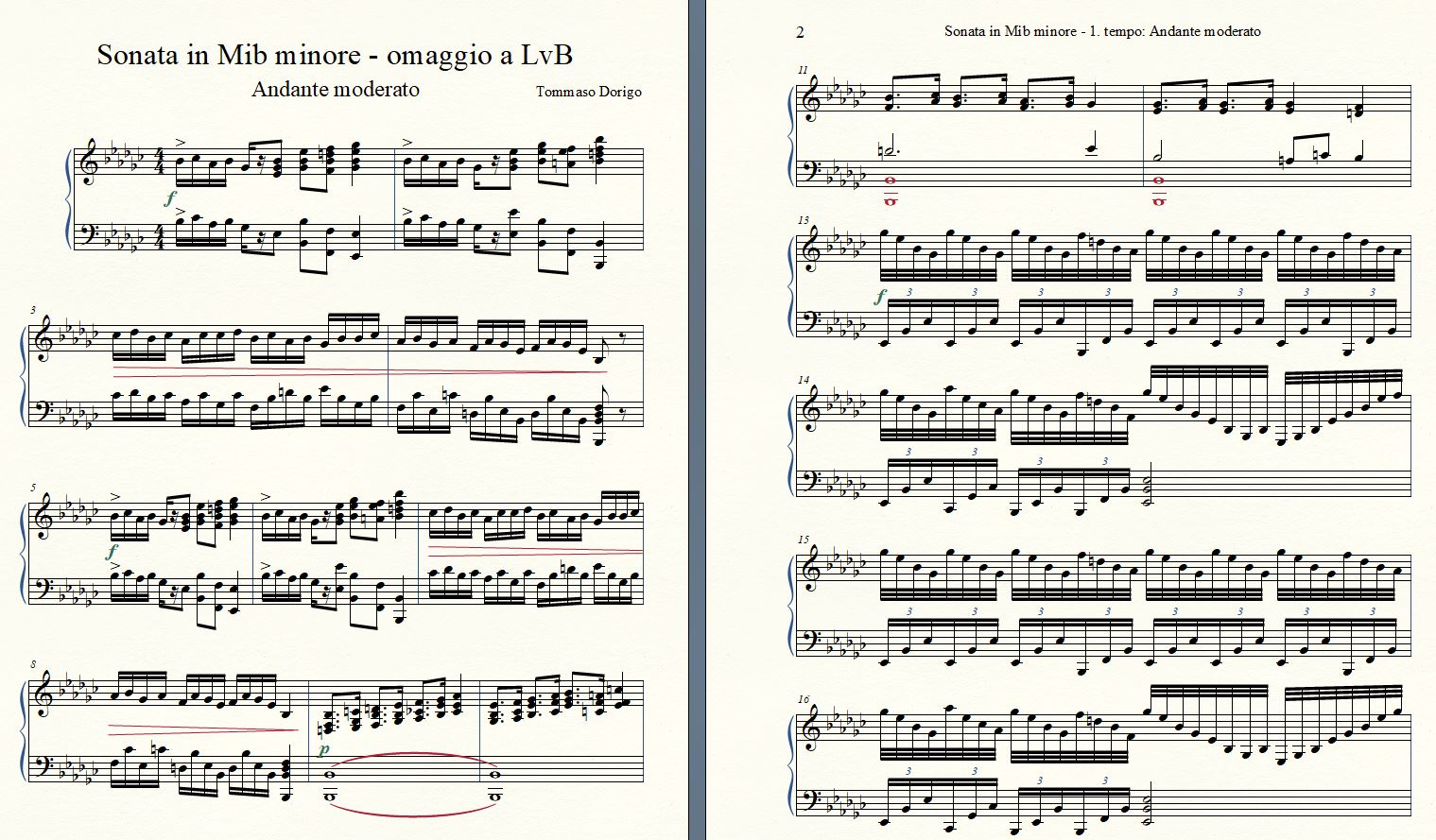
A long time ago, before starting the studies which would lead to a career as a particle physicist, I studied music. After getting a degree as a master in Antique Instruments, I studied composition for four years. But I was not particularly well versed in that tough discipline, and I did the right thing in dropping out. I was 18, and I decided that Science was going to be my job, not music. But I kept an interest in music and I continued - a bit erratically - to study the piano.
The title of this post is the same of a non-technical presentation I gave today at the 2021 USERN Congress. The USERN (Universal Scientific and Education Research Network) is an organization fostering the diffusion of science, which provides prizes to researchers who distinguish themselves for their scientific advancements, and strives for science across borders. As a member of its advisory board I was invited to give a presentation in the first session of the virtual congress, which deals with human versus artificial intelligence.