Fake Banner
The Strange Case Of The Monotonous Running Average

These days I am putting the finishing touches on a hybrid algorithm that optimizes a system (a...

Turning 60

Strange how time goes by. And strange I would say that, since I know time does not flow, it is...

On The Illusion Of Time And The Strange Economy Of Existence

I recently listened again to Richard Feynman explaining why the flowing of time is probably an...

RIP - Hans Jensen

Today I was saddened to hear of the passing of Hans Jensen, a physicist and former colleague in...

User picture.
picture for Hank Campbellpicture for Patrick Lockerbypicture for Heidi Hendersonpicture for Bente Lilja Byepicture for Sascha Vongehrpicture for Johannes Koelman
Tommaso DorigoRSS Feed of this column.

Tommaso Dorigo is an experimental particle physicist, who works for the INFN at the University of Padova, and collaborates with the CMS and the SWGO experiments. He is the president of the Read More »

Blogroll
Creativity is one of the things that really makes us human - in fact, a number of human activities which we identify as specific of our nature, and which we believe could hardly be mimicked by artificial intelligence, rely on our inventiveness and capability of creating new objects, images, concepts, methods, or finding new purpose in old tools. Art, among all of these activities, is the quintessential result of our willful act of creating beauty - or even ugliness, if that is considered a worthy pursuit by the artist.
 
Although unconventional, the ideas of Gregory Ryskin on vacuum energy sound interesting to me, so I invited him to share them with you in this guest post. 

Ryskin's physics journey began with fluid dynamics, first in Russia, then in the US, at Caltech. Later, the flow of complex fluids, such as polymer solutions or liquid crystals. Then Brownian motion and Markov processes. In 2000, he became interested in geology and geophysics, particularly in the causes of mass extinctions and the origin of the Earth’s magnetic field. His current research is focused on cosmology. His academic home is Northwestern University, Department of Chemical and Biological Engineering.

The text below is Gregory's.

---
If you are a follower of Science20, you probably know that  I have always been very liberal in this column about what deserves to be mentioned as a possible new idea in Physics. I even invited some "non-conventional", independent scientists to write about their own ideas and pet theories here, in many occasions. I do not think this collides with the main purpose of this blog, which is to discuss real science and do some proper outreach and dissemination. In fact, I find it instructive and enlightening on what really Science is.

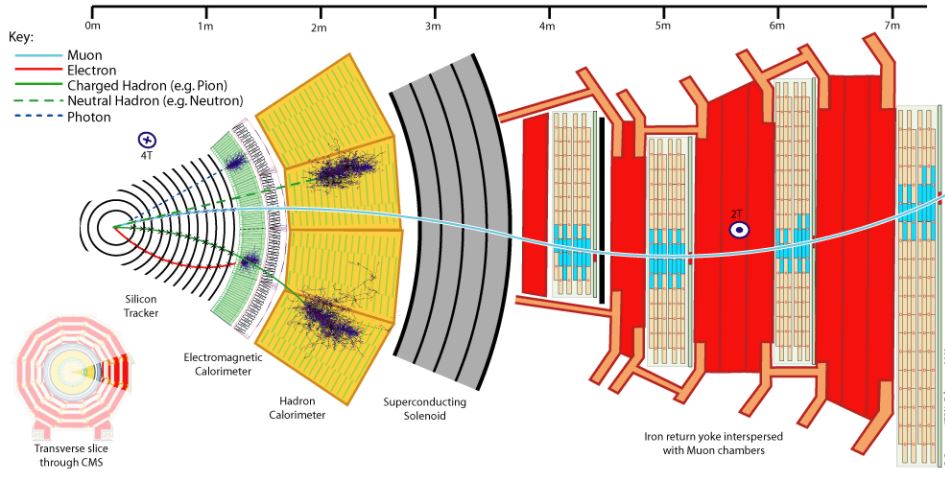
The title of this post is no news for particle physicists - particle detectors are complex instruments and they work by interpreting the result of stochastic phenomena taking place when radiation interacts with the matter of which detectors are built, and it looks only natural that deep learning algorithms can help improve our measurements in such a complex environment.

However, in this post I will give an example of something qualitatively different to providing an improvement of a measurement: one where a deep convolutional network model may extract information that we were simply incapable of making sense of. This means that the algorithm allows us to employ our detector in a new way.
The neutron, discovered in 1932 by Chadwick, is a fascinating particle whose existence allows for the stability of heavy nuclei and a wealth of atoms of different properties. Without neutrons, Hydrogen would be the only stable element: protons cannot be brought together and bound in a stable system, so e.g. Helium-2 (an atom made of two protons with two electrons) is very short-lived, as are atoms with more protons and no neutrons. So our Universe would be a very dull place.