Another year just started, and this is as good a time as any to line up a few wishes. Not a bucket list, nor a "will do" set of destined-to-fail propositions. It is painful to have to reckon with the failure of our strength of will, so I'd say it is better to avoid that. Rather, it is a good exercise to put together a list of things that we would like to happen, and over which we have little or no control: it is much safer as we won't feel guilty if these wishes do not come true.
A long while ago (my gosh, 13 years!!) I wrote on this site a
two-
post piece titled "
Five Tips for Particle Physics Ph.D. Wannabes". At 43 years of age, I felt confident that I could look back to some experience gathered while being a Ph.D. myself, and later on while advising others. I believe the few advices I put together there are still mostly valid today. Have a look if you are a grad student in search for tips!
The title of this post is not of my making - it is something you may read in a list of recent ATLAS results, in
one of the otherwise dry and business-like web pages of the experiment:

Don't get me wrong, I am all for a bit of personality in such web outlets, so the above rather than criticism should be seen as an exhortation to my CMS colleagues (as CMS the experiment I am a member of) to mimic its competitor. I look forward to a listing of "CMS wondrous new results on Higgs physics", e.g. ...
That's the title of a short article I just published (it is
online here, but beware - for now you need to access from an institution that can access the journal contents), on Nuclear Instruments and Methods - a renowned journal for particle physics and nuclear physics instrumentation. The contents are nothing very new, in the sense that they are little more than a summary of things that the MODE collaboration published last March here. But for the distracted among you, I will summarize the summary below.
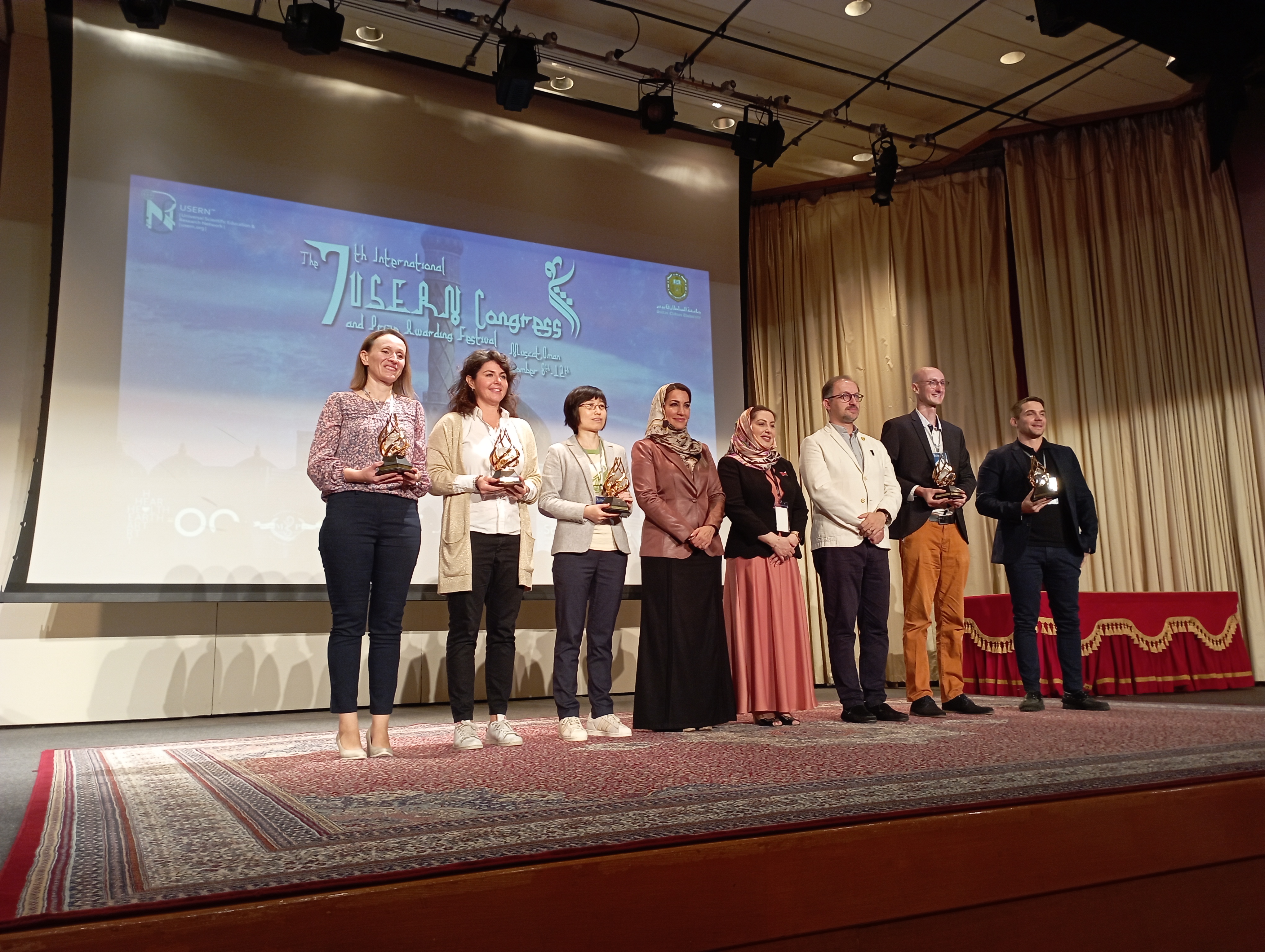
Humanity progresses thanks to the diffusion and sharing of human knowledge. In particular, scientific progress is brought forth by the sharing of ideas, measurements and experimental results among scientists, and the distribution of excellent education. We have grown very good at doing that, but can we improve the sharing of knowledge for the common good?
The answer is certainly yes, as the interconnection of the scientific community and the interdisciplinarity of its efforts are hampered by borders, language barriers, cultural differences, political influences, religious hindrances, education system challenges, and also by different conventions, policies, metrics in the different areas of scientific research.
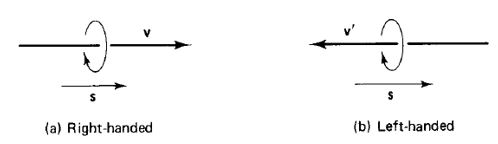
At about this time of the year I find myself teaching my students about the construction of V-A theory, which is a milestone in the construction of the Standard Model of particle physics. And in so doing I rejoice about having a chance to tell them the details of one of the most brilliant experiments of the twentieth century, one performed in 1957 by Maurice Goldhaber with his colleagues Grodzins and Sunjar, and which has become a cornerstone of the physics of weak interactions and of particle physics in general.


 A Research Position In Neuromorphic Computing And Nanophotonics Open In Padova, Italy