The sanitary emergency presently affecting most countries across the World is highlighting the duties that each of us, as a member of a collectivity of individuals who share commodities, services and infrastructure, is called at times to attend to. In a well-functioning society paying taxes should not be enough to earn the right to be a citizen. Indeed, the "social contract" also demands us to, e.g., abide to laws.
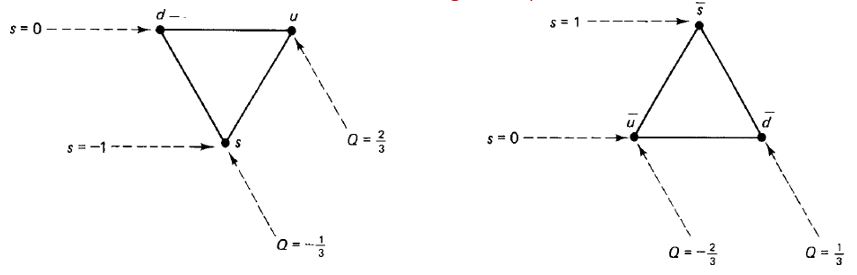
Every time I lecture my students about the static quark model I find that the construction of hadrons from their constituents is really entertaining. Probably I have more fun than my students as I explain the details, but today you get to be the judge - I am going to explain it here, and test your patience and skills as a matter builder.
Hadrons are composite particles made of quarks. The word "hadron" comes from ancient Greek αδρος, which means "thick, bulky". The two hadrons we know best are protons and neutrons, which make up atomic nuclei; but there exist literally hundreds more, which are unstable and decay very quickly after they are created, in subnuclear reactions we can produce using particle accelerators.
For some reason today I remembered that 11 years ago (wow time flies) I wrote a two-parts piece on advices for PhD students doing a thesis in experimental particle physics. As I checked it out, I found that I mostly share the views I had back then (TBH that's not necessarily a good thing - consistency requires you to be as ignorant as you were earlier on). Since I think that stuff I posted over 10 years ago are otherwise lost in oblivion and not picked up by generic google searches, I decided it is time to recycle that text - here it is below, unamended but collated into a single longish article. Enjoy!
Particle Physics deals with the study of the elementary constituents of matter, and the interactions that they withstand. When non-insiders hear of elementary particles and the experiments that study them, probably their mind goes to experiments at the Large Hadron Collider, CERN's giant accelerator of protons and heavy ions that produced the collisions used by the ATLAS and CMS experiments in 2012 to discover the Higgs boson. The association with LHC and the Higgs particle is very likely because that discovery took the media by storm when it was announced, and rightly so.
W bosons, what are they? To answer this question, let me first tell you that our world is made of matter held together by forces. If you look deep within, you will realize that matter is essentially constituted by "fermions": quarks and leptons, particles that possess a half-integer unit of spin, in a certain meaningful system of measurement units. Forces, on the other hand, are the result of fermions exchanging different particles called "bosons", particles that possess integer units of spin.


 Living At The Polar Circle
 Conferences Good And Bad, In A Profit-Driven Society
 USERN: 10 Years Of Non-Profit Action Supporting Science Education And Research
 Baby Steps In The Reinforcement Learning World