Fake Banner
A Chess Study Requiring Backpropagation

The following position is a win for white. But how?It seems like white is able to grab a knight...
Co-Design Of Scientific Experiments

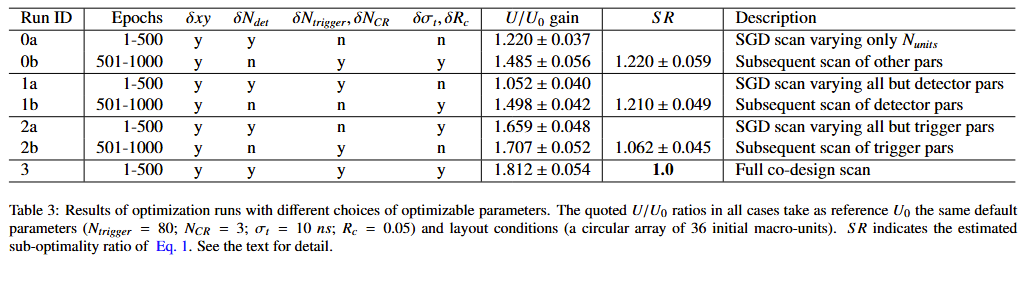
Next Monday, or Tuesday at the latest, you will find a new bulky paper in the arXiv. Titled "On...
Travel With Two Infants

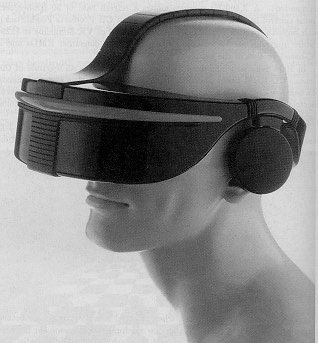
The other day I traveled with Kalliopi and our two newborns to Padova from Lulea. After six full...
A Nice Little Combination

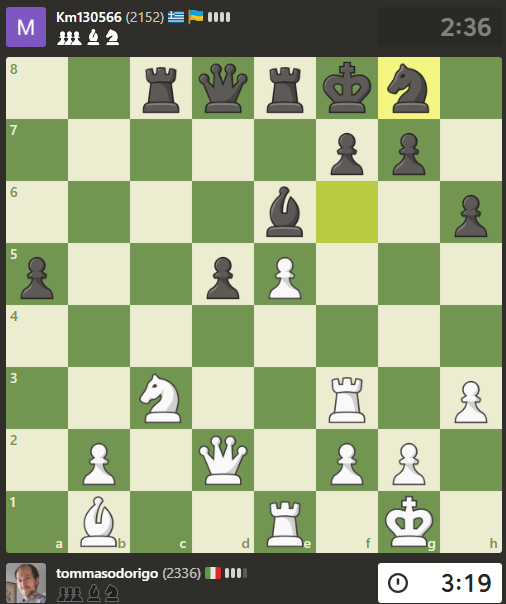
Although I have long retired from serious chess tournaments (they take too much time, a luxury...

User picture.
picture for Hank Campbellpicture for Patrick Lockerbypicture for Heidi Hendersonpicture for Bente Lilja Byepicture for Sascha Vongehrpicture for Johannes Koelman
Tommaso DorigoRSS Feed of this column.

Tommaso Dorigo is an experimental particle physicist, who works for the INFN at the University of Padova, and collaborates with the CMS and the SWGO experiments. He is the president of the Read More »

Blogroll
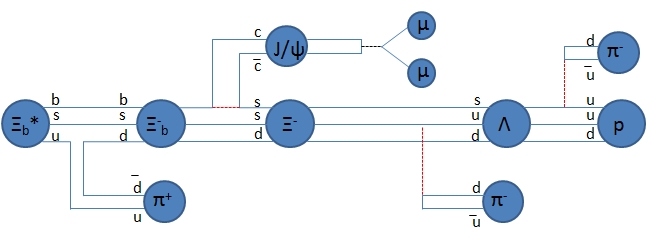
No, unfortunately not yet the discovery of the century. Still, the new particle found by CMS in its 2011 dataset is a very important piece of the puzzle of low-energy spectroscopy. Here "low" should be taken with a pinch of salt: the new particle, an excited state of the Ξ_b series, has a mass only slightly lower than six GeV, and is thus "heavy" if compared to most other hadrons.
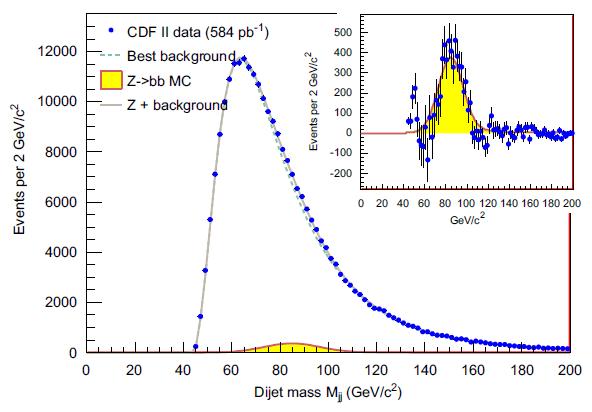
When I started a career in particle physics, joining the CDF experiment at the Fermilab Tevatron proton-antiproton collider about two decades ago, the search for a particle decay signal into hadronic jets was not something one would undertake lightly at a hadron collider: jets are omnipresent when you collide hadrons at high energy, so they constitute a irreducible background. Just as a detective looking for a blonde thief with swedish accent in Sweden, you would be close to clueless.
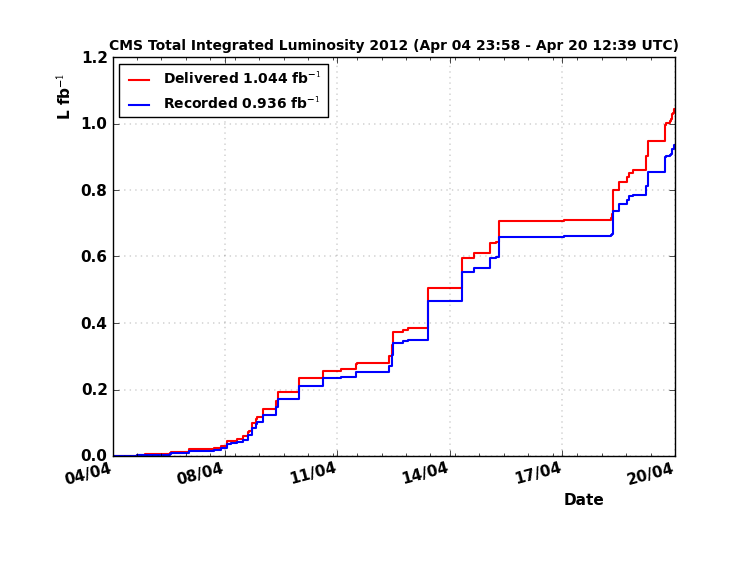
The LHC is ramping up in instantaneous luminosity according to schedules, and has just surpassed the measure of one inverse femtobarn of collisions delivered to the CMS experiment, as shown in the picture below.

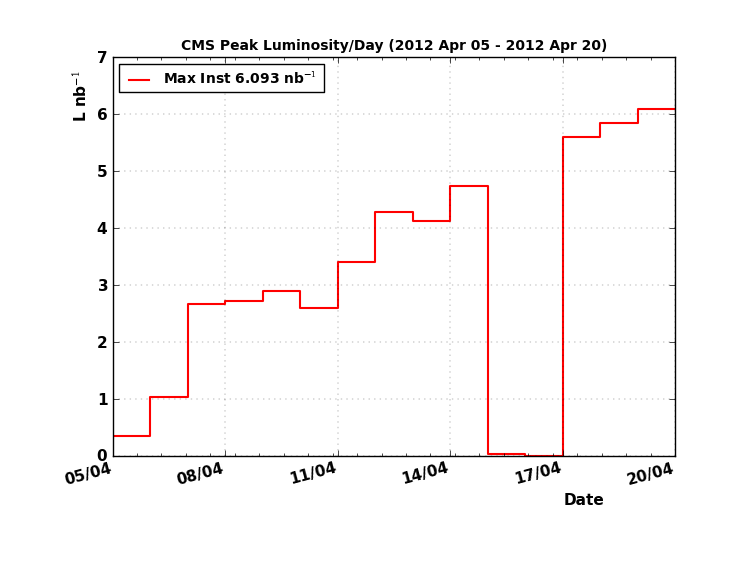
The peak instantaneous luminosity shown below exhibits a nice smooth increase:

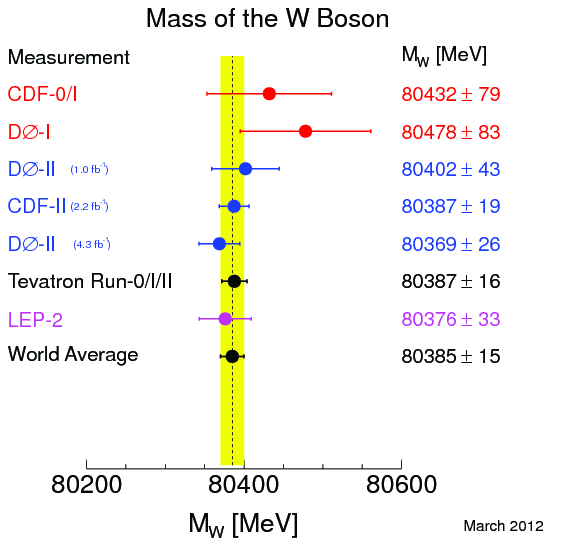
A couple of weeks ago the CDF and DZERO experiments have produced a combination of their measurements of the W boson mass. Besides two older determinations of this fundamental parameter of the Standard Model, the new 2.2/fb measurement by CDF and the 4.3/fb measurement by DZERO have been averaged together, accounting for correlated systematics. [x/fb is a shorthand for the amount of collisions from which the W boson datasets have been extracted by the experiments: 1/fb is about 80 trillion proton-antiproton collisions.]
I am just back from a vacation to Greece, where last Sunday was orthodox Easter. My fiancee Kalliopi is Greek, and it was about time for me for me to experience a bit of Greek customs. So we flew to Athens, and then headed to Salamina, where I had a lot of fun the Greek way in the company of a very cheerful dozen of relatives and friends.

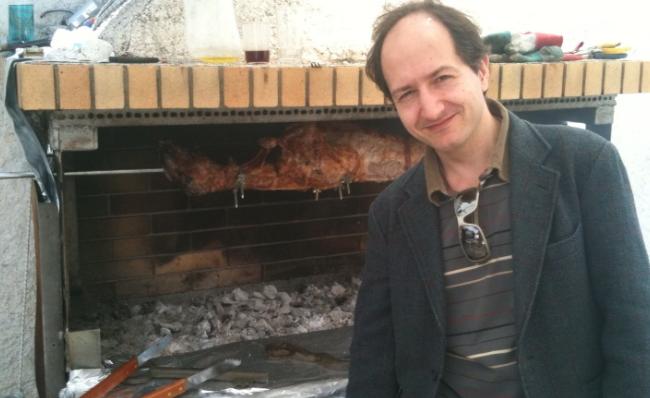
Among the obligatory ingredients of a Greek Easter is the roasted lamb. It is cooked all in one piece, on a huge skewer, by rolling it for hours over hot coals. Its appearance is a bit disturbing at first, that is until the smell start to turn from that of a corpse to that of delicious food.  Below you can see me in front of the thing as it was already in the good-smelling and edible-looking phase.
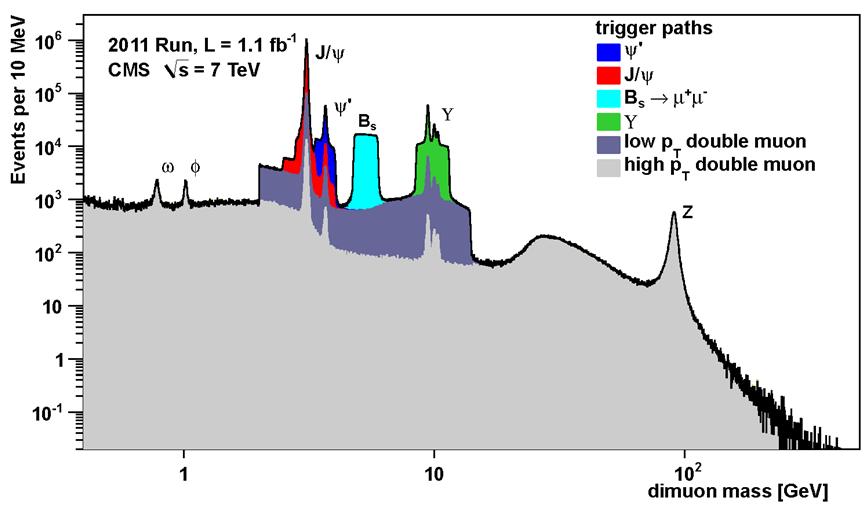
For once I allow myself some self-advertising... I just published on the Cornell arXiv the preprint of a proceedings paper I wrote for the Bormio 2012 conference on Nuclear Physics, where I presented the most recent results from the CMS experiment in a review talk. The paper is titled "Recent Results of the CMS Experiment".

The paper is 33-pages long, and thus configures as a general review of the results that CMS produced from the analysis of data collected during 2011, the 5 inverse femtobarns of proton-proton collisions, which among other things granted a first feeble but trustworthy evidence of a Higgs boson when read together with similar ATLAS results.