Fake Banner
A Chess Study Requiring Backpropagation

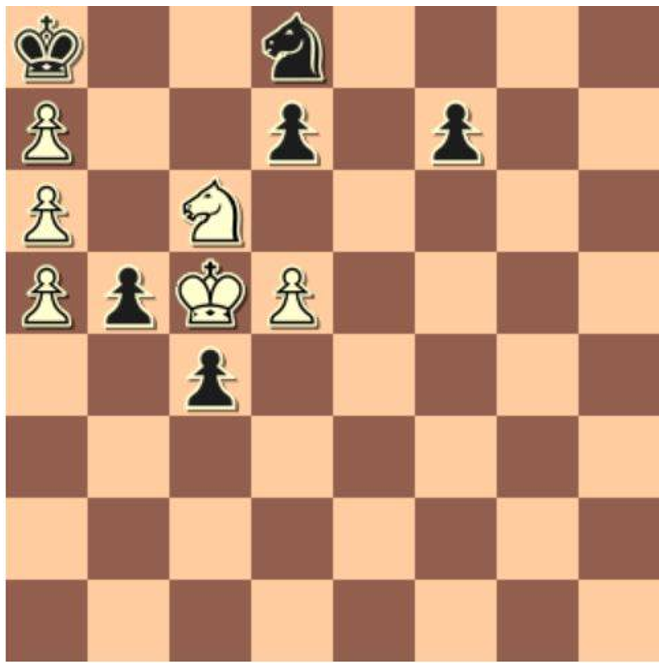
The following position is a win for white. But how?It seems like white is able to grab a knight...
Co-Design Of Scientific Experiments

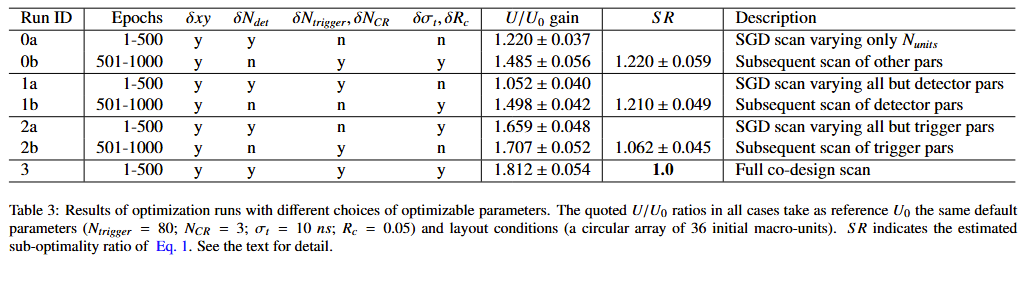
Next Monday, or Tuesday at the latest, you will find a new bulky paper in the arXiv. Titled "On...

Travel With Two Infants

The other day I traveled with Kalliopi and our two newborns to Padova from Lulea. After six full...
A Nice Little Combination

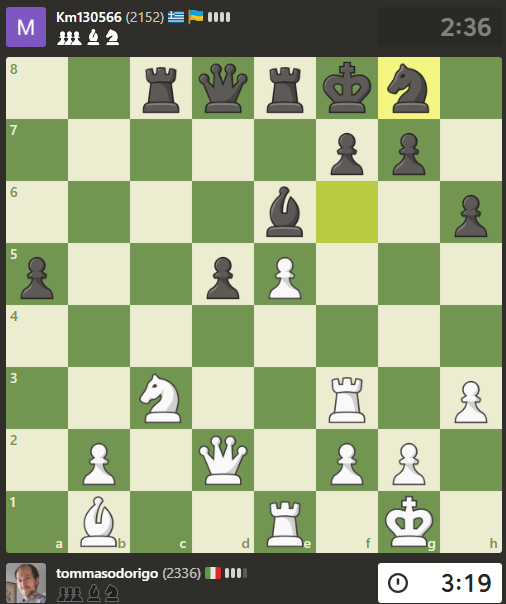
Although I have long retired from serious chess tournaments (they take too much time, a luxury...

User picture.
picture for Hank Campbellpicture for Patrick Lockerbypicture for Heidi Hendersonpicture for Bente Lilja Byepicture for Sascha Vongehrpicture for Johannes Koelman
Tommaso DorigoRSS Feed of this column.

Tommaso Dorigo is an experimental particle physicist, who works for the INFN at the University of Padova, and collaborates with the CMS and the SWGO experiments. He is the president of the Read More »

Blogroll
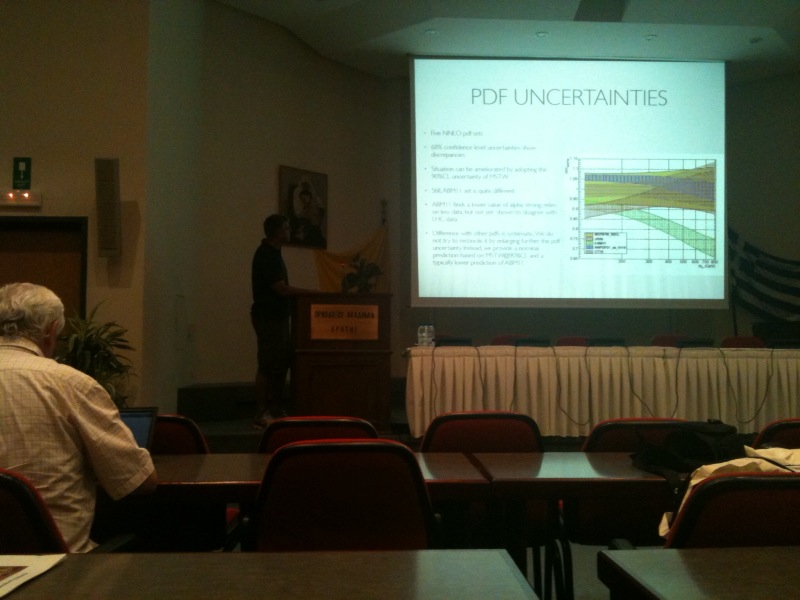
The International Conference on New Frontiers in Physics (ICFP) 2012 started today with a rich program of experimental and theory talks. I should be swimming in the Cretan sea in front of the nice conference venue (which is 40 meters away from the water), but my sense of duty forces me to give you some impressions of the presentations I heard.
The island of Crete, in the middle of the Mediterranean sea, is home to ICFP 2012, a conference in high-energy physics. I arrived yesterday night and this morning I woke up with a gorgeous view of the sun rising over a blue sea.


(The picture shows a beach not far from here, which I'll visit on Wednesday. It is called "Balos beach" and it is a wonderful place).
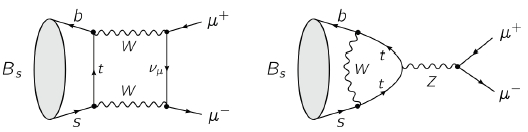
The CERN average of searches for rare B decays to muon pairs has been shown yesterday in a talk given by Mitesh Patel at the "Physics at the LHC" conference, which is being held in Vancouver (BC) this week. And the results are not very encouraging for supporters of Supersymmetry: the data is compatible with a Standard Model signal, but there is almost no space left for additional contributions due to the exchange of virtual SUSY particles in the loops producing the decays.
The winner picture of the Venus transit must be the one below, whose original version can be found here. Thanks Bente Lilya Bye for posting the link on her Facebook page!


The picture was taken by Hinode, a joint JAXA-NASA mission to study the Sun's magnetism in and around sunspots.
Well, so as predicted Venus passed over the disk of our Sun yesterday (this morning, if you live in Europe), and it produced quite a show, as many pictures and videos available around testify. To make the view more pleasing, our Sun was showing a discrete amount of solar spots, betraying the fact that we are approaching Solar Max (there is a 11-year cycle of solar activity, which manifests itself visually with black spots appearing on the disk, and on the Earth with auroras and electromagnetic disturbances).

In case you want a quick link to a nice slideshow showing Venus crossing the Sun's disk in a set of some thirty images, please visit this flicker site.
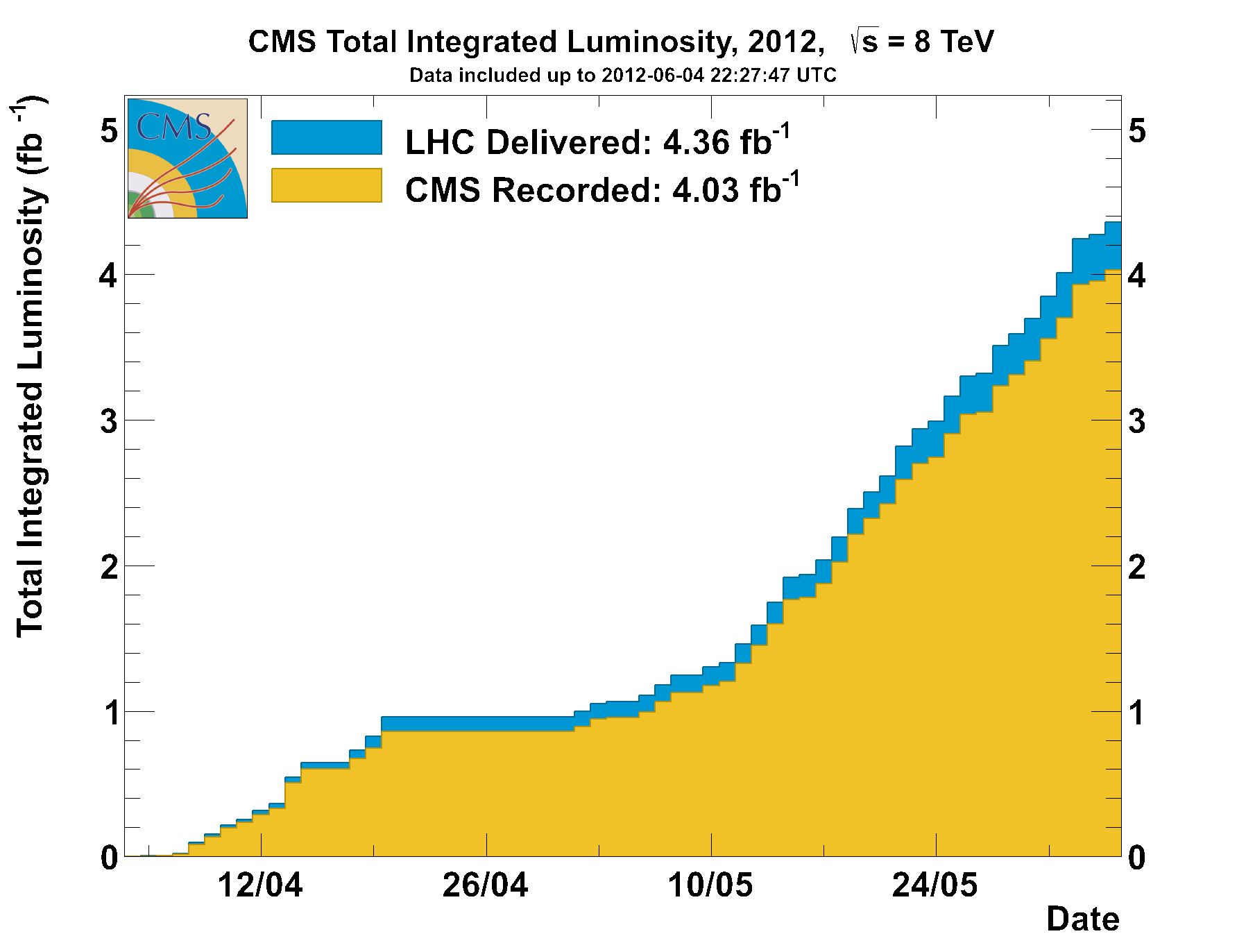
The LHC collider has been producing proton-proton collisions at a centre-of-mass energy of 8 TeV for two months now, and the integrated luminosity collected by the CMS experiment has surpassed the mark of 4 inverse femtobarns (see figure below). That's already about 80% of the total bounty of 2011!