Fake Banner
Turning 60

Strange how time goes by. And strange I would say that, since I know time does not flow, it is...

On The Illusion Of Time And The Strange Economy Of Existence

I recently listened again to Richard Feynman explaining why the flowing of time is probably an...

RIP - Hans Jensen

Today I was saddened to hear of the passing of Hans Jensen, a physicist and former colleague in...

2026 Plans

This year opened in slow motion for me, at least work-wise. I have been on parental leave since...

User picture.
picture for Hank Campbellpicture for Patrick Lockerbypicture for Heidi Hendersonpicture for Bente Lilja Byepicture for Sascha Vongehrpicture for Johannes Koelman
Tommaso DorigoRSS Feed of this column.

Tommaso Dorigo is an experimental particle physicist, who works for the INFN at the University of Padova, and collaborates with the CMS and the SWGO experiments. He is the president of the Read More »

Blogroll
In my short summary of analyses recently published by CMS, yesterday I left out one which had not yet been released. It is the search for the "golden channel" of Higgs decay, the one which motivated the construction of detectors with large acceptance to energetic leptons: the decay to two Z bosons, with a subsequent decay of the Z's to two charged leptons each.
An orgy of new results has started. Let me just show a few of them concerning Higgs searches in CMS - I am on vacation after all, and I have little time left to comment these interesting new papers and plots after all the sunbathing and restaurants.

Let us start with the Higgs search in the diphoton decay mode by CMS (paper here). With 1.09 inverse femtobarns of data, CMS has a pretty good reach even to this very rare decay mode of the Higgs boson. Let me remind you that only a handful every thousand Higgs particles decay into two photons, in the most favourable circumstances.
Impressive. If you had been seeking for top quarks in 4-inverse-picobarns datasets since 1992 as I have, and then rejoiced at the 7-event signal from which CDF extracted in 1994 mass and cross section of the long-sought sixth quark, you would now also be looking for adjectives upon having a look at the figures in the new CMS paper, which uses over one inverse femtobarn of proton-proton collisions to measure the tiny asymmetric kinematics of top quark pairs produced at the LHC.
This afternoon (2.30 PM Chicago time) Pat Lukens, an old-timer of the CDF experiment, will give a "wine and cheese" seminar at Fermilab on the new observation of a heavy baryon, of the family of baryons containing bottom quarks, which was still at large.

The new particle, called "Xi_b^0", fits a hole in the group representation graph of ground-state baryons with J=1/2. You can see it in the graph on the right. Of all states in the middle level (ones containing one bottom quark) only the Xi_b^0 was still missing. By the way: none of the baryons of the top level have yet been observed.
Today I casually ran into a very nice figure which is perfect for an entry as "guess the plot", both because of its mysterious appearance, and because of the interesting physics it hides. It is a two-dimensional "surface" and its shape should tell you something. For the moment, I will just say it is something which has to do with both particle physics and astrophysics, and that it is quite cool, being a new way of looking at something we know well.


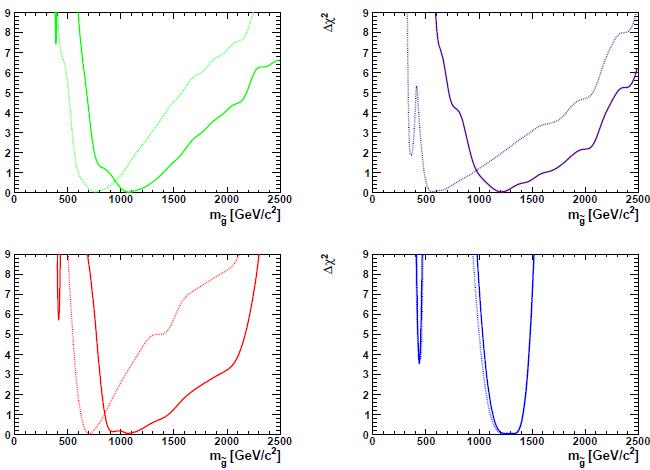
Blogging from the whereabouts of one of the most beautiful places of the Mediterranean, Balos Beach (see picture), I wish to draw your attention today to one fun search that CMS produced on data collected in 2010: the one for gluinos in events with six jets.