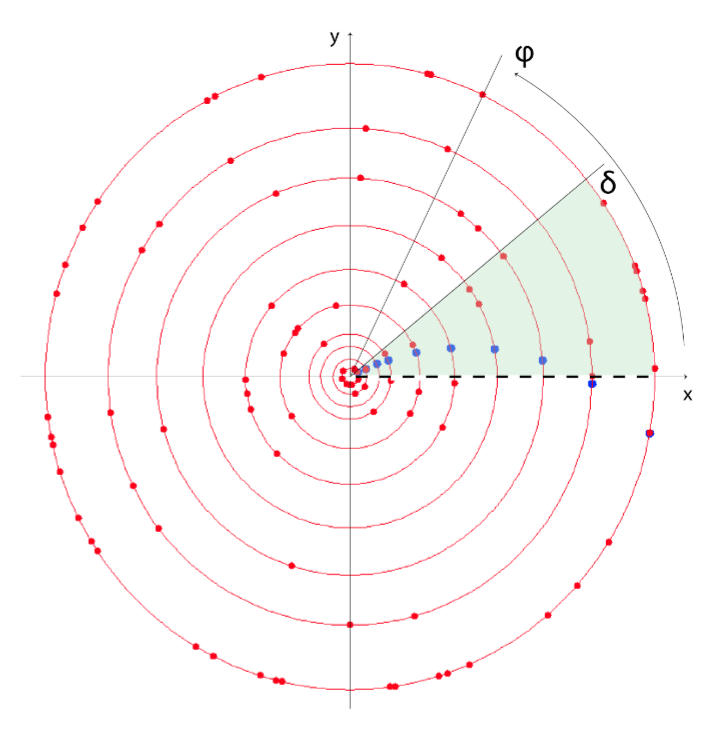
As part of the celebrations for 20 years of blogging, I am re-posting articles that in some way were notable for the history of the blog. This time I want to (re)-submit to you four pieces I wrote to explain the unexplainable: the very complicated analysis performed by a group of physicists within the CDF experiment, which led them to claim that there was a subtle new physics process hidden in the data collected in Run 2. There would be a lot to tell about that whole story, but suffices to say here that the signal never got confirmed by independent analyses and by DZERO, the competing experiment at the Tevatron. As mesmerizing and striking the CDF were, they were finally archived as some intrinsic incapability of the experiment to make perfect sense of their muon detector signals.
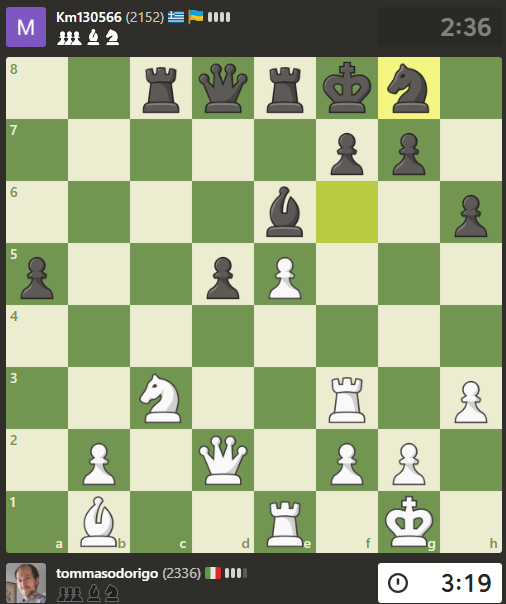
During Christmas holidays I tend to indulge in online chess playing a bit too much, wasting several hours a day that could be used to get back on track with the gazillion research projects I am currently trying to keep pushing. But at times it gives me pleasure, when I conceive some good tactical sequence.
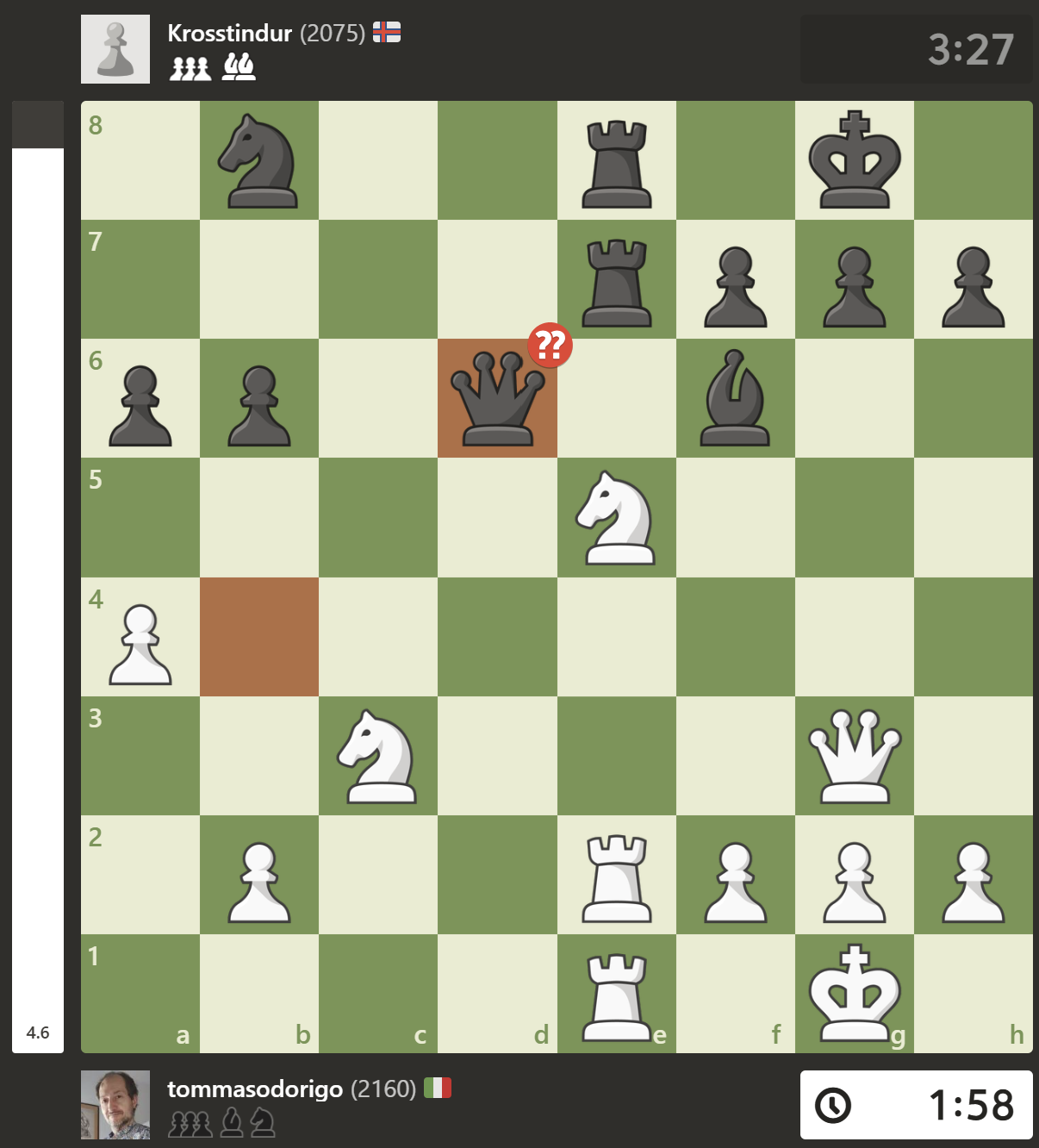
Take the position below, from a 5' game on chess.com today. White has obtained a winning position, but can you win it with the clock ticking? (I have less than two minutes left for the rest of the game...)
As part of my self-celebrations for having survived 20 years of blogging (the anniversary was a few days ago, see my previous post), I am re-posting a few representative, old articles I wrote in my column over the years. The selection will not be representative of the material I covered over all this time - that would be too tall an order. Rather, I will hand-pick a few pieces just to make a point or two about their content.
Twenty years ago today I got access for the first time to the interface that allowed me to publish blog posts for the Quantum Diaries web site, a science outreach endeavor that involved some 12 (then 15, then 25 or so IIRC) researchers around the world. A week before I had been contacted by the Fermilab outreach team, who were setting the thing up, and at that time I did not even know what a blog was!
At the IV Workshop in Valencia a student from my group, Emanuele Coradin, presented the results of a novel algorithm for the identification of charged particles in a silicon tracker. The novelty is due to the use of neuromorphic computing, which works by encoding detector hits in the time of arrival of current impulses at neurons, and by letting neurons "learn" the true patterns of hits produced by charged particles from the noise due to random hits.


 Travel With Two Infants
 A Nice Little Combination
 The Strange Case Of The Monotonous Running Average
 Turning 60