Banner
    CO2 As A Greenhouse Gas
    By Patrick Lockerby | April 14th 2010 01:44 PM | 18 comments | Print | E-mail | Track Comments
    About Patrick

    Retired engineer, 60+ years young. Computer builder and programmer. Linguist specialising in language acquisition and computational linguistics....

    View Patrick's Profile
    CO2 As A Greenhouse Gas


    A greenhouse keeps an air volume warm mainly by enclosing it as fixed volume of air.  From that perspective, the term 'greenhouse gas' is a somewhat unfortunate choice of term.  But we seem to be stuck with it.

    Obsolete books and web site pages continue to describe the atmosphere in terms of 'well-mixed gases'.  That is counterfactual.  Gases entering the atmosphere from whatever source can take a very long time indeed to become well distributed even even within a single hemisphere.  Or even within a single atmospheric layer.

    Figures cited for CO2 such as 389 ppm are global average distributions.  This average figure is an artificial construct.  Any attempt to disprove the global warming effects of anthropogenic CO2 based on the tacit assumption that the ppm figure applies to a well-mixed gas is a fallacy of the average.

    The Fallacy Of The Average is based on the false notion that the effect of a thing averaged out is equivalent to the effect of any randomly chosen specific instance of the same thing.  Imagine taking the average annual precipitation for your country or state and having it all dumped on one town or city in a single day.

    Another example: the average point on our planet is under 4 kilometers of water.  See:
     Understanding Climate : #6 - Hypsography.

    Atmospheric CO2 is not well mixed


    Any instantaneous snapshot of the earth's atmosphere does not reveal an even distribution of well mixed gases.  Specific to this article: the amount of CO2 is averagely higher in the Northern than in the Southern Hemisphere as a result of the combustion of coal, oil, and natural gas.  Again, within either hemisphere, the CO2 is averagely higher within specific zones of latitude.

    The people who update the Keeling curve know this.   From what I read on the web, the majority of Keeling curve detractors are strangers to the concept of uneven distribution.
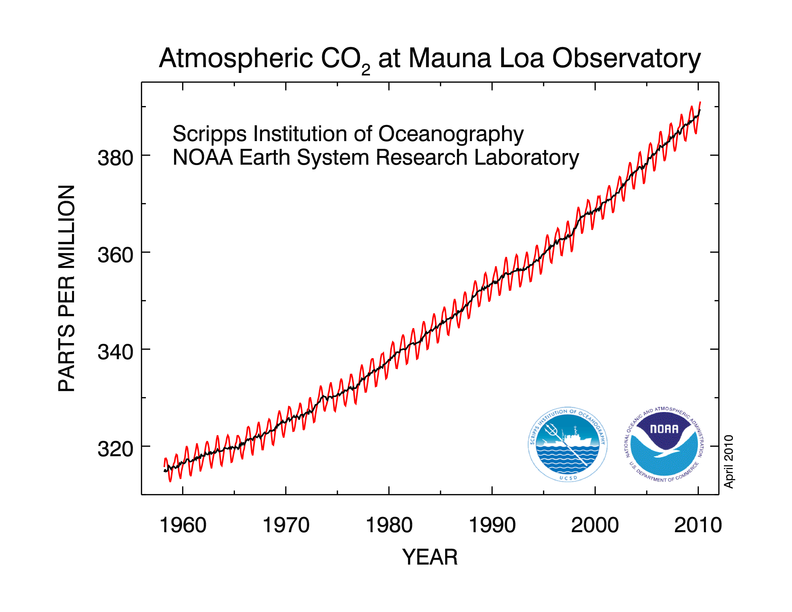


    The table shows annual mean carbon dioxide growth rates for Mauna Loa.

    The annual mean rate of growth of CO2 in a given year is the difference in concentration between the end of December and the start of January of that year. If used as an average for the globe, it would represent the sum of all CO2 added to, and removed from, the atmosphere during the year by human activities and by natural processes.
    ...
    The estimated uncertainty in the Mauna Loa annual mean growth rate is 0.11 ppm/yr.
    http://www.esrl.noaa.gov/gmd/ccgg/trends/#mlo_full
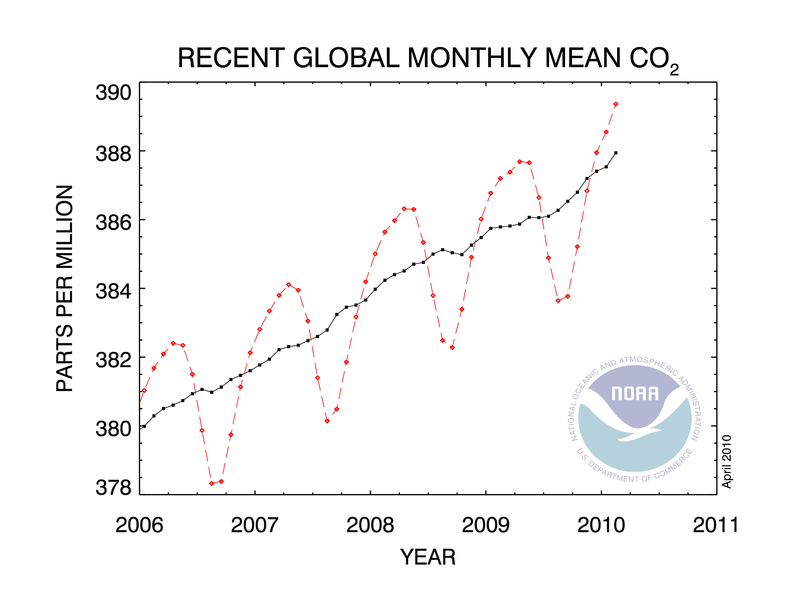
    Please note: "an average for the globe".

    The graph shows recent monthly mean carbon dioxide globally averaged over marine surface sites.

    The Global Monitoring Division of NOAA/Earth System Research Laboratory has measured carbon dioxide and other greenhouse gases for several decades at a globally distributed network of air sampling sites (Conway, 1994). A global average is constructed by first fitting a smoothed curve as a function of time to each site, and then the smoothed value for each site is plotted as a function of latitude for 48 equal time steps per year. A global average is calculated from the latitude plot at each time step (Masarie, 1995). The last four complete years plus the current year are shown here. The last year of data are still preliminary, pending recalibrations of reference gases and other quality control checks.
    http://www.esrl.noaa.gov/gmd/ccgg/trends/#mlo_full
     We have confidence that the CO2 measurements made at the Mauna Loa Observatory reflect truth about our global atmosphere. The main reasons for that confidence are:

       1. The Observatory near the summit of Mauna Loa, at an altitude of 3400 m, is well situated to measure air masses that are representative of very large areas.
       2. All of the measurements are rigorously and very frequently calibrated.
       3. Ongoing comparisons of independent measurements at the same site allow an estimate of the accuracy, which is generally better than 0.2 ppm.
    http://www.esrl.noaa.gov/gmd/ccgg/about/co2_measurements.html

    Satellite data shows conclusively that CO2 is not well mixed in the atmosphere.
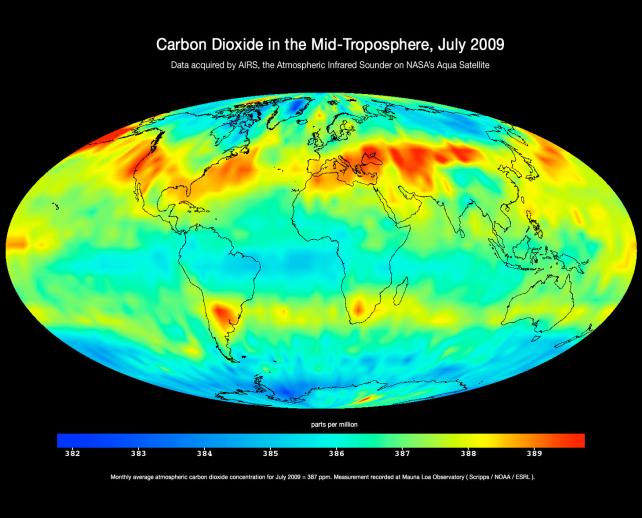

    http://photojournal.jpl.nasa.gov/catalog/PIA12339

    Launched into Earth-orbit on May 4, 2002, the Atmospheric Infrared Sounder, AIRS, moves climate research and weather prediction into the 21st century. AIRS is one of six instruments on board the Aqua satellite, part of the NASA Earth Observing System.
    ...
    AIRS uses cutting-edge infrared technology to create 3-dimensional maps of air and surface temperature, water vapor, and cloud properties. With 2378 spectral channels, AIRS has a spectral resolution more than 100 times greater than previous IR sounders and provides more accurate information on the vertical profiles of atmospheric temperature and moisture. AIRS can also measure trace greenhouse gases such as ozone, carbon monoxide, carbon dioxide, and methane.
    http://airs.jpl.nasa.gov/overview/overview/

    Painting the greenhouse

    Some deniers of anthropogenic global warming and / or the effect of CO2 as a 'greenhouse gas' are taking the greenhouse analogy too far.  One of their arguments goes like this.  If you paint a window you cut down the light.  Another coat of paint cuts the light further.  There soon comes a time when adding another coat of paint makes no difference.  It follows that after a certain level, adding more CO2 makes no difference.  Couple that with a fallacy of the average CO2 ppm and you have cooked yourself a very nice red herring.

    Have these people never heard of the planet Venus?  Its atmosphere is about 97% CO2.  The surface temperature is 460o C.  Anybody who suggests a 'cut-off' line where more CO2 makes no difference to warming had best explain where that cut-off lies within the 97% CO2 on Venus.  The Venus day is 243 earth days.  Its night is 243 earth days.  No, not earth nights.  'Days' as in 24 hour periods.  The temperature difference between Venus day and Venus night is entirely trivial.  This is due to the blanketing effect of an atmosphere with 97% CO2 and a fair bit of SO2, the strongest greenhouse gas effect in the solar system.

    If you paint a window, it blocks the light, sure.  But even if you painted it with a foot thickness of paint it would not stop your house cooling down in winter if you turn off the heating.  'Light' is not a synonym for 'electromagnetic radiation', it is just a small part of a very wide spectrum.  There is no such thing as a perfect heat insulator.  Paint is a poor conductor of heat, but an infrared camera would soon reveal that a painted window doesn't block heat transmission.

    Anyway, its an entirely spurious analogy.  CO2 doesn't work like that.  CO2 is more akin to refractory materials.  It absorbs heat and then re-emits it.  When a refractory material does that in a steam engine's firebox or in a furnace it has a major amplifying effect on temperatures.  There is no upper limit on thickness other than the fact that the train has to fit under bridges.

    So there you have it.  Argue the effects of various quantities of CO2 by all means.  But remember that the ppm average means lots and lots of square kilometers of land and ocean with low CO2 levels and far fewer densely inhabited square kilometers with excessively high CO2 levels.

    And I haven't even begun to discuss the vertical distribution in our layered atmosphere.

    Comments

    Not bad, Patrick. Not bad at all! ;-)
    CO2 is "well mixed" by the usual meaning of the term, in stark contrast to various other trace gases like water vapour, ozone, sulphates, and so on.

    Have a look at the scale on your the diagram. it goes from a low of 382 ppm to a high of 389 ppm. That's about 3.5 ppm above and below a mean value, or just under 1% above and below the mean. That's pretty well mixed! The small variations that have recently been measured a very useful in particular for identifying the sources and sinks of CO2 into the atmosphere, and the small magnitudes of the differences confirm how quickly CO2 is mixed throughout the atmosphere. As far as the atmospheric greenhouse effect is concerned, using the average for CO2 is just fine.

    This does not apply, on the other hand, for water vapour. CO2 is well mixed both vertically and horizontally. H2O, on the other hand, is not. It has strong variations bother vertically and horizontally. Given that most of the greenhouse effect is from H2O, this variation IS significant, in a way that the CO2 variation is not.

    Minor quibble on an otherwise good article!

    Cheers -- sylas

    logicman
    sylas: I'm glad you think it's a good article. 

    A couple of points.  Atmospheric models which treat gases as well mixed mean exactly that: a planet surrounded by a uniform mixture.  As you can see from the AIRS satellite image, the CO2 is distributed rather like clouds are.  Neither CO2 nor H2O is in any way uniformly mixed.

    CO2 is well mixed both vertically and horizontally. H2O, on the other hand, is not.
    Neither is well mixed either horizontally or vertically.  Well mixed means uniformly distributed, like the pigments in paint.  The atmosphere of Venus is almost uniform.  You only need to look at clouds and contrails to see how our atmosphere is by no means uniform.

    Given that most of the greenhouse effect is from H2O, this variation IS significant, in a way that the CO2 variation is not.
    There is a difference in the way that CO2 and H2O are distributed, but that is due mainly to the heat capacity of H2O.  H2O can precipitate out, CO2 can't.

    My last points: an increase in temperature can rapidly - i.e. on a scale of 1 or 2 days - drive up H2O levels through evaporation from oceans.  That is not true of CO2.  As a greenhouse gas, CO2 leads and H2O follows.  If you could take all of the H2O out of the atmosphere today, most of it would be back within 24 to 48 hours.  If you did the same with CO2 it would take about a decade, maybe longer, to reach about 200 ppm - all other factors being held constant.
    Actually, Patrick, the definition of "well-mixed" is NOT uniformly mixed. There is, I grant, some ambiguity in terminology here. However, the most common meaning of "well-mixed" gases in climate science, to my knowledge, is that a gas is considered "well-mixed" if it has a lifetime in the atmosphere that is substantially longer than that time it takes to be mixed through the troposphere.

    That is, the atmospheric lifetime is substantially longer that the atmospheric transport times. The implication of this is that such gases become well mixed through the troposphere, on time scales comparable with atmospheric transport times.

    You point to small variations in CO2. This is quite true. But I believe you are missing the following points.
    : The variations are small. Less than plus or minus 1%.
    : The rate of annual increase in CO2 is of a comparable order of magnitude. (About 0.5%) Even a well mixed gas will take some time for the mixing to occur between hemispheres.
    : There is no indication of any divergence in concentrations. That is, ALL the atmosphere is increasing in CO2 concentrations at about the same rate. The clear implication of this is that the gas IS being well mixed, and what you are seeing there is a gradient between sources and sinks of a gas that is being very thoroughly mixed indeed.

    Your closing points are a bit confused. There is indeed a difference in distributions of CO2 and H2O. That is because H2O has a very short lifetime, and hence it is NOT well mixed -- in contrast to CO2 which is mixed very effectively. The short lifetime of H2O has nothing at all to do with its "heat capacity", but rather with its capacity to condense out of the atmosphere so quickly.

    You propose thought experiments about removing gases from the atmosphere, with which I am in agreement. But what is funny is that that you speak of CO2 reaching 200ppm. WHERE? The answer is, of course -- throughout the atmosphere. There's no such measure for water vapour. Specific humidity is a highly regionalized, and you cannot give a global humidity value in the same way that you can give a meaningful global CO2 concentration.

    Cheers -- sylas

    logicman
    There is no indication of any divergence in concentrations.

    sylas: the satellite observations clearly show at a glance a continual distribution of CO2 which never shows signs of becoming uniform, just like H2O.  My point is that modellers treat the atmosphere as if it was as well mixed as freshly stirred paint.  It is in reality only as well mixed as warm bathwater with the hot tap left running.  It can only become well mixed if you turn off the tap.  The earth's tap never gets turned off.  I hope. ;-)

    The short lifetime of H2O has nothing at all to do with its "heat
    capacity", but rather with its capacity to condense out of the
    atmosphere so quickly
    Rain falls when H2O reaches its precipitation temperature.  This is entirely related to its heat capacity and changes of state.  That is why we see the phenomenon of cloud ceiling.  CO2 has no such mechanism within the normal range of atmospheric pressure and temperature.  It leaves the atmosphere only through chemical reactions.

    Specific humidity is highly regionalized, and you cannot give a
    global humidity value in the same way that you can give a meaningful
    global CO2 concentration.

    But you can.  You can  have a global average of anything at all.  Try global average income.  A very few billionaires and billions of people starving adds up to a very high and entirely meaningless figure.  You accept that a global atmospheric H2O figure is not meaningful, so why not apply the same logic to CO2?  It is highly concentrated in industrialised zones, just like the money.

    It is intuitive to think of atmospheric H2O as not being uniformly distributed because we just have to look up at the clouds.  Today, we can look down at the CO2 clouds.  The idea of non-uniform distribution of CO2 should be as intuitive as for H2O.

    To give another example: we hear a lot about Arctic sea ice extent.  This is another meaningless average.  Unless you factor in age, thickness and compaction versus fragmentation you get an entirely false picture of the state of Arctic sea ice.  It is never uniformly distributed.


    My core argument is this:
    Any climate model, any argument about climate, any formula will be fundamentally flawed if it treats CO2 as being as uniformly distributed across the entire planet as pigment is in well-mixed paint.  You have to factor in the distribution gradients and see that it is more like paint which is in process of being blended and stirred.  Or coffee.  Which reminds me ...   :-)
    sylas
    This is a bit long; hope that's okay!

    When you see the phrase "well mixed gas" with respect to atmospheric gases, it usually means either that variation is small, or that residence times are large with respect to atmospheric transport times. In practice these two definitions are interchangeable. I do not think it EVER means absolutely uniform, or "perfectly" mixed, in this literature, which appears to be the definition you are using.

    Do you agree that this is a different definition of the term from what you are using? (A direct answer to this will help us make progress, I think!)

    If you fail to see the two definitions on the table, then you are bound to misunderstand what is written on the subject. The issue is made more difficult by the fact that papers typically don't give a formal definition of the term, and that is unfortunate, particularly when the papers become a focus of interest for people who are not actually experts in the subject area.

    Some references which explicitly associate the phrase "well-mixed" with residence times include:

    • Shine and Forster (1999) "The effect of human activity on radiative forcing of climate change: a review of recent developments", in Global and Planetary Change 20, pp 205–225

    • IPCC 4AR WG1 (2007), technical summary page 24.


    Some references also explicitly note that "well mixed" does not mean completely uniform, but rather mean that mixing ratios are nearly the same everywhere, or approximately equal.

    For full technical details of atmospheric physics, I have learned a heck of a lot from Ray Pierrehumbert's excellent textbook: "Principles of Planetary Climate" (Cambridge University Press, 2010) (Forthcoming). He gives perhaps the clearest account of mixing, residence times and small variations. From page 79 in Chapter 2:
    Constituents will tend to become well mixed over a great depth of the atmosphere if they are created or destroyed slowly, if at all, relative to the characteristic time required for mixing. In the Earth’s atmosphere, the mixing ratio of oxygen to nitrogen is virtually constant up to about 80km above the surface. The mixing ratio of carbon dioxide in air can vary considerably in the vicinity of sources at the surface, such as urban areas where much fuel is burned, or under forest canopies when photosynthesis is active. Away from the surface, however, the carbon dioxide mixing ratio varies little. Variations of a few parts per million can be detected in the relatively slowly mixed stratosphere, associated with the industrial-era upward trend in fossil fuel carbon dioxide emissions. Small seasonal and interhemispheric fluctuations in the tropospheric mixing ratio, associated with variations in the surface sources, can also be detected. For most purposes, though, carbon dioxide can be regarded as well mixed throughout the atmosphere. In contrast, water vapor has a strong internal sink in Earth’s atmosphere, because it is condensable there; hence its mixing ratio shows considerable vertical and horizontal variations. Carbon dioxide, methane and ammonia are not condensable on Earth at present, but their condensation can become significant in colder planetary atmospheres.

    As a brief side point on "heat capacity". You said also:
    Rain falls when H2O reaches its precipitation temperature. This is entirely related to its heat capacity and changes of state. That is why we see the phenomenon of cloud ceiling. CO2 has no such mechanism within the normal range of atmospheric pressure and temperature. It leaves the atmosphere only through chemical reactions.

    If you omit the phrase "heat capacity" and just limit yourself to "changes of state", then your paragraph here is fine. As Pierrehumbert points out, other gases which could become condensable in a colder atmosphere include CO2, CH4 and NH3. His book is really good on things like this, because it applies general principles that work for a whole range of different planetary atmospheres. What matters for whether a gas becomes well mixed is the residence time. If a gas is condensable in normal atmospheric conditions, then it has a very low residence time, and will not be well mixed. Specific heat doesn't come into it. In our atmosphere, H2O is condensable and CO2 is not. Hence CO2 is well mixed and H2O is not. But in a colder atmosphere, CO2 may become condensable as well, which would give it a short residence time and mean it is no longer well mixed. Clear?

    Back to mixing ratios:

    The discovery of small variations in CO2 is not new. We've known that for years. We've known that there is slightly more CO2 in the Northern Hemisphere than in the South, and by about how much. We've known that the atmosphere above a source of CO2 tends to have a little bit more than the atmosphere out in the Pacific, because it takes a bit of time for mixing to occur. None of that changed with the new AIRS data.

    What AIRS showed is a fine grained picture of distributions. You can see, for example, the sources of CO2 in industrial centers in South Africa and South America, and how that is picked up by circulation patterns to spread east and west. That's the first time it has been measured, I believe; though the same stronger effects in the industrial centers of the North were already known. This is just showing the process of mixing going on.

    Now we can map it better over the whole globe.

    So it is flatly wrong to claim that the AIRS observations have revealed that CO2 is not well mixed. It actually confirms that it is well mixed by the usual meaning applied in the literature, and confirms that it is not perfectly mixed as we already knew anyway.

    On to some specifics. You said:
    the satellite observations clearly show at a glance a continual distribution of CO2 which never shows signs of becoming uniform, just like H2O. My point is that modellers treat the atmosphere as if it was as well mixed as freshly stirred paint. It is in reality only as well mixed as warm bathwater with the hot tap left running. It can only become well mixed if you turn off the tap. The earth's tap never gets turned off. I hope. ;-)
    Except that it is not just like H2O at all. It's wildly different from H2O!

    The AIRS diagram clearly shows that CO2 is being well mixed, which H2O most certainly is not. And no-one has said it is becoming uniform. That's a strawman: a confusion of applying inappropriate definitions. What I said is that CO2 is being mixed, not that it is uniform. I noted that this means there will be gradients. That is, new additions mix through the whole atmosphere well before those additions are removed by chemical or other processes.

    The comparison with a warm bath and hot tap is a very good one, especially if you continually stir the bath. In this case, the water close to the tap is detectably warmer, but it is also being effectively mixed and the whole bath is increasing in temperature. That is precisely what we see with CO2. The "hot spots" are the sources (analogous to a running tap). The stirring is normal atmospheric circulation (you can see it most clearly in the east/west circulation patterns in the AIRS data, where CO2 mixes more quickly along a common latitude than along a common longitude). And you can see that even the lowest concentrations of CO2 are already greater than the highest concentrations you would have measured even a few years ago, which is analogous to how hot water mixes into a bath and makes the whole thing warmer.

    Now it is true that most models treat CO2 as uniformly mixed. (Most, not all!) This is known to be an approximation. The issue is -- is this approximation a fundamental flaw, or is it a reasonable numerical approximation? What difference does it make? The answer is, I suggest... it is a perfectly reasonable approximation which makes little practical difference.

    You conclude:
    My core argument is this:
    Any climate model, any argument about climate, any formula will be fundamentally flawed if it treats CO2 as being as uniformly distributed across the entire planet as pigment is in well-mixed paint. You have to factor in the distribution gradients and see that it is more like paint which is in process of being blended and stirred. Or coffee. Which reminds me ... :-)

    Any mathematical model of the atmosphere is a numeric approximation of some kind. We calculate fluid flows, and transports, using steps sizes in time, and in space; and we apply all kinds of numeric approximations to capture aspects of the real physical world. As some wag has noted, models are always wrong and often useful.

    Some models do, in fact, consider variations in CO2... but mainly because they explicitly include the carbon cycle as part of the physical processes being modeled. Let's consider what difference there is in the radiative forcing, ok?

    As you may know, the radiative forcing for CO2 is approximately proportional to the logarithm. For each natural log of CO2, you get about 5.35 W/m^2 of forcing.

    Now, what is the impact of the Keeling curve? This involves variations of around 4 or 5 ppm across the seasons. Using 380 ppm as the base level (around about 2006 levels), a model which takes the Keeling curve into account will get a forcing change with the seasons of 5.35*Ln(1+5/380), or 0.07 W/m^2.

    Or how about the difference between Northern and Southern hemispheres? It's a bit less than the Keeling curve seasonal difference.

    What about the difference between "hot spots" in Europe and "cold spots" in the Great Southern Ocean? In the AIRS diagram, you are comparing about 390 and about 382, at the most. 5.35*Ln(390/382) is about 0.11 W/m^2. This is pretty much an absolute maximum on the extremes of forcing difference that might arise in a model that includes fine grained CO2 variation. By comparison, regional differences forcing with seasonal cloud can be more than two orders of magnitude larger. Here is a sample reference, describing seasonal changes from a low of 50 W/m^2 to a high of 110 W/m^2, from cloud effects.


    So I don't know what you mean by "fundamentally flawed" here. You seem to be straining at gnats. I hope you are not buying into the notion that a model is "fundamentally flawed" if it isn't perfect; I would be surprised if you really think that! There are certainly lots of ways models can be improved, and they are being improved all the time. The small variations in CO2 are, well, SMALL. That's why many models simply use an average for CO2, but not for H2O. The first is a very good first order approximation, the other isn't.

    In those cases where models DO look at regional differences in CO2, the major importance of this is simply working out the carbon cycle, which is not particularly well modeled at present. The importance of this is for sorting out the likely overall CO2 levels after a number of years, for a given emissions scenario. The regional forcing differences are not the big issue, at all.

    Here is an example of current modeling work on carbon cycles:


    There's lots more at the Ocean Carbon-Cycle Model Intercomparison Project.

    Here then is my core argument:

    • The phrase "well mixed gas" in the literature of trace atmospheric gases never means "uniformly mixed". The usage of terms in a paint shop are a lousy guide to the meanings of terms in atmospheric physics.

    • We have long known that there are small variations in CO2 across seasons and across hemispheres, and linked to sources and sinks of CO2. The AIRS data improves resolutions; it does not reveal major differences in magnitudes from what was already.

    • The variations in CO2 that exist are small, and so it can be well approximated with a global mean for most purposes. The use of such approximations is not a fundamental flaw, but a normal part of using approximations to get useful insights from models.

    • In all of this, H2O is radically different from CO2. It is not well mixed, it cannot be well approximated with a global mean, and the variations are large. Grasping this difference is fundamental to understanding what the term "well-mixed gas" means in the scientific literature.


    It might be useful to ask a genuine expert in modeling and atmospheric physics (Gavin Schmidt springs to mind) if he would comment on this.

    PS. I'm "sylas", who commented above. I've signed up so as to use the facilities here a bit better.
    logicman
    Chris: that's not a comment, it's a whole article!  ;-)


    From my article:
    within either hemisphere, the CO2 is averagely higher within specific zones of latitude.

    The people who update the Keeling curve know this.   From what I read
    on the web, the majority of Keeling curve detractors are strangers to
    the concept of uneven distribution.
    Climate modellers have long known about gradients, of course.  But article writers on denier sites tend to neglect what has long been known, thus their readers are never enlightened by good science, but are blinded by bad science.

    Do you agree that this is a different definition of the term from what you are using? (A direct answer to this will help us make progress, I think!)
    I agree.  I should make it clear that I am addressing the issue here of AGW deniers who use a tacit assumption of CO2 as a well mixed - i.e. perfectly uniform - gas in area and depth, and then use that flawed model to 'prove' that CO2 can't cause global warming, or not so much warming.

    If you neglect the layering of the atmosphere and the source-sink gradient then a simple formula for the radiation effects of CO2 will give meaningless results.  Genuine climate scientists don't use that model.  Deniers use that model to 'prove' their points.

    Can you agree that a locally minor CO2 density increase can account for much of the urban island effect?

    My 'fundamentally flawed' statement about models is aimed squarely at AGW deniers who - deliberately or otherwise - neglect most of the elements used by experienced, professional  climate modellers.  My arguments are most specifically not directed at these real climate modellers, who presumably know a lot more about these topics than I will ever know.

    Constituents will tend to become well mixed over a great depth of the atmosphere if they are created or destroyed slowly, if at all, relative to the characteristic time required for mixing. In the Earth’s atmosphere, the mixing ratio of oxygen to nitrogen is virtually constant up to about 80km above the surface. The mixing ratio of carbon dioxide in air can vary considerably in the vicinity of sources at the surface, such as urban areas where much fuel is burned, or under forest canopies when photosynthesis is active. Away from the surface, however, the carbon dioxide mixing ratio varies little.
    Key phrases:
    "if they are created or detroyed slowly".
    Timescale is undefined. Hours? Geological time?  Ambiguous statements like this are picked up daily by deniers to 'prove' their points.

    "the mixing ratio of oxygen to nitrogen is virtually constant up to about 80km" 

    No it isn't.   O2 is much lower at altitude, especially above about 10km, which is why so many early balloonists and aviators died trying to breath ordinary air.

    The O2 concentration is also lowered in lock-step with CO2 production where fossil fuels are being consumed on industrial scales.  At the scale of breathable atmosphere - up to 10km - O2 is not uniformly distributed.  There are sources and sinks.  Above that height the Troposphere is much more uniformly mixed.

    My point again - aimed at deniers who present flawed arguments:

    Constituents in the atmosphere become well mixed only over relatively long time scales, ranging from days through decades, and any vertical slice through the atmosphere shows that each bounded layer has its own average percentages of various gases.  Even within the Troposphere, there is a mixing boundary about 10 km below which H2O and GHG gradients are mush more emphasised. The atmosphere, taken in its entirety, is not well mixed.  This is even more true of the ordinarily breathable atmosphere.  There are many examples: pools of volcanic CO2 gas, lakes which have a high CO2 concentration and act as a source, mountain ranges and inversion layers which slow the atmospheric mixing of CO2 and other pollutants, thus creating smog banks which are readily visible from space. 

    Consider also NaCl, which is a cloud seed.  Its distribution in the atmosphere is as a high concentration over oceans with a gradient over land from coast to furthest inland.  Broadly speaking, any map of land and sea is a map of atmospheric sea-salt concentration.


    If you assume a single layer of well mixed gases and then analyse the effects in that single layer of varying the CO2 concentration you will get a false impression that there is an upper limit beyond which adding more CO2 has no effect.  That model has been bounced around many denier sites and is prima facie flawed.


    Here then is my core argument:

    • The phrase "well mixed gas" in the literature of trace atmospheric gases never means "uniformly mixed". The usage of terms in a paint shop are a lousy guide to the meanings of terms in atmospheric physics.

    • We have long known that there are small variations in CO2 across seasons and across hemispheres, and linked to sources and sinks of CO2. The AIRS data improves resolutions; it does not reveal major differences in magnitudes from what was already.

    • The variations in CO2 that exist are small, and so it can be well approximated with a global mean for most purposes. The use of such approximations is not a fundamental flaw, but a normal part of using approximations to get useful insights from models.

    • In all of this, H2O is radically different from CO2. It is not well mixed, it cannot be well approximated with a global mean, and the variations are large. Grasping this difference is fundamental to understanding what the term "well-mixed gas" means in the scientific literature.


    I agree with these points.  But the people who are being addressed by writers of bogus arguments aim their arguments at a lay readership that doesn't know these things.  In the ordinary use of the English language, 'well mixed' means exactly what it says on the tin: 'no stirring needed'.  That is the sense in which bad climate science argumenst are - deliberately or otherwise -  disseminated by bad writers to a lay readership.

    "The variations in CO2 that exist are small, and so it can be well approximated with a global mean for most purposes. "
    For most purposes, yes.  But the global mean and the tacit assumption of an unlayered, perfectly mixed atmosphere are used together for the purpose of demonstrating to deniers that CO2-induced AGW isn't happening. 

    Professional climate modellers need to emphasise for a general public that climate scientists  know about source-sink gradients, that gradients are important in a model, and that anyone who leaves out the gradients - especially in modelling an argument for public consumption -  needs to explain to what purpose they were left out.


    You raise many excellent points which I will come back to.  Meanwhile, it has been a very long day for me and I need to rest my poor, aching brain.

    Thank you for your comments. I particularly enjoy comments which add to the knowledge base through scientific debate.

    I'll be back to address more of your points - and any fresh ones you may raise.
    CO2 is clearly well mixed.

    It varies between 389 and 386 ppm over almost the entire globe. I am shocked at how well mixed that is. Thanks for bringing up this information.

    Another important point here is on how a color bar can easily confuse and mislead people. By allrights, the dark blue should be 0 ppm and red should be say 400 pp. Then the entire globe would be a constant light red color, and everyone would understand how well mixed CO2 is.

    logicman
    It varies between 389 and 386 ppm over almost the entire globe.
    ...
    By allrights, the dark blue should be 0 ppm and red should be say 400 pp. Then the entire globe would be a constant light red color

    The graphic shows a clear distribution of about 8ppm, not 3ppm.
    If you mix red and blue, you don't get light red.
    Perhaps you could go a little deeper into defining what is "well mixed" and what is "uniformly mixed" and other gradients of mixing a put it on a scale. I'll take a stab at it right here...

    1 = fully separated
    2 = some mixing
    3 = partially mixed
    4 = mixed
    5 = well mixed
    6 = uniformly mixed

    You could certainly apply more detailed parameters to it. CO2 is definitely not a uniformly mixed gas in the atmosphere. At only 2% variation CO2 is clearly a "well mixed" gas. Your argument here is poor because you are merely saying that CO2 is not uniformly mixed, in essence a straw man.

    logicman
    Your argument here is poor because you are merely saying that CO2 is not uniformly mixed, in essence a straw man.

    Rob: I have to disagree.

    This article was written mainly as a response to global warming deniers.  If the atmosphere was as well-mixed as a laboratory specimen of gases then some arguments about high CO2 levels not producing corresponding global warming would be sound.  However, CO2 is not well-mixed vertically due to the atmosphere having well-defined layers.  Also, CO2 tends to concentrate in urban areas and in latitudes having high populations.

    The Keeling curve shows measured concentrations of CO2 in a location where the atmosphere is well-mixed.  CO2 levels in urban and industrial areas and in temperate northern latitudes are measurably higher.  It follows that CO2 is not, globally, a well-mixed gas.  Hence, any argument about the global warming effects of various CO2 levels in a well-mixed planetary atmosphere are hypothetical only and should not be used to 'disprove' the known effects of atmospheric CO2 as a greenhouse gas.
    The painting the greenhouse glass scenario is not a very good analogy to CO2 saturation. For one thing, it doesn't take into account the intensity of the incoming radiation. There is a lot more infrared radiation at CO2's fingerprint wavelengths on Venus than here on Earth (much hotter planet closer to the sun). Consequently, comparing Earth to Venus is moot. The historical evidence here on Earth suggests that once CO2 levels reach somewhere around 400 ppm, it has absorbed all available IR at its fingerprint wavelengths within about 10 meters or so. Adding more CO2 simply means it will absorb it over a shorter distance. A better analogy is a sponge soaking up water. Once all the water is soaked up, adding more sponges has no additional affect. Also, the refractory argument doesn't make sense. Refractories absorb heat. IR radiation is not heat, it's light. The only way light energy can be changed to thermal energy is through molecular collisions. If the CO2 molecule re-emits the light, that CO2 molecule is benign (no contribution to heating gases around it). Moreover, keep in mind that thermal energy cannot promote gas molecules to higher vibrational states, as proven by heat capacity ratio studies. The only way the N2 or O2 could absorb that light energy from a CO2 molecule is in translational and rotational degrees of freedom. It's simple physical chemistry.

    James, your comment makes a number of basic errors in physics.

    First, as concentrations of atmospheric CO2 increase, the main effect is that a wider band of IR becomes absorbed. Details of this give the essentially logarithmic relation between CO2 concentration and radiative forcing, which continues up until CO2 levels are more like 100,000 ppm; and certainly throughout any concentrations Earth is likely to see in the next few million years. This is called "increased absorption in the wings"; it corresponds the band which is "saturated" becoming wider as concentrations increase.

    Second, you neglect the fact that CO2 is able to transfer vibrational energy to other molecules by mechanical means, as it collides with other molecules in a gas. This is easy demonstrated in a laboratory setting, as you can heat a mixed gas with IR radiation even if most of the molecules are not IR absorbers.

    Third, you miss the fact that the radiation emitted from a gas reflects the temperature of the gas, and not the temperature of the IR radiation it is absorbing. Basically, the atmosphere absorbs IR radiation mainly from the surface, and emits it again but with a lower characteristic temperature, corresponding to the cooler temperatures of the atmosphere. This again follows from the previous point above heat transferring between molecules of a gas by collisions.

    In fact, pretty much the only thing that is correct is your final comment that this is simply physical chemistry! The best way to following this is to simply check the basic physics with a suitable undergraduate level text book. I would recommend, for example An Introduction to Atmospheric Radiation, by Professor K.N. Liou (2nd ed, 2002).

    This is basic physics that you are getting wrong.

    Hank
    A mathematician and a chemist arguing about physics!   This is why I love Science 2.0.
    I like it as well; the level of discussion here is better than at many blogs. But frankly, I don't consider this much of an argument. The physics here is not particularly hard (the point about absorption in the wings tends to be a bit specialized, but the rest is really basic).

    The main thing to underline, in my view, is that this is not an argument between experts. If anyone is unsure about the subject matter, don't take my word for it. Go back to the basic textbooks on the subject. I'm mildly curious how James might respond, but it would be a mistake to think this is a "debate" that matters for experts. Climate related discussions attract all kinds of bizarre statements, and it can be hard to an onlooker to sort out the wheat from the chaff.

    It is wheat and chaff, however. One of James or I is speaking complete nonsense here. This happens a lot in discussions on the net where climate is mentioned.

    logicman
    ... don't take my word for it.

    That's one of my favorite sayings, Chris. 

    Another, much like it, is "Don't let me do your thinking for you."  :-)
    I have read that the so called green house effect violates the laws of thermodynamics. The atmosphere acts as an insullator. Ignoring the phase change characteristics of H2O, the primary means of heat transport in the atmosphere is by means of convection. Variations in CO2 content have little effect on the R value of the atmosphere.

    logicman
    The 'greenhouse effect' is more of a 'blanket thickness' effect.  If you feel cold at night and use a thicker blanket, you get warmer.  That is a fact, and has nothing whatsoever to do with the fact that heat cannot flow by conduction from a colder to a hotter body.  As with blankets, clothing and insulation generally, so with the greenhouse effect: the rate of loss of heat is reduced.  The laws of thermodynamics are most certainly not violated.

    Add a comment

    The content of this field is kept private and will not be shown publicly.
    • Allowed HTML tags: <sup> <sub> <a> <em> <strong> <center> <cite><TH><ul> <ol> <li> <dl> <dt> <dd> <img> <br> <p> <blockquote> <strike> <object> <param> <embed> <del> <pre> <b> <i> <table> <tbody> <div> <tr> <td> <h1> <h2> <h3> <h4> <h5> <h6> <hr> <iframe><u><font>
    • Web page addresses and e-mail addresses turn into links automatically.
    CAPTCHA
    If you register, you will never be bothered to prove you are human again. And you get a real editor toolbar to use instead of this HTML thing that wards off spam bots.