Banner
Pilot Study: Fibromyalgia Fatigue Improved By TENS Therapy

Fibromyalgia is the term for a poorly-understood condition where people experience pain and fatigue...

High Meat Consumption Linked To Lower Dementia Risk

Older people who eat large amounts of meat have a lower risk of dementia and cognitive decline...

Long Before The Inca Colonized Peru, Natives Had A Thriving Trade Network

A new DNA analysis reveals that long before the Incan Empire took over Peru, animals were...

Mesolithic People Had Meals With More Tradition Than You Thought

The common imagery of prehistoric people is either rooting through dirt for grubs and picking berries...

User picture.
News StaffRSS Feed of this column.

News Releases From All Over The World, Right To You... Read More »

Blogroll

Researchers have discovered that neurons can use two different neurotransmitters that target the same receptor on a receiving neuron to shape the transmission of a nerve impulse.

Although the researchers’ experiments identified the “co-release” of the two neurotransmitters only in specific types of neurons in the brain’s auditory center, their finding may apply more broadly in the brain, they said.

Thus, the finding may represent a new way in which the brain precisely modulates the nerve impulses that travel from neuron to neuron in its circuitry.

It may not be for all people, but I am betting 90% of the readers of this site and 100% of the writers would buy this car; active suspension, six-wheel drive with independent steering for each wheel, no doors, no windows, no seats and the only color available is gold.

And no passenger seat. Pure off-roading heaven.

But NASA's latest concept vehicle is meant to go way off-road, as in 240,000 miles from the nearest pavement, and drive on the moon.

Children who under-achieve at school may just have poor working memory rather than low intelligence according to researchers who have produced the world's first tool to assess memory capacity in the classroom.

The researchers from Durham University, who surveyed over three thousand children, found that ten per cent of school children across all age ranges suffer from poor working memory seriously affecting their learning. Nationally, this equates to almost half a million children in primary education alone being affected.

However, the researchers identified that poor working memory is rarely identified by teachers, who often describe children with this problem as inattentive or as having lower levels of intelligence.

Boulders the size of footballs could help scientists predict the West Antarctic Ice Sheet’s (WAIS) contribution to sea-level rise according to new research published this week in Geology.

Scientists from British Antarctic Survey (BAS), Durham University and Germany’s Alfred Wegener Institute for Polar and Marine Research (AWI) collected boulders deposited by three glaciers in the Amundsen Sea Embayment – a region currently the focus of intense international scientific attention because it is changing faster than anywhere else on the WAIS and it has the potential to raise sea-level by around 1.5 meters.

Analysis of the boulders has enabled the scientists to start constructing a long-term picture of glacier behavior in the region.

Taking the supplement ginkgo biloba had no clear-cut benefit on the risk of developing memory problems, according to a study published in Neurology®.

The three-year study involved 118 people age 85 and older with no memory problems. Half of the participants took ginkgo biloba extract three times a day and half took a placebo. During the study, 21 people developed mild memory problems, or questionable dementia: 14 of those took the placebo and seven took the ginkgo extract. Although there was a trend favoring ginkgo, the difference between those who took gingko versus the placebo was not statistically significant.

The number of scientists is increasing along with the number of scientific journals and published papers, the latter two thanks in large part to the rise of electronic publishing. Scientists and other researchers are finding it more difficult than ever to zero in on the published literature that is most valuable to them.

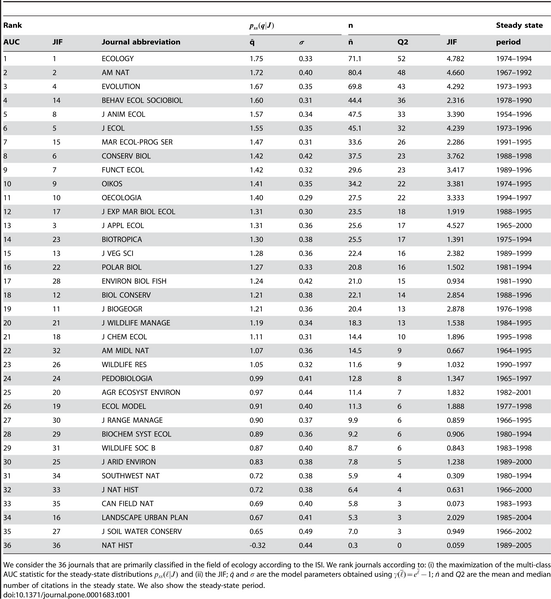
A team of researchers from Northwestern University say they have developed a mathematical method to rank scientific journals according to quality.

The team analyzed the citation data of nearly 23 million papers that appeared in 2,267 journals representing 200 academic fields and that spanned the years from 1955 to 2006; their analysis produced 200 separate tables of journal rankings by field.