The Large Hadron Collider is delivering as expected a large amount of integrated luminosity of proton-proton collisions to CMS and ATLAS, running at a centre-of-mass energy of 8 TeV. The total collected in 2012 by CMS has just now crossed the mark of 10 inverse femtobarns: this is twice as much data as that collected in 2011. And the CMS detector is working like a charm, with all subsystems collecting data flawlessly.
Physicists need large integrated luminosity to explore rare phenomena, and high energy to probe processes which may only "turn on" above a certain threshold. So given the x2 luminosity so far collected (but we will get to x5 by the end of the year!) and x1.14 energy, the discovery potential of 2012 data is already several times larger than that of 2011 data.
I am very happy to have been invited, by Matteo Polettini, to two events that will take place at
Festivaletteratura (literature festival), an important cultural event that takes place in Mantova, a beautiful town in northern Italy, from the 5th to the 9th of September.
ATLAS has just
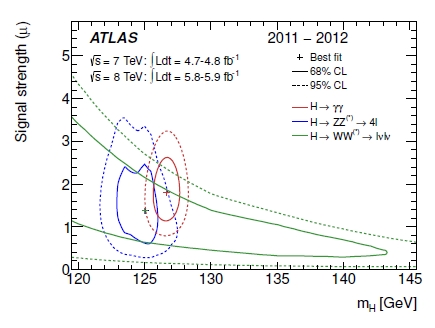
released a note which summarizes the searches for the standard model Higgs boson in 7-TeV and 8-TeV data. Since July 4th the main improvement is the addition of the WW channel, which had not been shown back then. With it, the combined local significance of the 126 GeV Higgs boson excess in the WW, ZZ, and γγ channels grows to 5.9 standard deviations. In the words of a Facebook friend who's in ATLAS: "if this is not a discovery, I don't know what is".
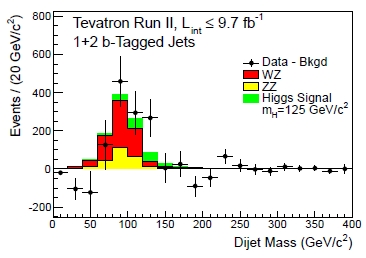
The Tevatron experiments have jointly
published on the arxiv two days ago a paper which is titled "
Evidence for a particle produced in association with weak bosons and decaying to a bottom-antibottom quark pair in the search for the Higgs boson at the Tevatron collider". You can get the paper in the arxiv.
The communication of science to the general public is a subject dear to me, but unfortunately one that the majority of my colleagues neglect to consider as one to which to devote time and efforts.
In the last decade blogs have started to fill the huge gap that exists between scientific journals and general news media, a gap that no popularization magazine can bridge, given their restricted scope. More recently, I see efforts that employ video and graphics more heavily than before, and this is of course a step in the right direction - reading is harder, or at least less immediate, than watching an image or following a video clip.


 Choosing Your Bets: The Selection Bias
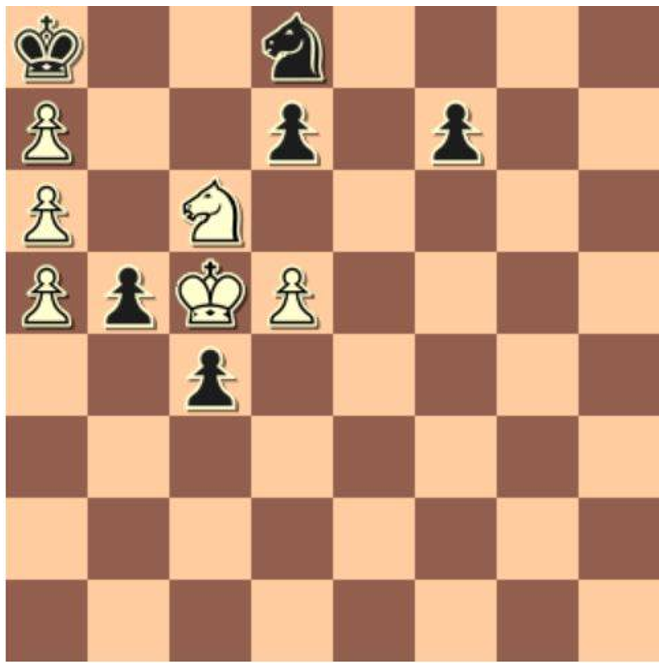 A Chess Study Requiring Backpropagation
 Co-Design Of Scientific Experiments