The parallel sessions at the international conference on High-Energy Physics in Paris are over, and it is time for a summary of results. Of course if you are following the conference you will get it from the summary talks, but if you prefer some armchair, remote attendance of the conference, I have collected for you a few meaningful plots.
Here I wish to assemble some of the electroweak physics results produced by CMS in time for ICHEP. The CMS experiment has shown results that use up to 280 inverse nanobarns of proton-proton collisions, but for electroweak measurements -those involving W and Z signals, to be clear- the statistics used is up to 200 inverse nanobarns of well-understood data.
Just a note here because I figured it is not clear - I am on vacation these days and, while I continue to post at a regular frequency, I am much more erratic than usual with answering comments in the threads. I would like this to be clear, because I usually do make a point of answering all comments that lend themselves to be answered.
With a slow connection and the need to spend as much time as possible swimming in the blue waters of Elafonisos, this is bound to be a side effect. I will be back in regular blogging mood by August 10th.
While a thousand physicists gather in hot Paris and listen to talk after talk, I am confined in a small island of the Mediterranean, trying to relax and gather my ideas for the next few aggressive months of data analysis, a course of subnuclear physics in the fall, and of course, more reckless
rumor-mongering!
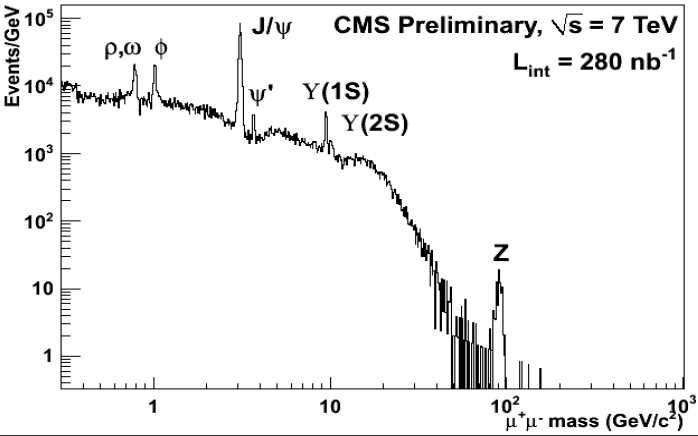
The CMS collaboration at the LHC collider has just produced its very first results on the production of Upsilon particles, with 280 inverse nanobarns of proton-proton collisions at 7 TeV center-of-mass energy. I wish to discuss these results here, to explain what is interesting in these very early measurements, and what we can expect to learn in the future from them.
The production of resonances decaying to muon pairs is one of the first things one wants to study when a hadron collider starts operation. This is because these particles are extremely well known, so one immediately figures out whether the detector is working properly, what is the resolution on the momenta of the reconstructed particles, etcetera.
I am preparing a disclaimer to be added to the bottom of my posts here. The problem I am trying to solve -at least in part- is that the colleagues in the scientific collaborations I work for apparently fear that I be identified, by science reporters or other media agents, as an official source of information from those experiments.