Fake Banner
Choosing Your Bets: The Selection Bias

As some of the long-time readers of this blog know, in this column I have occasionally discussed...

Have A Master In Science, Want A Post-Doc Position Directly?

Do you have a master in Science, and want to start a Post-Doc position directly? You can have it...
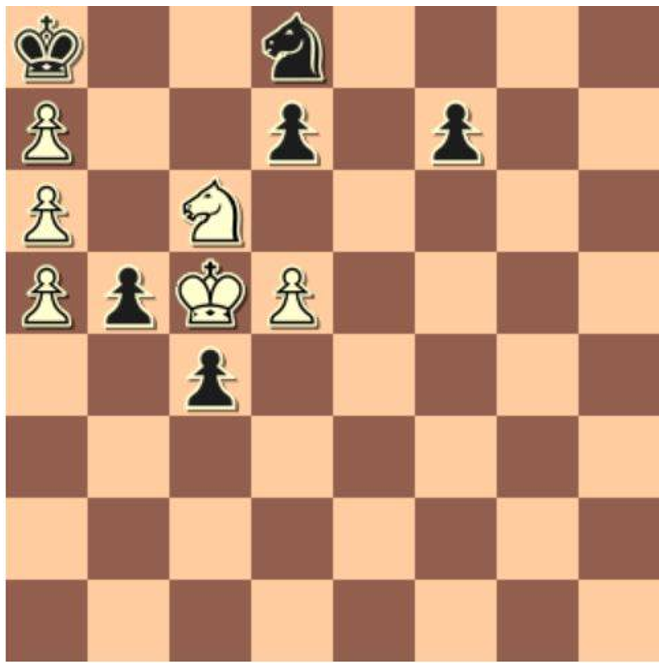
A Chess Study Requiring Backpropagation

The following position is a win for white. But how?It seems like white is able to grab a knight...
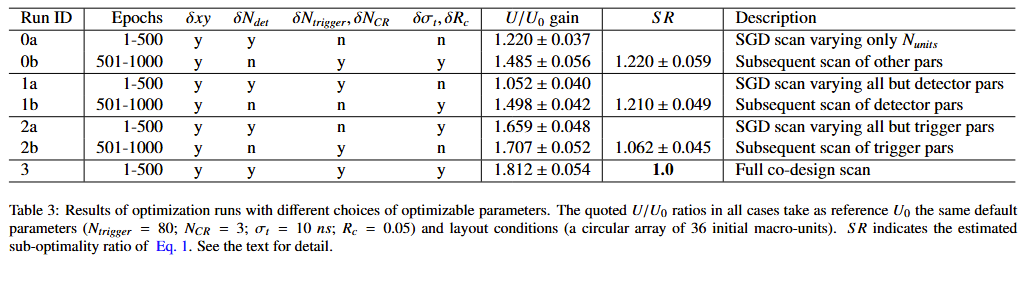
Co-Design Of Scientific Experiments

Next Monday, or Tuesday at the latest, you will find a new bulky paper in the arXiv. Titled "On...

User picture.
picture for Hank Campbellpicture for Heidi Hendersonpicture for Patrick Lockerbypicture for Bente Lilja Byepicture for Sascha Vongehrpicture for Johannes Koelman
Tommaso DorigoRSS Feed of this column.

Tommaso Dorigo is an experimental particle physicist, who works for the INFN at the University of Padova, and collaborates with the CMS and the SWGO experiments. He is the president of the Read More »

Blogroll
"Every great man nowadays has his disciples, but it is always Judas who writes the biography."

Oscar Wilde
Analogies are a powerful way to explain complicated scientific concepts. I use them as much as I can whenever I describe particle physics in this blog or when I give a outreach talk in a school. However, good ones are not always easy to find. One usually needs examples from everyday life, which are simple to describe and which do not possess distracting features.

Today I wish to try my luck with you, to see if you come up with an analogy which is better than the one I could find to explain a feature of weak interactions. I must say I am not dissatisfied with my own find, but it is always good to subject oneselves to external judgement.
This is to inform you of the new luminosity record set today by the Tevatron collider at Fermilab. The machine has been working excellently, improving its performance as the machinists found ways to obtain higher stacks of antiprotons, reducing inefficiencies in the transport of the beams from one accelerator to the other in the injection process, or finding better beam tunes. A painstaking work that brought increasing returns, it seems.
I read with interest and excitement a very lightweight preprint on the Cornell preprint arxiv this afternoon. Although I usually skip reading papers on subjects I know little about (Cosmology), the title startled me enough to plunge into it:

"Solution to the Dark Energy Problem".

Single author, Paul Howard Frampton. Hmmm. A thought crossed my mind at the very start. Was this the work of a crackpot, sneaked into the arxiv while nobody was looking ?
This is just to mention that I have been blogging for this site for exactly one year.

During the last twelve months here I have observed a few changes from the old blog which I ran at wordpress. First of all, being hosted in Scientific Blogging extended my readership. However, I also lost some regular readers, probably ones who deem a site running commercial ads not worth reading. I specifically remember some of them, who contributed frequently to the comments threads in the old site - Fred, Guess Who, Tripitaka, Jeff ... The list is long. Too bad, it's life. Growth, I am convinced, only happens through change.
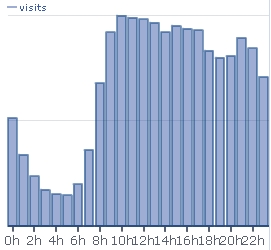
Have a look at the figure on the left. It shows the number of visits to this site broken down in hours of the day -the time of the server used by the visitor. The statistics of each bar is sufficient that the uncertainty on their height is of the order of 2%, so almost indistinguishable by eye. What you can see, therefore, are real variations with time of the traffic to this site, and not random fluctuations up and down.