Fake Banner
The Strange Case Of The Monotonous Running Average

These days I am putting the finishing touches on a hybrid algorithm that optimizes a system (a...

Turning 60

Strange how time goes by. And strange I would say that, since I know time does not flow, it is...

On The Illusion Of Time And The Strange Economy Of Existence

I recently listened again to Richard Feynman explaining why the flowing of time is probably an...

RIP - Hans Jensen

Today I was saddened to hear of the passing of Hans Jensen, a physicist and former colleague in...

User picture.
picture for Hank Campbellpicture for Patrick Lockerbypicture for Heidi Hendersonpicture for Bente Lilja Byepicture for Sascha Vongehrpicture for Johannes Koelman
Tommaso DorigoRSS Feed of this column.

Tommaso Dorigo is an experimental particle physicist, who works for the INFN at the University of Padova, and collaborates with the CMS and the SWGO experiments. He is the president of the Read More »

Blogroll
Top quarks are most often produced in pairs at hadron colliders. The reason of this fact is that the strong interaction, which produces most of the reactions between the projectiles, is flavor-blind, and it cannot create a single new flavor of quarks out of nothing. In other words, physical processes mediated by strong interactions conserve the quantum numbers describing the difference between the number of quarks and antiquarks of any given kind: U, D, C, S, T, and B.
Well, not really a "true" queen sacrifice, but it is still a nice little combination the one I played against a strong 1st category player today at the "Baracchi Memorial" in Venice, a one-day rapid chess tournament which is held every May in Venice in memory of a young and promising member of our chess club, who died in a car accident.

The position after black's 15th move (15. ...Be6) is the one shown below. I am white.

T.Dorigo - L.Pasqualetto, Memorial Baracchi 20/5/2012


In this sorry age for Supersymmetry (SUSY) phenomenologists, it is quite easy to step on an aching toe while discussing the results of the Large Hadron Collider experiments, whose results have let these physicists down by excluding the presence of SUSY where most of them used to put their moneys until yesterday.
Today I read with pleasure a paper on Supersymmetry which is surprisingly well written and clear. I can only warmly advise anybody seriously interested in the phenomenology of SUSY (in particular, the version called "constrained minimal supersymmetric extension of the Standard Model", cMSSM for friends) to give it a close look.

The cMSSM is a very attractive "minimal" option to extend the Standard Model with a minimal addition of parameters (still, quite a few, as in any Supersymmetric theory). Its appeal lies in the fact that one may basically study the resulting predicted phenomenology by just investigating five crucial parameters.
The family of Upsilon resonances is among the few things that can always cheer me up and remind me about my fascination for elementary particles when I get bored about my job. The sight of their mass peaks implies that heavy quarks bind together exactly as electrons and positrons do, orbiting around one another for a brief instant of time. An impossibly brief one, and yet quite long for subnuclear standards. It is always a refreshing and inspiring sight (below, see the three lowest-lying Upsilon states as they are seen by the CDF experiment at the Fermilab Tevatron collider, in a sizable fraction of their Run II data: lovely, aren't they ?).


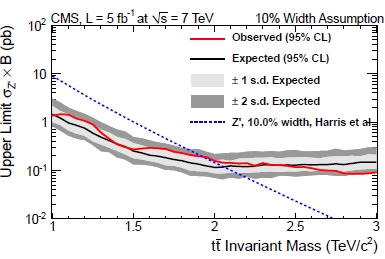
This week's graph comes from a recent publication by the CMS experiment, the one I am a proud member of together with about 3000 colleagues from all over the world.