Fake Banner
The Strange Case Of The Monotonous Running Average

These days I am putting the finishing touches on a hybrid algorithm that optimizes a system (a...

Turning 60

Strange how time goes by. And strange I would say that, since I know time does not flow, it is...

On The Illusion Of Time And The Strange Economy Of Existence

I recently listened again to Richard Feynman explaining why the flowing of time is probably an...

RIP - Hans Jensen

Today I was saddened to hear of the passing of Hans Jensen, a physicist and former colleague in...

User picture.
picture for Hank Campbellpicture for Patrick Lockerbypicture for Heidi Hendersonpicture for Bente Lilja Byepicture for Sascha Vongehrpicture for Johannes Koelman
Tommaso DorigoRSS Feed of this column.

Tommaso Dorigo is an experimental particle physicist, who works for the INFN at the University of Padova, and collaborates with the CMS and the SWGO experiments. He is the president of the Read More »

Blogroll
To the couple of positions I posted yesterday from the Chess Tournament I played this weekend, let me add one I played on round II, when I was white against Fausto Scali, the blind player. The position arose from the Advance variation of the French defense (1.e4 e6 2.d4 d5 3.e5), which however we reached with a transposed move-order (1.e4 c5 2.c3 d5 3.e5). In the position below, black has just played an inaccuracy in an already slightly worse queenless middlegame:


Chess is a game, a sport, and a very radical way to test one's concentration and discipline in pure thought. Besides liking it as a game (a precondition to enjoy the other benefits), I also enjoy immensely the demands that a chess game puts on your brain's functioning; and this is brought to the extreme during a chess tournament, where you are also subject to pressure from competition factors extraneous to the 64 squares where the battles develop.
No, unfortunately not yet the discovery of the century. Still, the new particle found by CMS in its 2011 dataset is a very important piece of the puzzle of low-energy spectroscopy. Here "low" should be taken with a pinch of salt: the new particle, an excited state of the Ξ_b series, has a mass only slightly lower than six GeV, and is thus "heavy" if compared to most other hadrons.
When I started a career in particle physics, joining the CDF experiment at the Fermilab Tevatron proton-antiproton collider about two decades ago, the search for a particle decay signal into hadronic jets was not something one would undertake lightly at a hadron collider: jets are omnipresent when you collide hadrons at high energy, so they constitute a irreducible background. Just as a detective looking for a blonde thief with swedish accent in Sweden, you would be close to clueless.
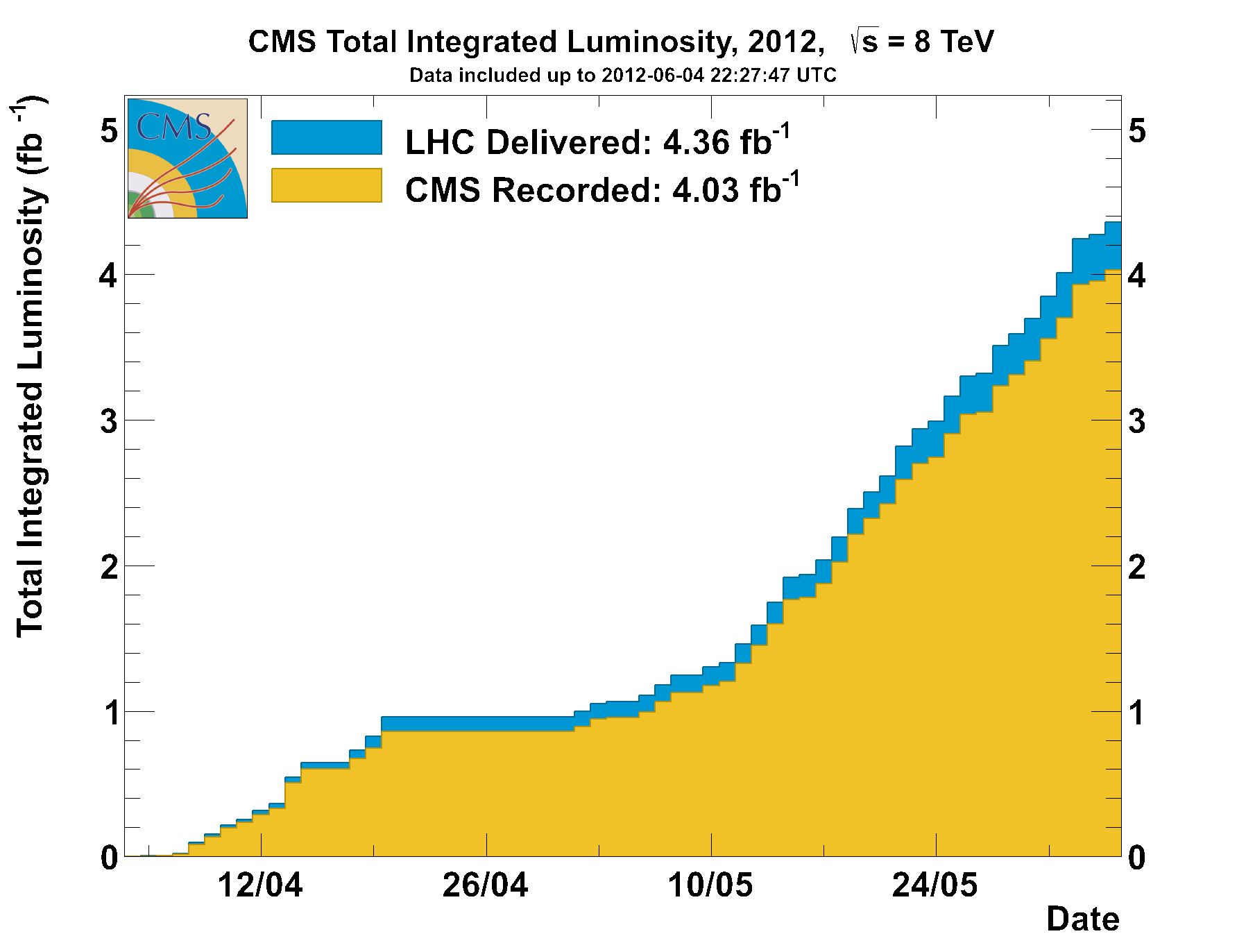
The LHC is ramping up in instantaneous luminosity according to schedules, and has just surpassed the measure of one inverse femtobarn of collisions delivered to the CMS experiment, as shown in the picture below.

The peak instantaneous luminosity shown below exhibits a nice smooth increase:

A couple of weeks ago the CDF and DZERO experiments have produced a combination of their measurements of the W boson mass. Besides two older determinations of this fundamental parameter of the Standard Model, the new 2.2/fb measurement by CDF and the 4.3/fb measurement by DZERO have been averaged together, accounting for correlated systematics. [x/fb is a shorthand for the amount of collisions from which the W boson datasets have been extracted by the experiments: 1/fb is about 80 trillion proton-antiproton collisions.]