Fake Banner
Living At The Polar Circle

Since 2022, when I got invited for a keynote talk at a Deep Learning school, I have been visiting...

Conferences Good And Bad, In A Profit-Driven Society

Nowadays researchers and scholars of all ages and specialization find themselves struggling with...

USERN: 10 Years Of Non-Profit Action Supporting Science Education And Research

The 10th congress of the USERN organization was held on November 8-10 in Campinas, Brazil. Some...

Baby Steps In The Reinforcement Learning World

I am moving some baby steps in the direction of Reinforcement Learning (RL) these days. In machine...

User picture.
picture for Hank Campbellpicture for Patrick Lockerbypicture for Heidi Hendersonpicture for Bente Lilja Byepicture for Sascha Vongehrpicture for Johannes Koelman
Tommaso DorigoRSS Feed of this column.

Tommaso Dorigo is an experimental particle physicist, who works for the INFN at the University of Padova, and collaborates with the CMS and the SWGO experiments. He is the president of the Read More »

Blogroll
What machine will replace the Large Hadron Collider to further our knowledge of fundamental physics at the high-energy frontier, in the forthcoming decades? 

The question is not at all a far-fetched one: these large machines require two decades to be built - and can then typically be operated for two further decades, amassing collision data that slowly but steadily improve the precision of our estimates of the parameters of nature.
As I mentioned in yesterday's post, there is a workshop going on this week at Fermilab, where 110 attendees - mostly particle physicists, but some computer scientists are also present - discuss how to push for more effective use of machine learning tools in the extraction of information on particle collisions. 

Also one goal is to understand what new ideas from the world of machine learning could find ideal applications in the typical use cases of research in fundamental physics. Here I wish to mention a few interesting things that I heard at the workshop so far, in random order. I will rarely make direct reference to the talks, to encourage you to dig into the pdf files available here.
When I  took Hwy 88-E toward Fermilab, shortly after landing at the Chicago O' Hare Airport yesterday afternoon, it occurred to me that the first time I had driven there happened 26 years and five months ago, in June 1992, when I was 26 years and five months old. 
What makes the observation significant is that the trip to Fermilab I made 26 years ago arguably marked the start of my career as a particle physicist, something that I consider as a non-trivial defining moment in my life. I was still a student back then, but from that point on I started doing serious research with the physics of elementary particles, and I have never stopped doing that since. 
I flew to the US yesterday to get to Fermilab, where I am following a workshop titled Machine learning for jet physics". My goal of this post is to explain what this is about in general terms, such that if I have enough stamina I will give, in follow-ups to it, a few examples of the status of this interesting research activity, which encompasses particle physics and computer science and can provide spin-offs in a number of related areas of fundamental research.
Right now (3PM Central European Time), Venice is being hit by the third biggest flood in over a century - in fact I think it is the third biggest flood ever recorded. The water is predicted to surge to 1.60 meters above average sea level, which means that most of the ground in the island will be under 50 cm of water, with some parts of the town under up to 80 cm. 
The strongest high tide in history is the one of November 4th, 1966, with 1.94 meters above sea level. And the second one I recall happened in 1980, with 1.68 meters. In both cases the damage was very large. In the recent past Venice has withstood some improvements, with new pavements in many of the most used walkways, but these sea levels mean that if you want to walk around you need proper fishing gear.
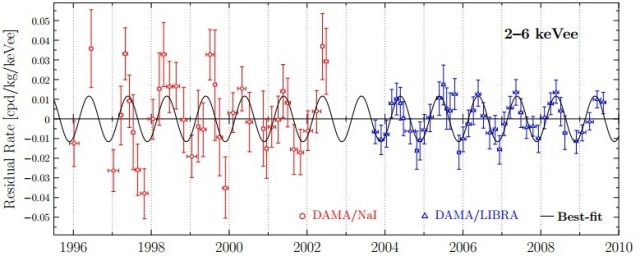
What is Dark Matter (DM) and why should you care? I feel I should start this article by explaining these two things first, as we live in an age when nobody has time for long historical or context-setting introductions.