I'll admit, I wanted to rather title this post "Billionaire Awards Prizes To Failed Theories", just for the sake of being flippant. But in any joke there is a little bit of truth, as I wish to discuss below.
The (not-so-anymore) news is that the "Special Breakthrough prize" in fundamental physics, instituted a decade ago by Russian philantropist Yuri Milner, and then co-funded by other filthy wealthy folks, recently went to three brillant theoretical physicists: Sergio Ferrara, Dan Freedman, and Peter van Nieuwenzhuizen, who in the seventies developed an elegant quantum field theory, SuperGravity.
Our current understanding of the Universe includes the rather unsettling notion that most of its matter is not luminous - it does not clump into stars, that is. Nobody has a clue of what this Dark Matter (DM) really is, and hypotheses on what it could be made of are sold at a dime a dozen.
On the other hand, we clearly see the gravitational effects of DM on galaxies and clusters of galaxies, so the consensus of the scientific community is that one of those cheap theories must be true. What make this very close to a dream situation for an experimental scientist is the fact that we do have instruments capable of detecting, or ruling out, dark matter behaving according to most of the majority of those possibilities.
While you and I may have been lagging behind a bit as of late, excused by a particularly hot July, the CMS collaboration has kept grinding its data, producing exquisite new results from the large amounts of proton-proton collisions that the experiment has been collecting during Run 2, i.e. until last year.
Of course, the process of going from subatomic collisions to submitted papers is a long and complex one. The first part of the journey involves triggering, storage, and reconstruction of the acquired datasets, and reduction of the data into an analysis-friendly format. While this might sound like a partly automatic and painless procedure, it involves the expense of liters of sweat by conscentious collaborators who oversee the data acquisition and their processing.
Andras Kovacs studied Physics at Columbia University. He currently works as CTO of BroadBit Batteries company. Andras recently wrote an interesting book, which I asked him to summarize and introduce here. The text below is from him [T.D.]
This blog post introduces a newly published book, titled "Maxwell-Dirac Theory and Occam's Razor: Unified Field, Elementary Particles, and Nuclear Interactions".
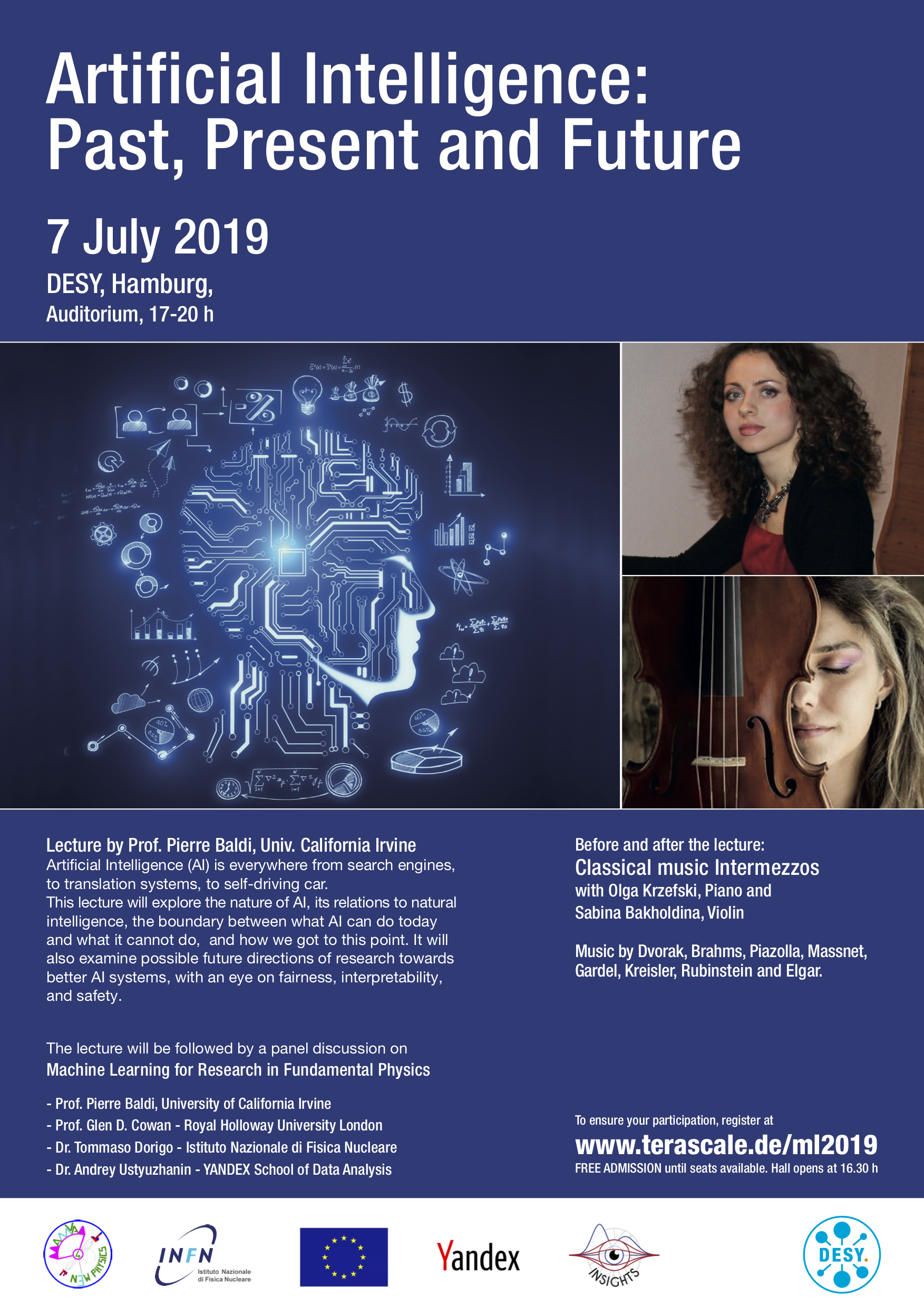
Are you going to be in the Hamburg (Germany) area on July 7th? Then mark the date! The AMVA4NewPhysics and INSIGHTS ITN networks have jointly organized, with the collaboration of the DESY laboratories and the Yandex school of machine learning, a public lecture titled "Artificial Intelligence: past, present, and future". The lecturer is Prof. Pierre Baldi, from the Center for Machine Learning at the University of California Irvine.
The venue is the auditorium (horsaal) of the Deutsches Elektronen-Synchrotron (DESY) laboratories, just west of the center of Hamburg, at Notkestrasse 85. The event starts at 5PM.
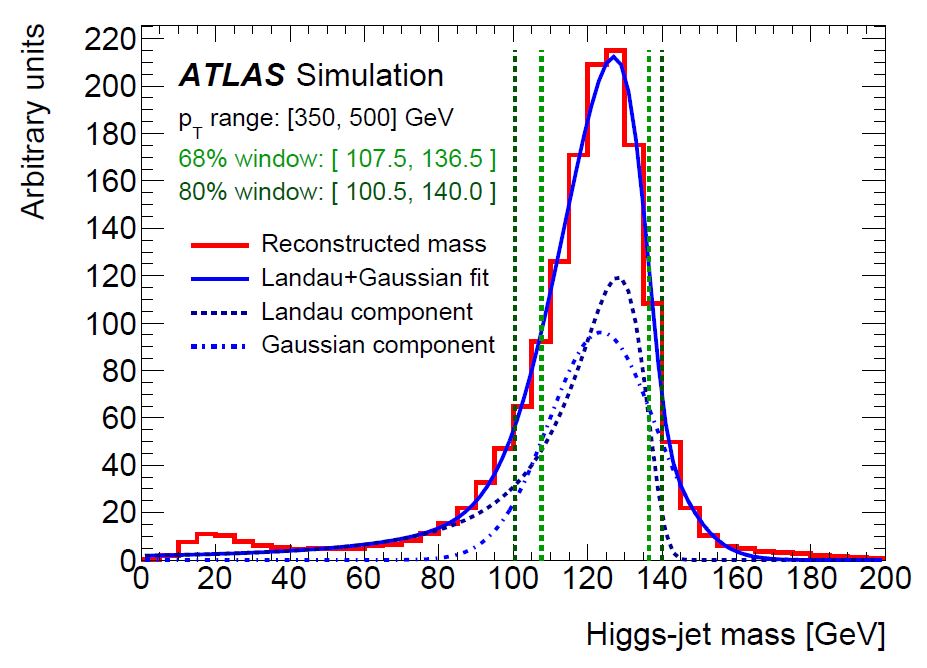
Particle physicists call "jet" the combined effect of many particles produced together when an energetic quark or gluon is kicked out of the hadron it called home, or when it is produced out of the blue by the decay of a massive particle.
The clearest example of the first process are the collisions we routinely produce at the Large Hadron Collider, where pairs of protons traveling at close to the speed of light bang into each other head-on. Protons are like bags of garbage: they contain a complex mix of quarks and gluons. So what happens in the collision is that one individual quark or gluon inside one proton hits a corresponding constituent in the other proton; the two pointlike objects scatter off each other, and get ejected out of the proton containing them.


 A Research Position In Neuromorphic Computing And Nanophotonics Open In Padova, Italy