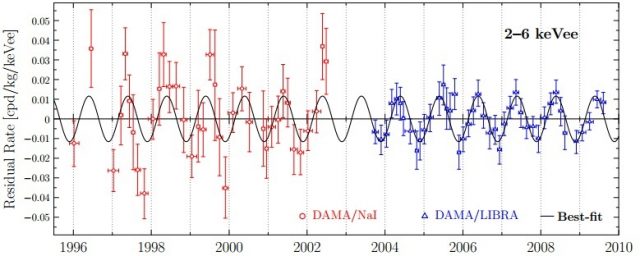
Sometimes browsing the Cornell ArXiv results in very interesting reading. It is the case with the preprint I got to read today,
"DAMA/LIBRA annual modulation and Axion Quark Nugget Dark Matter Model", by Ariel Zhitnitsky. This article puts forth a bold speculative claim, which I found exciting for a variety of reasons. As is the case with bold speculative claims, the odds that they turn out to describe reality is maybe small, but their entertainment value is large. So what is this about?
On August 20, in occasion of the "
5th International Workshop on Nucleon Structure at Large Bjorken x", organized at the Orthodox Academy of Crete, I had the pleasure to accompany at the piano my wife, the soprano Kalliopi Petrou, for a concert offered to the participants to the workshop by the organizers.
Today I am back from the 8th edition of the ICNFP conference, which finished yesterday in Kolymbari (Crete). This event is very interesting because of its wide scope, bringing together physicists from quite different fields in a venue that, due to its very relaxing, secluded nature favours post-session discussions and exchanges among the over 250 participants.
I am presently spending a few days in the pleasant island of Crete, in the middle of the Mediterranean, where I am attending the
eight edition of the "International Conference on New Frontiers in Physics". Crete is a gorgeous island at the crossroads of three continents, and because of its location it is brimming with relics of ancient to less ancient history. Anyway, this post is rather about physics, so let me go back there.
Like it or not, human-enhanced global warming is an established scientific fact. Indeed, as much as we hate the idea that we are affecting the future living conditions of hundreds of millions of human beings (not to mention animal species) with our carbon dioxide emissions, most of us - reasonable people with no agenda or direct interests in polluting industries - agree on the fact, and most of us also agree that we are doing far too little to alleviate the dramatic ongoing phenomenon. The science is out, and while it is a healthy thing to question the data and the results in all cases, it is a far healthier thing to accept evidence when it is overwhelming.
Ever since telescopes were first invented, by some dutch lens grinder in the late XVIth century, and then demonstrated to be invaluable tools for investigating the cosmos around us by Galileo Galilei in the early 1600s, there has been a considerable, steady effort to construct bigger and better ones. Particularly bigger ones.


 A Research Position In Neuromorphic Computing And Nanophotonics Open In Padova, Italy