Fake Banner
The Strange Case Of The Monotonous Running Average

These days I am putting the finishing touches on a hybrid algorithm that optimizes a system (a...

Turning 60

Strange how time goes by. And strange I would say that, since I know time does not flow, it is...

On The Illusion Of Time And The Strange Economy Of Existence

I recently listened again to Richard Feynman explaining why the flowing of time is probably an...

RIP - Hans Jensen

Today I was saddened to hear of the passing of Hans Jensen, a physicist and former colleague in...

User picture.
picture for Hank Campbellpicture for Patrick Lockerbypicture for Heidi Hendersonpicture for Bente Lilja Byepicture for Sascha Vongehrpicture for Johannes Koelman
Tommaso DorigoRSS Feed of this column.

Tommaso Dorigo is an experimental particle physicist, who works for the INFN at the University of Padova, and collaborates with the CMS and the SWGO experiments. He is the president of the Read More »

Blogroll
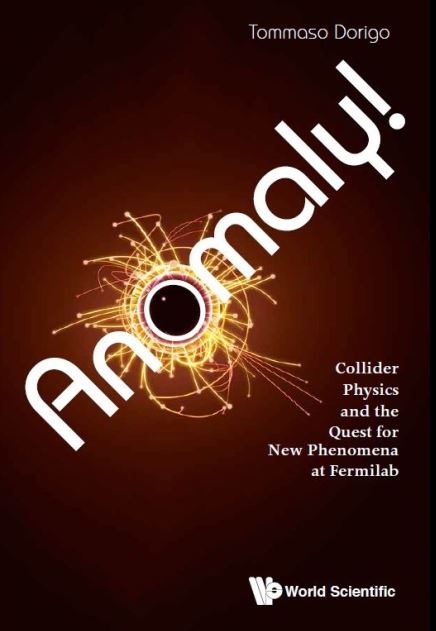
A new review of my book, "Anomaly! Collider Physics and the Quest for New Phenomena at Fermilab", has appeared on the June issue of "Physics World". It is authored by Gavin Hesketh, a lecturer at University College London, and you can read it here.
In the evening of May 30 a giant fireball lit up the skies south of Venice, Italy. The object, which was traveling very slowly along a south-north trajectory, was captured by three video stations in the area, plus observed by countless bystanders and recorded in pictures. The video data allowed to precisely measure the trajectory, which made it clear that the rock was headed straight toward the Venice metropolitan area, and that it would have landed there if it had not disintegrated in flight.

This article continues the series of postings in this blog on the results of artistic work by high-school students of three schools in Venice (out of five who took part initially) that participate in a contest and exposition connected to the initiative "Art and Science across Italy", an initiative of the network CREATIONS, funded by the Horizon 2020 programme of the EU.

Today I gave a seminar at the Physics Department of the University of Helsinki, to talk of "Controversial Phenomena in Collider Data and the 5-Sigma Criterion in HEP", invited by Juska Pekkanen and Mikko Voutilanen, two CMS colleagues. 
The seminar is more or less the same I have given several times in the past year around Europe and the US. It contains some statistics, some HEP history, and some material taken from my recent book, "Anomaly!".
The CMS collaboration at the CERN Large Hadron Collider has pulled off an extremely neat new measurement of the Higgs boson production rate - one which, for some reasons, is extraordinary in its own right.

Despite being the decay mode with the highest probability (two thirds of Higgs bosons die that way), the H->bb process is among the most elusive to put in evidence in LHC data, because b-quarks are quite commonplace there. 

As I explained in the previous post of this series, students in high schools of the Venice area have been asked to produce artistic works inspired by LHC physics research, and in particular the Higgs boson.