Fake Banner
Living At The Polar Circle

Since 2022, when I got invited for a keynote talk at a Deep Learning school, I have been visiting...

Conferences Good And Bad, In A Profit-Driven Society

Nowadays researchers and scholars of all ages and specialization find themselves struggling with...

USERN: 10 Years Of Non-Profit Action Supporting Science Education And Research

The 10th congress of the USERN organization was held on November 8-10 in Campinas, Brazil. Some...

Baby Steps In The Reinforcement Learning World

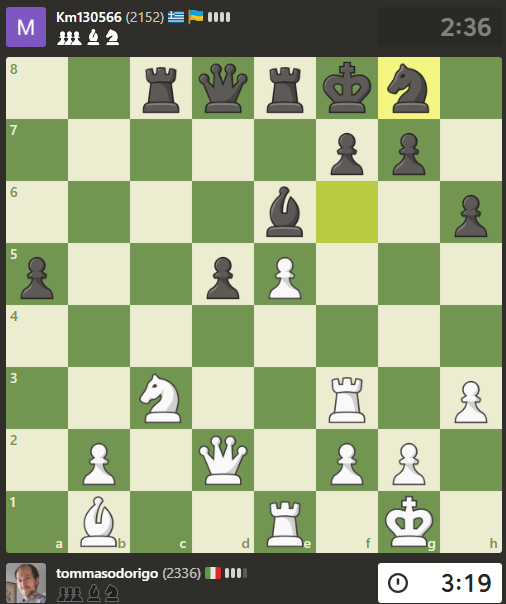
I am moving some baby steps in the direction of Reinforcement Learning (RL) these days. In machine...

User picture.
picture for Hank Campbellpicture for Patrick Lockerbypicture for Heidi Hendersonpicture for Bente Lilja Byepicture for Sascha Vongehrpicture for Johannes Koelman
Tommaso DorigoRSS Feed of this column.

Tommaso Dorigo is an experimental particle physicist, who works for the INFN at the University of Padova, and collaborates with the CMS and the SWGO experiments. He is the president of the Read More »

Blogroll

The text below is part of a chapter of "Anomaly!" which I eventually removed from the book, mainly due to the strict page limit set by my publisher. It is a chapter that discusses the preparations for Run 2 of the Fermilab Tevatron, which started in 2002 and lasted almost 10 years. There were many, many stories connected to the construction of the CDF II detector, and it is a real pity that they did not get included in the book. So at least I can offer some of them here for your entertainment... [A disclaimer: the text has not been proofread and is in its initial, uncorrected state.]

The first few copies of my new book, “Anomaly! – Collider Physics and the Quest for New Phenomena at Fermilab” arrived this morning from Singapore.

The INFN exam for nuclear and subnuclear physicists, to select 58 new researchers, took place on September 19th (first test) and 20th (second test) in Rome. Two different locations for the two tests were set up as the number of candidates who enrolled in the selection were 720, a too large number to manage in a single location.
Yesterday I read with interest and curiosity some pages of a book on the search and discovery of the Higgs boson, which was published last March by Rizzoli (in Italian only, at least for the time being). The book, authored by physics professor and ex CMS spokesperson Guido Tonelli, is titled "La nascita imperfetta delle cose" ("The imperfect birth of things"). 
The 2012 measurements of the Higgs boson, performed by ATLAS and CMS on 7- and 8-TeV datasets collected during Run 1 of the LHC, were a giant triumph of fundamental physics, which conclusively showed the correctness of the theoretical explanation of electroweak symmetry breaking conceived in the 1960s.

The Higgs boson signals found by the experiments were strong and coherent enough to convince physicists as well as the general public, but at the same time the few small inconsistencies unavoidably present in any data sample, driven by statistical fluctuations, were a stimulus for fantasy interpretations. Supersymmetry enthusiasts, in particular, saw the 125 GeV boson as the first found of a set of five. SUSY in fact requires the presence of at least five such states.
Next Monday, the Italian city of Rome will swarm with about 700 young physicists. They will be there to participate to a selection of 58 INFN research scientists. In previous articles (see e.g.