

Banner
    Should You Read Science Press Releases Or Science Papers?
    By Hank Campbell | May 3rd 2012 04:00 AM | 14 comments | Print | E-mail | Track Comments
    About Hank

    I'm the founder of Science 2.0® and co-author of "Science Left Behind".

    A wise man once said Darwin had the greatest idea anyone...

    View Hank's Profile
    We carry some press releases on Science 2.0 and of course that is what Science Codex in our sidebar is. It's been an intentional effort since the communications arm of Science 2.0 began in 2006. The first, and most important reason, for that is because we think the audience is smart and don't need journalists putting context to most stories. Our audience just wants to know first so if something looks interesting, it will hit this page on the minute the embargo lifts. Everything else is written by scientists or at least (mostly) knowledgeable people(1).

    So we have an advantage mainstream media does not.  When something is really interesting, or really bad, we have people who will provide the necessary context. It's safe for us to throw up a rewritten press release about a miracle vegetable or play Devil's Advocate on woo because we're not a newspaper written for 14-year-olds.

    That doesn't mean press releases are not dirty business.  They are competitive and generate a lot of money for the companies publishing them. They can also sometimes be used to pump up excitement for rather middling, incremental 'studies'.  Professor Michael Eisen, investigator for the Howard Hughes Medical Institute and evolutionary biologist at UC Berkeley, takes the media slightly to task for buying into aggressive press release coverage but we have to give the New York Times a break -  churnalism is what most of them do, just like in most other mainstream outlets (and even, errrr, us, though doing it for free as a service to science readers is arguably different than being a paid journalist) and reading the press release about genomic fortune-telling and what it can't do is snazzy.  But who didn't know that?  The only people claiming a lack of certain genes linked to certain diseases or even cancer provides a for a consequence-free life are people selling genetic testing.

    To wit:

    “In families with strong histories of cancer, whole genome sequencing can still be very informative for identifying inherited genes that increase cancer risk,” said Victor Velculescu, M.D., Ph.D., professor of oncology. “But hereditary cancers are rare. Most cancers arise from mutations acquired through environmental exposures, lifestyle choices and random mistakes in genes that occur when cells divide.”

    Yet most people who get cancer think cancer 'runs in their family'.  It's nice to think that because then diseases are both egalitarian and exculpatory.  If you get it, it isn't because you did anything wrong. Random mutations could obviously be the fallback also but no one could sell any genetic testing services then and its hardly world-shaking stuff to have that debunked. What really gets Eisen going is that the researchers seem intent on publicizing the possible benefits of their research effectively (and who can blame them?) but the people most likely to increase the citations and value of the research itself can't actually read it.  Eisen is at one of the largest research universities in the world and couldn't read the study.  He would have to have paid $15 to read Science Translational Medicine, of all things.  Why would researchers be okay with blocking it off to the public when they clearly want to promote it?  More importantly, he scolds the publisher of the journal, AAAS, for claiming to care about "engaging the public" but then not actually doing so when they can make a buck formatting an article they did not write, about research they did not do, that was funded by someone else - and getting to charge a hundred bucks a year for it.

    Eisen is co-founder of American open access publisher Public Library of Science so clearly he is no cynical opportunist whining on the Internet and wanting something for nothing, he put his time into building what he feels is a better way. He believes this stuff and he lives for engagement in a way large corporations only talk about.  He wants the mold broken, basically, which is very Science 2.0.  We did a panel together(1) at an AAAS conference in 2009 and his first slide was this:
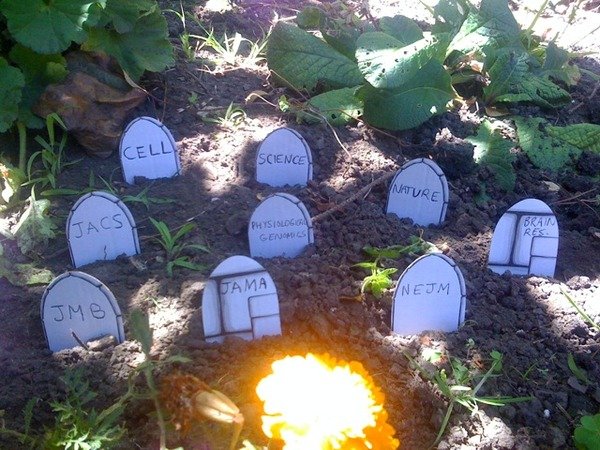

    At least he didn't single any of them out.  Credit: not sure, he said it was something he and his brother did.

    Who didn't laugh that he was at an AAAS conference talking about how the future of research was going to be better without them? Probably them.  I certainly have not been invited back to talk.

    If press releases are all the public gets (and, to be fair, many of them are quite good) then dumping NSF money into outreach campaigns seems a little silly. It isn't improving science literacy and we don't need to pretend it is all that vital when the government is redistributing money for research and doesn't put a stop to keeping articles out of the hands of taxpayers and keeps on making science a de facto subsidy for publishing conglomerates.

    Despite his dislike for federally funded research not being available for free to all taxpayers who are funding it, he was kind enough to link to the journal article and increase its Internet authority. I suppose if he can be gracious, so can I:

    Nicholas J. Roberts, Joshua T. Vogelstein, Giovanni Parmigiani, Kenneth W. Kinzler, Bert Vogelstein, and Victor E. Velculescu, “The Predictive Capacity of Personal Genome Sequencing”, Sci. Transl. Med. DOI: 10.1126/scitranslmed.3003380

    NOTES:

    (1) An open community gets some cranks that fly in under the radar.

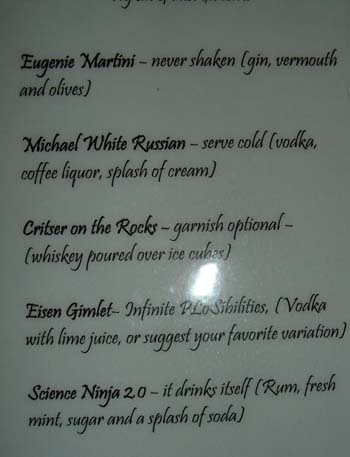
    (2) And we sponsored an afterparty with drinks named after the participants - and you needed a golden ticket to get in.  It was all very Willy Wonka:
    Comments

    Journalists should read the science papers. The public, however, can get good use out of well-written press releases, especially those coming out of academic institutions.

    I'm a little confused on the message you're trying to put out here, but maybe I stumbled on the wrong part of this conversation. The beef, it seems, is with the publishing industry, not the press releases.

    To paint broadly, at the core of modern scientific publishing is a now-outdated artifact of an age when printing presses were expensive. Scientific societies formed to afford its members a means of sharing information, which was solely through print journals. Over time, many of these society journals were gobbled up by publishing companies, who could publish and distribute in ways that the societies could not. So now most of the smaller journals are published exclusively by companies like Elsevier, with input from (largely) academic editorial staffs.

    Now, as PLoS has shown, we don't need the printing presses as much. I think we still need the societies, though. I would like to envision a database where anyone can publish anything, and the authors could appeal a society (or multiple societies) for input and peer-reviewing. Where readers can see revisions over time and how additional experiments were called for by reviewers, etc. Good research could carry the stamp of approval from multiple sources, increasing its visibility. It would be a golden age of universal access, unicorns, and butterflies. Universal access would encourage researchers to write up their for a broader audience, but their main goal should always be their peers.

    Either way, all the open access journals in the world won't negate the need for good science writing both in terms of the journalists who cover the science and the public information writers who are increasingly writing directly for the public (and niche groups therein). I can tell you, as a PIO, I know when I'm writing for coverage in the paper and when I'm writing to help my researchers get noticed by their peers or by potential funding organizations. The New York Times might not be interested in some obscure genetic disorder, for example, but I can guarantee you that there is a support group of a half-dozen parents out there somewhere looking for news on the topic.

    Hank
    The largest distributor of press releases charges universities to distribute them and also publishes a top tier science journal (and and the one mentioned above) and charges for the studies to be read.   I have no problem with a 'middleman' but in a digital age it seems a little silly.  Peer reviewers review for free and print costs money so if people want print, it makes some sense, but otherwise it makes little different if a journal is in print or not.  It's simple protectionism.

    I think that solid science writing has value - the public disagrees there is much of it out there these days, instead they feel like it has become even more politicized than regular journalism.  The rash of 'conservatives are anti-science' articles rehashing evolution and hESC from 6 years ago in mainstream science journalism is proof the public is right. While adult science literacy is much higher than when I was young and the science audience has ballooned, the demand for context from science journalists has plummeted.  Maybe well-written press releases are good enough, since so much of journalism is just rehashing them - but taxpayers should have transparency in study results just like they do in anything else taxpayers fund.
    Want more no-nonsense, independent science? Buy Science Left Behind
    In that, I agree. Taxpayers have a right to see what their money gets them. Its also in the best interest of the scientists themselves.

    However, as far as science journalism goes, I think it is the demand for context from journalism itself that has dropped, at least from traditional media sources. It isn't just science journalism, in-depth reporting of every sort has suffered in the last decade...but that's a different rant.

    Keep up the fight.

    Hank
    Yes, the drop in demand is overall but I think science requires context a little more.  And science journalists can be experts, though I chuckle at the anachronism of a TV show like "Meet The Press" because no one actually believes political journalists know anything special any more - but the good science journalists are really good. We have Greg Critser, Discover has Carl Zimmer, NY Times has John Tierney, etc.

    When the information is out there, people are engaged more.  Should we lament a decline in music critics, for example?  Not really. A music critic no longer has access I don't have, they are no longer needed.  But a car critic can still save us all some time and money. So it goes with some parts of science.  Amateur astronomers routinely kick the snot out of professional ones in discoveries because everyone has access to the data.  But 10 inverse femtobarns of collisions from a physics experiment will not allow an amateur to find a Higgs boson and explaining what it means and why it happens takes a creative person providing some context.

    Context remains key - but a lot of journalists instead engaged in framing when science topics became political.  And I would argue that killed the field.
    Want more no-nonsense, independent science? Buy Science Left Behind
    Asking journalists to read the actual science paper itself is nice in theory, but it won't work in practice. Most journalists aren't trained in science -- and that even includes some science journalists. I have a Ph.D. in microbiology, but if you asked me to read a paper about astrophysics, I couldn't understand the abstract.

    When I took a science writing course, we were trained to write press releases as our very first assignment. I didn't even know PIO's existed until I took that course. They labor away in relative obscurity. (THAT is true dedication, if you ask me.) And since you're a PIO, you know that many (most?) university press releases are written by very knowledgeable people, often actually trained in science. Do press releases hype up the research a bit? Sure. But, overall, I think press releases are informative and do a solid job.

    Thanks Mr. Campbell for connecting the dots so succinctly. It's nice to be able to put my two pet peeves in one basket [frustrated grad student] to better inform non-science friends/colleagues on Facebook, etc.

    John Hasenkam
    <i>_ Yes, the drop in demand is overall but I think science requires context a little more.</i>

    Yes but this is too often neglected. On my blog I always strive to place any individual research piece into the context of the relevant literature and where possible provide links to freely available studies. The internet, and especially sites like Science 2.0, can provide a much richer comprehension of the studies. It also pays to understand that so-called breakthroughs may take 20-50 years to find practical application. 


    There is far too much sensationalist reporting, especially in relation to cancer and dementia. There are far too many claims of a "novel finding" and even off the top of my head I can recall research making the same findings many years earlier. 


    Good science reporting too often drowned out by the sensationalism. Consider foodconsumer.com, that Mercola site. Mercola often makes outrageous interpretations of the literature that suit his disdain towards conventional medicine and endorsement of alternative approaches. Another author on the site, David Liu, typically offers much more conservative and appropriate interpretations. Think foodconsumer, everyone thinks Mercola, they should read David Liu and abandon Mercola. Foodconsumer is apparently the most popular web based alternative medicine new site. That's really sad not because alternative medicine is bad per se, it does have some useful ideas to explore, but because sites like foodconsumer degrade the science into a conventional-alternative political game. 


    Re-writing science press releases is fine with me as long as these rules are adhered to:

    1. The article must clearly state that it is based on a press release and provide a link the the original press release online (Universities and government agencies usually have online versions).
    2. The article must clearly delineate quotes from the press release so readers can tell where the inevitable spin is coming from.
    3. The article must provide a functioning link to the original paper/study online, stating if it is pay-walled, but link nonetheless.
    4. If the original study is not yet available in press and online, the article should not be written or published....to do so is just scientific rumor-mongering.
    5. The author of the article should state whether or not his comments or opinions are based on a reading of the full original paper or study. I would accept "I have not read the study in full but ... "

    Hank
    It's easier just to reprint the press release, since those are public domain. I don't know anyone who does what you describe anyway.  Maybe journalists.
    Want more no-nonsense, independent science? Buy Science Left Behind
    Mr. Campbell: Yes, my comment is about what journalists should be doing. About 3/4ths of what passes for 'science journalism', both in the MSM and on the net, is in reality just a press release lightly re-written to avoid just what you state --> simply reprinting the press release. It so common that it has its own name 'press release journalism'. The combined effect of a university/agency press release (with results spun by the university or agency public relations department to 'sex it up a bit') plus a media repackaging of the press release material, with further spin added by ignorant or activist 'science journalists, ' is what I (and others) call "Press Release Science" to distinguish it from real science and real science journalism.

    Hank
    Sometimes writing about the press release is more fun.   'Evidence for the Likely Origin of Homochirality in Amino Acids, Sugars, and Nucleosides on Prebiotic Earth' is somewhat incremental and therefore not all that interesting but when the release about it said there were dinosaurs ruling other planets based on it...well, that is worth a blog post even if the article itself is not. Eurekalert is, of course, owned by AAAS and they got $250 to publish the nonsensical press release.
    Want more no-nonsense, independent science? Buy Science Left Behind
    Gee...I missed that one. The link returns a "The page you are looking for has moved" error. Maybe they pulled it?

    I think science journalists writing about absurd science press releases is helpful. A little (or a lot) of public embarrassment helps to rein in the excesses of PR departments.

    Hank
    Here is another press release site: Could 'advanced' dinosaurs rule other planets?

    And it was written by the ACS, not some flaky journalism intern at a school. Which makes it especially funny.
    Want more no-nonsense, independent science? Buy Science Left Behind
    Thanks for the link.

    I have written Dr. Breslow to see if he really meant to say that his work on homochirality implied that "such life forms could well be advanced versions of dinosaurs"?

    I'll let yo know what he says.


