Fake Banner
Letter To A Demanding PhD Supervisor

A fundamental component of my research work is the close collaboration with a large number of scientists...

Letter To A Future AGI

I am writing this letter in the belief that the development of an artificial general intelligence...

A Great Year For Experiment Design

While 2025 will arguably not be remembered as a very positive year for humankind, for many reasons...

Living At The Polar Circle

Since 2022, when I got invited for a keynote talk at a Deep Learning school, I have been visiting...

User picture.
picture for Hank Campbellpicture for Patrick Lockerbypicture for Heidi Hendersonpicture for Bente Lilja Byepicture for Sascha Vongehrpicture for Johannes Koelman
Tommaso DorigoRSS Feed of this column.

Tommaso Dorigo is an experimental particle physicist, who works for the INFN at the University of Padova, and collaborates with the CMS and the SWGO experiments. He is the president of the Read More »

Blogroll
Your Move

Your Move

May 02 2013 | comment(s)

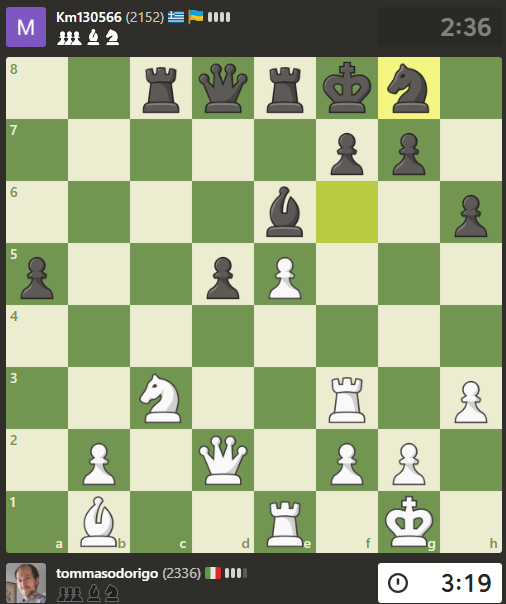
Last weekend I participated in a chess tournament in Mogliano. This year the event was not as strong a tournament as this used to be - only 24 players, two of them international masters.  Anyway there was room for fun, since the time control was of 90 minutes for the whole game, with 30 second increments per move. This fostered a livelier play with lots of blunders especially during the second half of the games: of course the quality of the games was low with so little time to think, and younger players were favoured with respect to older ones like myself.
ATLAS has just produced a very nice new study of jet production in Z-boson events. I will describe a sample graph below, but before I do I find it useful to explain to the less knowledgeable among you what a hadronic jet is, just in case you've been away during the last forty years.

Hadronic Jets: what are they ?
One of the most intriguing effects in subatomic physics is the phenomenon of violation of the discrete symmetry called "CP". It is intriguing at various levels.

First of all, CP violation is intriguing because of the depth of the concept: proof of that be that it is not at all easy to explain it to outsiders (I will make an attempt below, but I am likely to fail!).

Second, its elusive nature makes it even more mysterious and difficult to study: only a few subatomic physical systems exhibit it, and the effect is visible only as a modification of measurable quantities at the level of a few parts in a thousand.
"It is a melancholy experience for a professional mathematician to find himself writing about mathematics. The function of a mathematician is to do something, to prove new theorems, to add to mathematics, and not to talk about what he or other mathematicians have done. Statesmen despise publicists, painters despise art-critics, and physiologists, physicists, or mathematicians have usually similar feelings: there is no scorn more profound, or on the whole more justifiable, than that of the men who make for the men who explain.
Pictures showing the structure of matter and the organization of subatomic particles in different categories abound. Indeed, cataloging and classifying entities subject of study is a powerful means of grasping their essence and infer their properties. The most striking example I can offer is the Mendeleev table of elements (which allowed its creator to spectacularly deduce the existence of elements not yet discovered); but there are many others, like the Hertzsprung-Russell diagram of star classification, or the one for galaxies, or the cataloging of animal species...
There have been other attempts in the past, so this is not strictly a new idea. However I found the interactive web page at http://htwins.net/scale2/ extremely well constructed.

It is a graphical display of the largest and smallest structures from galaxy superclusters down to quarks and the Planck length. By moving a scroll bar left or right, you can get a very clear sense of scale of the different things. And in so doing you learn the relative size of different objects, from planets to stars, or from stars to galaxies; or vice-versa, from cells to molecules and atoms.

I highly recommend it!