Fake Banner
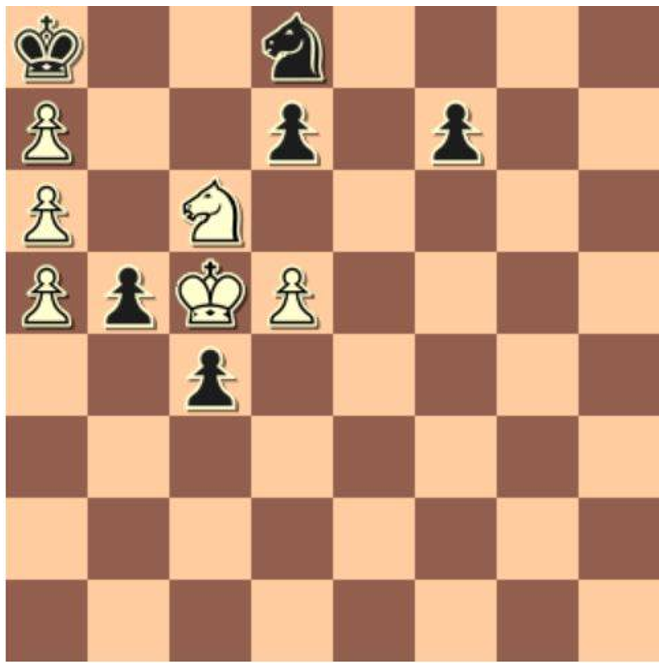
A Chess Study Requiring Backpropagation

The following position is a win for white. But how?It seems like white is able to grab a knight...
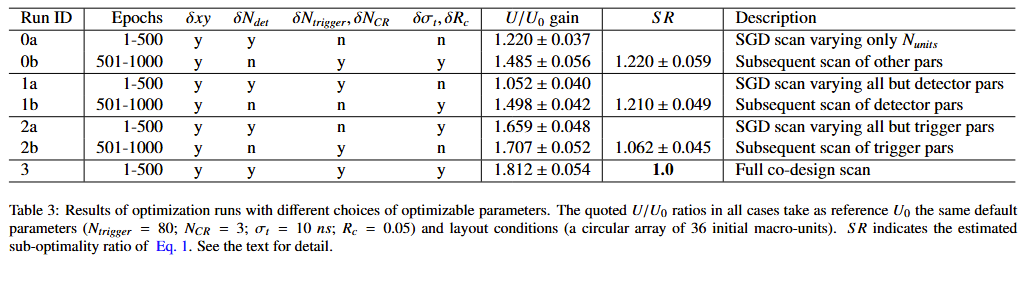
Co-Design Of Scientific Experiments

Next Monday, or Tuesday at the latest, you will find a new bulky paper in the arXiv. Titled "On...

Travel With Two Infants

The other day I traveled with Kalliopi and our two newborns to Padova from Lulea. After six full...
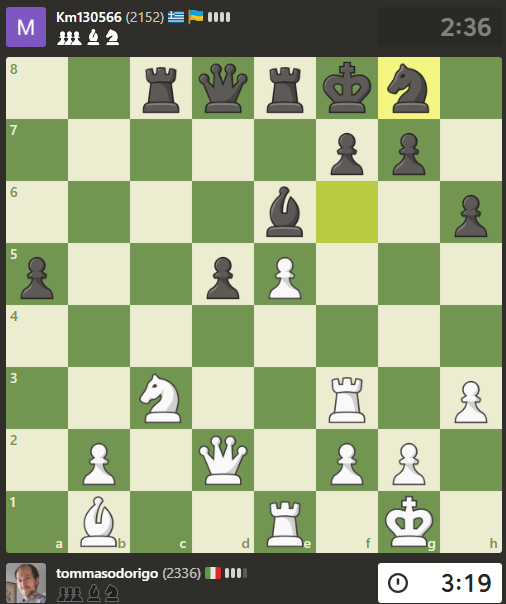
A Nice Little Combination

Although I have long retired from serious chess tournaments (they take too much time, a luxury...

User picture.
picture for Hank Campbellpicture for Patrick Lockerbypicture for Heidi Hendersonpicture for Bente Lilja Byepicture for Sascha Vongehrpicture for Johannes Koelman
Tommaso DorigoRSS Feed of this column.

Tommaso Dorigo is an experimental particle physicist, who works for the INFN at the University of Padova, and collaborates with the CMS and the SWGO experiments. He is the president of the Read More »

Blogroll
Here I vow to never "reblog", but exceptionally I will break that rule, translating from Italian a very nice article recently appeared on the Italian newspaper "Il Sole-24 Ore". The author is the INFN President, Fernando Ferroni. The reason why I break the rule is that the piece is quite clear and many of you may enjoy it. [The article transcript was taken from here]
The presentations of the last few days at the Neutrino Telescopes conference in Venice allowed me to get to full speed with the developments, new ideas, and new experiments taking data or just in design phase in this fascinating, relatively young field of investigation at the crossroads of particle physics and astrophysics.

The talk slides are online in the conference site, but as usual by just flipping them one usually does not manage to get the most important points. So I am providing summaries of every talk, at the conference blog site.

Yesterday I posted several articles there. Here is a list with links:

- Status of Gerda
Here is a list of the reports of talks given yesterday at the Neutrino Telescope conference in Venice. You should give these a look if you are interested in sterile neutrinos, in the mass hierarchy of neutrinos, or in the phenomenology of neutrinos in general. THe reports are a bit technical and there are at present no figures to complement the text, but figures will be added soon.

- Joachim Kopp: Status of Sterile Neutrino Scenarios

- Michael Cribier: Reactor Antineutrino Anomalies in Europe
Am following the Neutrino Telescope conference in Venice, which started yesterday in the beautiful setting of Palazzo Franchetti. For once I am quite happy to walk to work -different from the usual hour-and-something commute to Padova, where I have my office in the Physics Department. But I am not idle: I have been producing reports of all the talks at the conference, in the conference blog site.

Here is a list of pointers to the talk reports:

- A Tribute to Milla Baldo Ceolin

- Carlo Rubbia: A Millimole of Muons for a Higgs Factory
For the series "ideas worth spreading", CMS has copied the nice idea of ATLAS of producing an animated gif with increasing data leading to the Higgs boson discovery.

This is the mass distribution of Higgs boson candidates, detected by collecting events featuring four charged leptons (electrons or muons). The leptons are combined in pairs, and one pair (of same flavour) will usually yield a mass in the ballpark of the Z boson mass; the other pair will have lower energy if it is produced by an off-shell Z boson. Of course all four-lepton pairs compatible with quality criteria are kept, and the mass distribution thus contains a majority of events due to standard model production of ZZ pairs. This is the peaking background at masses above 180 GeV.
Carlo Rubbia discussed the prospects of constructing a muon collider to produce large amounts of Higgs bosons and study their properties in detail, crucially measuring the natural width of the particle, and testing couplings to a precision that LHC can't arrive at, to verify whether the particle is the Standard Model Higgs or if there are anomalies. The talk is discussed in detail in this report.

Here I just recall a question I asked Rubbia after the talk: