Fake Banner
Letter To A Demanding PhD Supervisor

A fundamental component of my research work is the close collaboration with a large number of scientists...

Letter To A Future AGI

I am writing this letter in the belief that the development of an artificial general intelligence...

A Great Year For Experiment Design

While 2025 will arguably not be remembered as a very positive year for humankind, for many reasons...

Living At The Polar Circle

Since 2022, when I got invited for a keynote talk at a Deep Learning school, I have been visiting...

User picture.
picture for Hank Campbellpicture for Patrick Lockerbypicture for Heidi Hendersonpicture for Bente Lilja Byepicture for Sascha Vongehrpicture for Johannes Koelman
Tommaso DorigoRSS Feed of this column.

Tommaso Dorigo is an experimental particle physicist, who works for the INFN at the University of Padova, and collaborates with the CMS and the SWGO experiments. He is the president of the Read More »

Blogroll
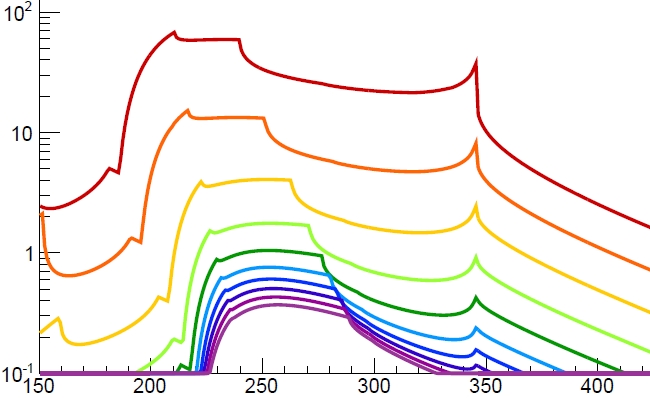
Occasional readers of this blog, I reckon, have time and again been left wondering what is the matter with these lower mass limits on new particles that physicists so copiously produce with their subnuclear physics experiments. How are they determined ? Why always lower mass limits and (almost) never upper limits ? And why do we care ?
Aldo Menzione

Aldo Menzione

Dec 29 2012 | comment(s)

It is with some delay that I decide to write about Aldo here. The reason is simply that after a house move I still have not been reconnected to the internet at home, and my absence from work for christmas holidays makes things even harder, and my presence online a sporadic break rather than a constant of motion.
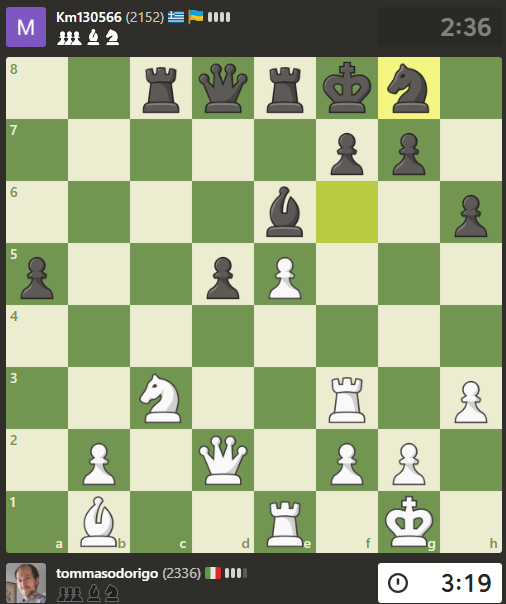
Last week I spent my time playing in a strong chess tournament in Padova. The tournament had 50 participants, among which 11 grandmasters and 10 international masters, and was definitely the strongest event I took part in during my amateur chess career.
I just left the following comment in the thread of my most recent posting, but thought it was more visible here, so I am cut-pasting it:

sorry for leaving comments unattended here for long. The fact is I am playing a chess tournament and have no internet connection at home because of a move, so I am a bit disconnected for a while. Will be back at full speed next week.
So maybe I can complement the information here about the chess tournament.

This is the XVth "Città di Padova" tournament, and it runs from December 16th to December 23rd. It is very strong (for my standards) with 11 grandmasters and 10 international masters, plus a few lesser souls such as yours truly acting as a mattress.
UPDATE: for more on this, I only now realize that my friend at Resonaances had written about it yesterday... It is nice to see that he agrees with my conclusions, anyway. Also Peter has news on it, and as usual additional links...

---

My ATLAS colleagues will have to pardon me for the slightly sensationalistic title of this article, but indeed the question is one which many inside and outside CERN are asking themselves upon looking into the new public material of ATLAS Higgs boson searches using the 2011 dataset in conjunction with the first part of 2012 data.
This is a post about basics. That's because I think a point needs to be made which is surprisingly not as well-known as its elementary nature would have you guess.

Correlation -in its most used version, due to Pearson- is a measure of how two quantities can be observed to be in linear dependence on one another. It is a very common quantity to report the results of scientific studies, particularly but not exclusively in the social sciences. Researchers try to evidence the presence of a correlation between two phenomena as a preliminary step to investigating whether one can be the cause of the other.