Fake Banner
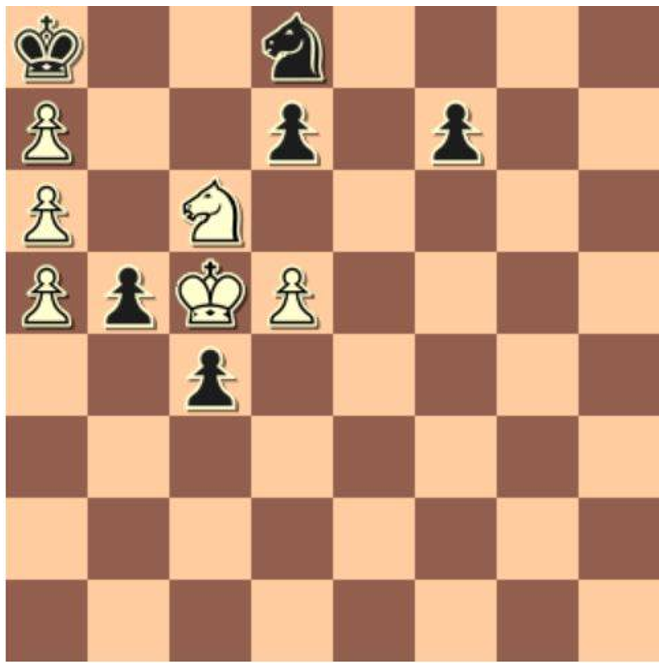
A Chess Study Requiring Backpropagation

The following position is a win for white. But how?It seems like white is able to grab a knight...
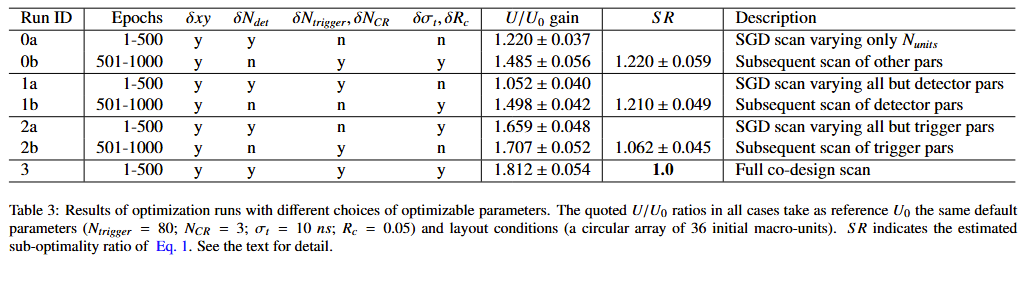
Co-Design Of Scientific Experiments

Next Monday, or Tuesday at the latest, you will find a new bulky paper in the arXiv. Titled "On...

Travel With Two Infants

The other day I traveled with Kalliopi and our two newborns to Padova from Lulea. After six full...
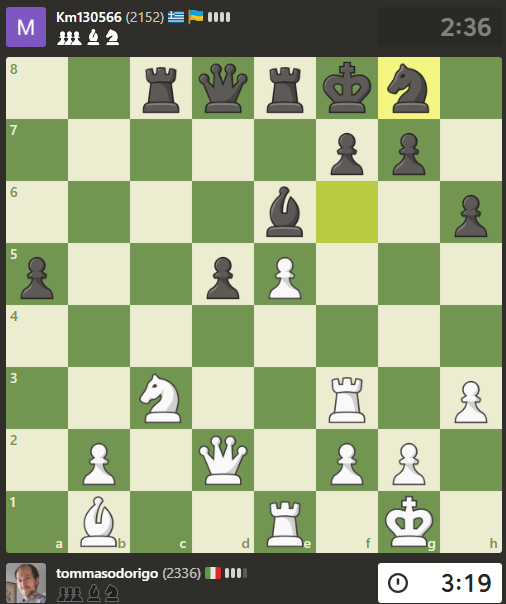
A Nice Little Combination

Although I have long retired from serious chess tournaments (they take too much time, a luxury...

User picture.
picture for Hank Campbellpicture for Patrick Lockerbypicture for Heidi Hendersonpicture for Bente Lilja Byepicture for Sascha Vongehrpicture for Johannes Koelman
Tommaso DorigoRSS Feed of this column.

Tommaso Dorigo is an experimental particle physicist, who works for the INFN at the University of Padova, and collaborates with the CMS and the SWGO experiments. He is the president of the Read More »

Blogroll
See, this is what I really like of a blog: when readers contribute significantly!
Yesterday I spent a very interesting day at Comunicare Fisica 2012, a conference held in TORINO which brought together researchers, high-school teachers, journalists and other professionals working in the field of the popularization of science. The session in the afternoon dealt with the use of the web 2.0, and of course among the topics discussed in the talks was the use of blogs.
Acknowledged!

Acknowledged!

Oct 11 2012 | comment(s)

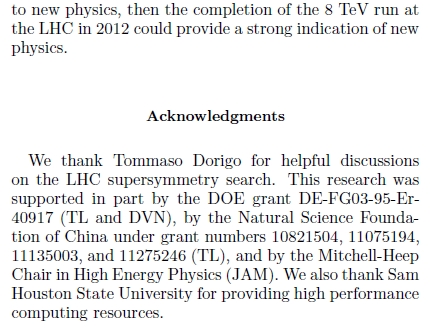
This is just to report that I feel greatly honoured to be cited on top of the acknowledgements section of the new paper by Dimitri Nanopoulos and colleagues.

I hope I will be able to review the paper for you here soon. The title ("Primordial Synthesis: F-SU(5) SUSY Multijets, 140-150 GeV LSP, Proton and Rare Decays, 125 GeV Higgs Boson, and WMAP7") promises a lot...

Below is a clip of the "acknowledgement" of my contribution (just a very pleasant chat with Dimitri in Athens last August, and little more).


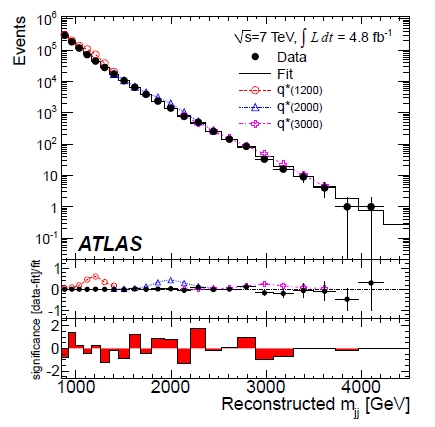
Two papers describing results of searches for high-mass resonances decaying into jet pairs have appeared on the arxiv this week. They are authored by the CMS and ATLAS collaborations, and they both report lower limits on the mass of hypothetical particles predicted by several new physics signatures. Both collaborations base their results on the analysis of their full 2011 datasets.
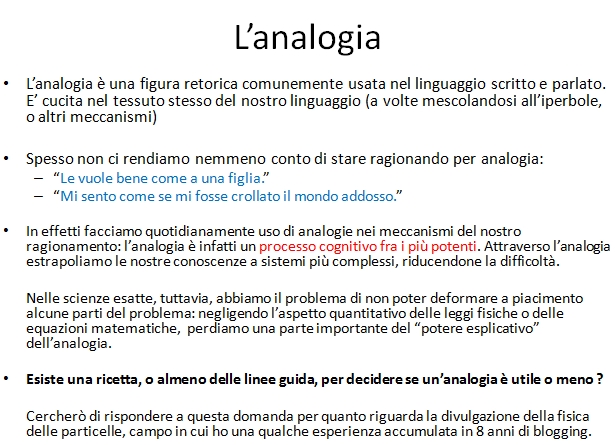
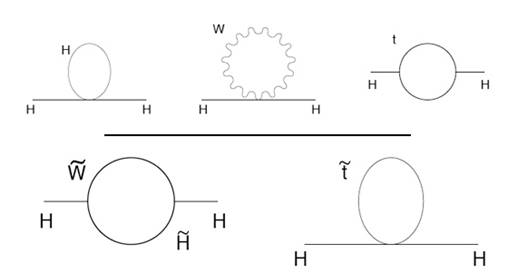
Five years ago I was fascinated by an analogy used by my friend Michelangelo Mangano to explain the problem of naturalness, a crucial issue in fundamental physics, and maybe the biggest single indicium we have that new physics beyond the standard model of particle physics should exist, and be not too far away from our current experimental reach.
In particle physics searches (and elsewhere) the word "significance" is associated with the quantitative measure of how discrepant is one observation with a so-called "null hypothesis". That is, one searches for a new effect in some dataset, and defines what one expects to see in the absence of anything discrepant from theoretical predictions: that is the null hypothesis. A new particle in the data will usually manifest itself as an excess of events, and this will cause the data to deviate from expectations.