Fake Banner
Letter To A Demanding PhD Supervisor

A fundamental component of my research work is the close collaboration with a large number of scientists...

Letter To A Future AGI

I am writing this letter in the belief that the development of an artificial general intelligence...

A Great Year For Experiment Design

While 2025 will arguably not be remembered as a very positive year for humankind, for many reasons...

Living At The Polar Circle

Since 2022, when I got invited for a keynote talk at a Deep Learning school, I have been visiting...

User picture.
picture for Hank Campbellpicture for Patrick Lockerbypicture for Heidi Hendersonpicture for Bente Lilja Byepicture for Sascha Vongehrpicture for Johannes Koelman
Tommaso DorigoRSS Feed of this column.

Tommaso Dorigo is an experimental particle physicist, who works for the INFN at the University of Padova, and collaborates with the CMS and the SWGO experiments. He is the president of the Read More »

Blogroll
Little less than one year ago the world of fundamental physics was shaken by the bold claim of the OPERA collaboration, which produced a measurement of the time of flight of neutrinos traveling underground from Geneva to the Gran Sasso mine in central Italy. The beam of neutrinos, produced by the CERN SpS proton synchrotron, was observed to produce interactions in the large mass of the OPERA detector with about 60 nanosecond anticipation with respect to what would be expected for a particle traveling at exactly the speed of light (2439096.1+-0.3 nanoseconds, since the flight path is of 731221.95+-0.09 meters).
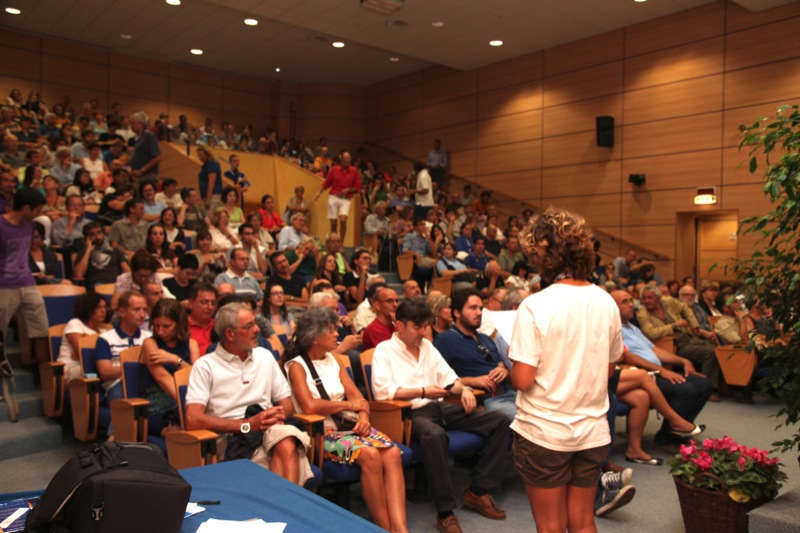
The way to get people to know you, attach your name to your face, and realize you are knowledgeable is, maybe suprisingly, to ask questions at meetings, as often as possible. You do not understand something about a plot your colleague is showing during his talk ? Ask about it. The x-axis labels are missing ? Ask what the heck are the units, even if Groucho's child of five could understand it. You arrive before the last slide and the speaker is saying she measured x with two inverse femtobarns ?
The Large Hadron Collider is delivering as expected a large amount of integrated luminosity of proton-proton collisions to CMS and ATLAS, running at a centre-of-mass energy of 8 TeV. The total collected in 2012 by CMS has just now crossed the mark of 10 inverse femtobarns: this is twice as much data as that collected in 2011. And the CMS detector is working like a charm, with all subsystems collecting data flawlessly.

Physicists need large integrated luminosity to explore rare phenomena, and high energy to probe processes which may only "turn on" above a certain threshold. So given the x2 luminosity so far collected (but we will get to x5 by the end of the year!) and x1.14 energy, the discovery potential of 2012 data is already several times larger than that of 2011 data.
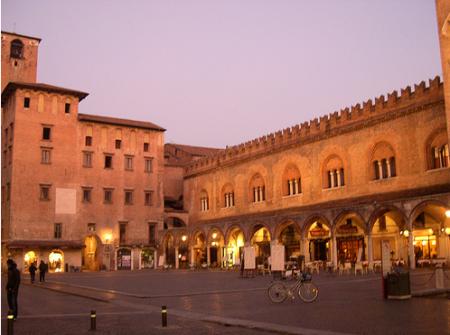
I am very happy to have been invited, by Matteo Polettini, to two events that will take place at Festivaletteratura (literature festival), an important cultural event that takes place in Mantova, a beautiful town in northern Italy, from the 5th to the 9th of September.
ATLAS has just released a note which summarizes the searches for the standard model Higgs boson in 7-TeV and 8-TeV data. Since July 4th the main improvement is the addition of the WW channel, which had not been shown back then. With it, the combined local significance of the 126 GeV Higgs boson excess in the WW, ZZ, and γγ channels grows to 5.9 standard deviations. In the words of a Facebook friend who's in ATLAS: "if this is not a discovery, I don't know what is".
The Tevatron experiments have jointly published on the arxiv two days ago a paper which is titled "Evidence for a particle produced in association with weak bosons and decaying to a bottom-antibottom quark pair in the search for the Higgs boson at the Tevatron collider". You can get the paper in the arxiv.