Fake Banner
Turning 60

Strange how time goes by. And strange I would say that, since I know time does not flow, it is...

On The Illusion Of Time And The Strange Economy Of Existence

I recently listened again to Richard Feynman explaining why the flowing of time is probably an...

RIP - Hans Jensen

Today I was saddened to hear of the passing of Hans Jensen, a physicist and former colleague in...

2026 Plans

This year opened in slow motion for me, at least work-wise. I have been on parental leave since...

User picture.
picture for Hank Campbellpicture for Patrick Lockerbypicture for Heidi Hendersonpicture for Bente Lilja Byepicture for Sascha Vongehrpicture for Johannes Koelman
Tommaso DorigoRSS Feed of this column.

Tommaso Dorigo is an experimental particle physicist, who works for the INFN at the University of Padova, and collaborates with the CMS and the SWGO experiments. He is the president of the Read More »

Blogroll
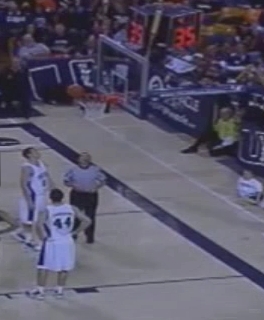
Dynamics can be surprising at times, even when applied to well-understood and tested physical systems such as a basketball and a basket. Look what happened to a free shot executed by Kamyl Kawrzydek in a match between Idaho State University and  Utah State University, played at Gossner's Invitational: the ball bounces on the basket, and then stops there for three full seconds, before eventually dropping into the basket.
Betting a grand on the existence or not of new physics is cool, but one does not need to be that daring (or to be that daring every other day) to enjoy the game of making predictions for what the fundamental research in experimental particle physics will discover or measure in a future close enough that we can reasonably expect to experience ourselves. So here I am, at the end of this eventful 2010, to look forward rather than backward, with no additional grand to invest but some insight to use, some reputation to waste, and a bit of humour to stuff between the lines.

Some unforeseen Christmas-vigil blog activity bringing here a few visitors more than average was traced today back to BBC News, who discussed the 2010 science highlights here.

The incoming link is in this paragraph:

The evolving role of the blogosphere in science came to the fore as particle physicists were preparing to gather in Paris for their annual conference. Internet rumours suggested that the US Tevatron particle smasher had seen hints of the elusive Higgs boson.

A reader of this blog asked in the comments thread of a recent piece the following interesting question:

"Assuming mH = 201 GeV/c2, how many Higgses shoud have been produced at
the Tevatron by now with an integated luminosity of 10 inverse
femtobarns? And how many H -> ZZ -> µµµµ would one expect to see?"
As sure as death and taxes, and as timely as a Swiss watch, the Tevatron collider never ceases to awe us. Well into its twentysixth year of life, the aged and celebrated proton-antiproton collider sitting just a few meters underground in the west Chicago suburbs hit the mark of 10 inverse femtobarns of collisions delivered to the core of the CDF and DZERO detectors.

10 inverse femtobarns! Ten inverse femtobarns of proton-antiproton collisions is a HELL of a lot of them. Plus, you should multiply that number by two, since the same number of collisions happened inside two different collision areas -those manned by the two competing collaborations.
An expert is a man who has made all of the mistakes which can be made, in a narrow field.
Niels Bohr