About a month ago I held a three-hour course on "Statistics for Data Analysis in High-Energy Physics" in the nice setting of Engelberg, a mountain location just south of Zurich. Putting together the 130 slides of that seminar was a lot of work and not little fun; in the process I was able to collect some "simple" explanatory cases of the application of statistical methods and related issues. A couple of examples of this output is given in a post on the
fractional charge of quarks and in an article on the
weighted average of correlated results.
A
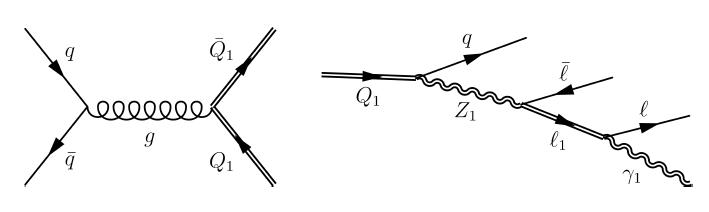
nice new search for heavy quarks has been completed by the ATLAS collaboration in 7 TeV proton-proton collisions data collected in 2011. The ideas behind the search are instructive to describe, so I will spend some time trying to do that before I discuss the results and their meaning.
Quarks: properties and decays
Of the dozens of new physics models which are currently on the market of Standard Model extensions and plug-ins, the ones hypothesizing the existence of additional dimensions of space-time beyond the 3+1 we know about are definitely among the most fascinating.
That is what Hamza Kashgari, a 23 years old reporter and poet from Saudi Arabia, is realizing the hard way. He used twitter to write a poetic "dialogue" with prophet Muhammad, and this was enough to get him condemned to death by the salafi sheikhs. Hamza tried to escape, but was arrested in Malaysia. He now risks beheading for his words.
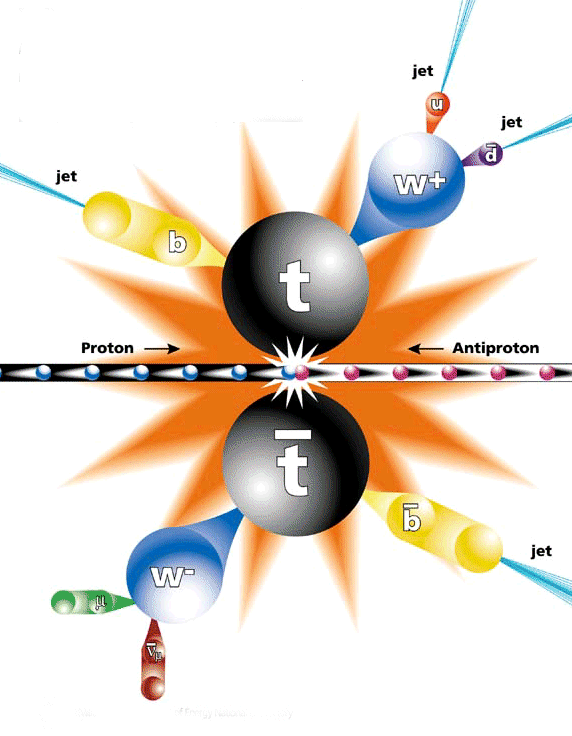
A new result by the CMS collaboration has been produced today on top quark physics. For those of you who only get triggered by the search of new particles or new forces, the study of "yesterday's signals", such as top quarks, is boring and uninformative; but high-energy physics is a rich field of research, and we extend our understanding of subnuclear physics no less by getting to know how exactly top quarks get produced in proton-proton collisions, than we do by placing limits on ephemeral particles (SUSY ones, e.g.).
So I salute the new measurement as an important advance. Using over one inverse femtobarn of data collected in 2011 (about a hundred trillion proton-proton collisions), CMS was able to study top quark pairs in great detail.
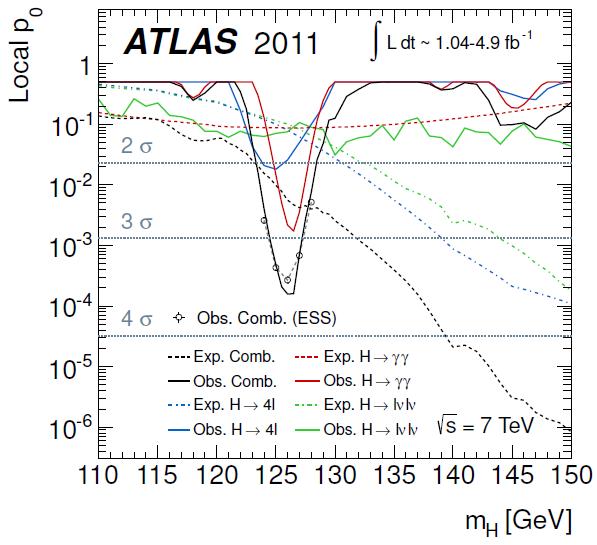
You have seen it already two months ago, but those were "preliminary" results. Now both CMS and ATLAS have produced full-fledged documents (
CMS here,
ATLAS here) describing their respective combinations of different Higgs boson searches, using data collected in 2011 by the two experimental apparata at the CERN Large Hadron Collider.


 Choosing Your Bets: The Selection Bias
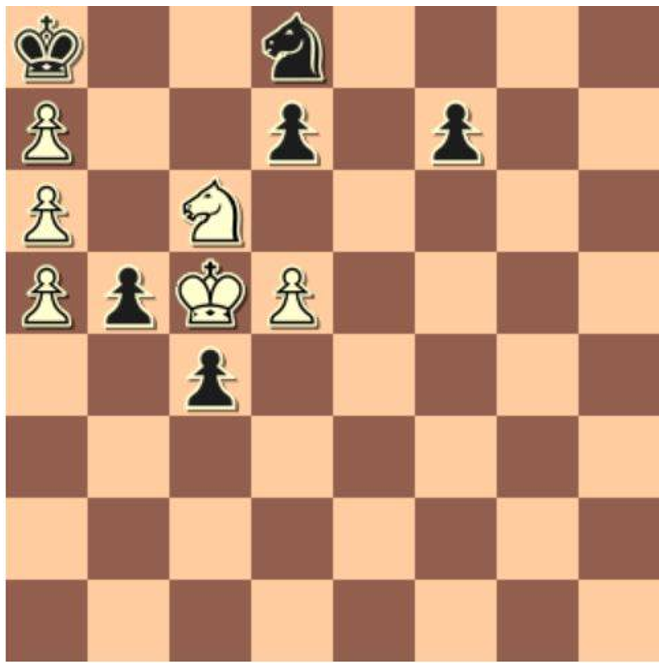 A Chess Study Requiring Backpropagation
 Co-Design Of Scientific Experiments