Today I am giving the opening speech at a workshop with the same title of this post. The workshop takes place at the Center for Particle Physics and Phenomenology of Université catholique de Louvain, in Belgium, and it is in a mixed formula - we will have 33 in-person attendees and 72 more attending by videolink.
The workshop is organized by the MODE collaboration, which I lead. It is a small group of physicists and computer scientists from 10 institutions in Europe and America, who have realized how today's deep learning technology allows us to raise the bar of our optimization tasks - we are now targeting the full optimization of the design of some of the most complex instruments ever built by humankind, particle detectors.
In
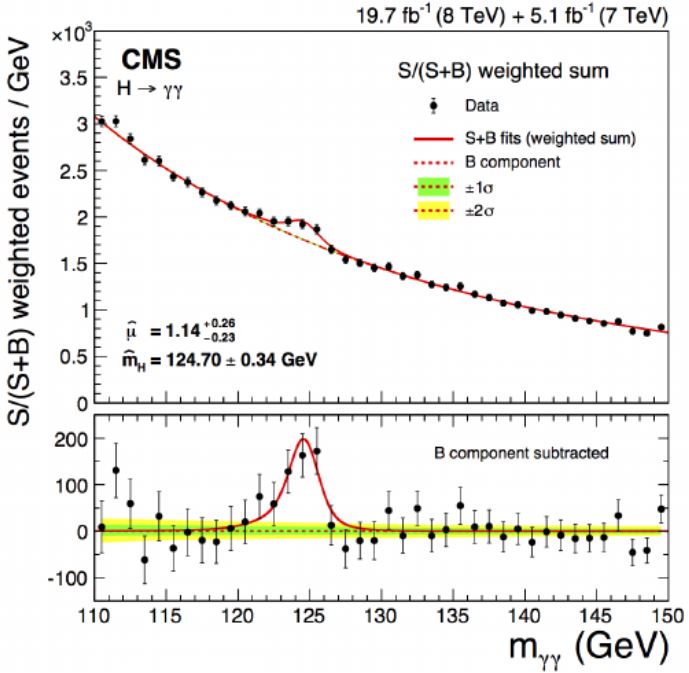
a recent post I discussed how even the simplest kind of data display graph - the histogram - can sometimes confuse and be misinterpreted. Which is a total howler, as graphs are supposedly means of clarification and immediate, at-a-glance, interpretation of data summaries.
Time and again, I get surprised by observing how scientific graphs meant to provide summarized, easy-to-access information get misunderstood, misinterpreted, or plainly ignored by otherwise well-read (mis-)users. It really aches me to see how what should be the bridge over the knowledge gap between scientists and the general public becomes yet another hurdle.
When subnuclear particles traverse matter they give rise to a multitude of physical phenomena. The richness of the different processes is a crucial asset for the construction of sensitive particle detectors, and it is interesting in its own right. Indeed, it has been a very vigorously pursued field of research of its own ever since the end of the nineteenth century, with the discovery of X rays
(produced when electrons released their kinetic energy as they reached the cathode of an accelerating tube), and then after Rutherford's team bombarded gold foils with alpha particles (helium nuclei) emitted by a radioactive substance.
With the delta variant of Covid-19 surging in many countries - e.g., over 100,000 new cases per day foreseen in the UK in the next few days, and many other countries following suit - we may feel depressed at the thought that this pandemic is going to stay with us for a lot longer than some originally foresaw.
In truth, if you could sort out your sources well, you would have predicted this a long time ago: epidemiologists had in fact foreseen that there would continue to be waves of contagions, although at some point mitigated by the vaccination campaigns. However, so much misinformation and falsehood on the topic has been since dumped on all media, and in particular on the internet, that it is easy to pick up wrong information.