What is a twistor, and why should we care? Well, I may not be the most qualified blogger out here to give you an answer, but I will try to at least give you an idea. Before I do, though, maybe first of all I should say why I am discussing here a rather obscure mathematical concept, in this typically experimental-physics-oriented blog.
Twistor theory is a mathematical construction that dates back to the sixties, and is probably mostly known for some of its uses within string theory. Funnily enough, it has now been brought to the fore by Peter Woit, a mathematical physicist from Columbia University who became internationally renowned when he published his 2006 book "Not Even Wrong".
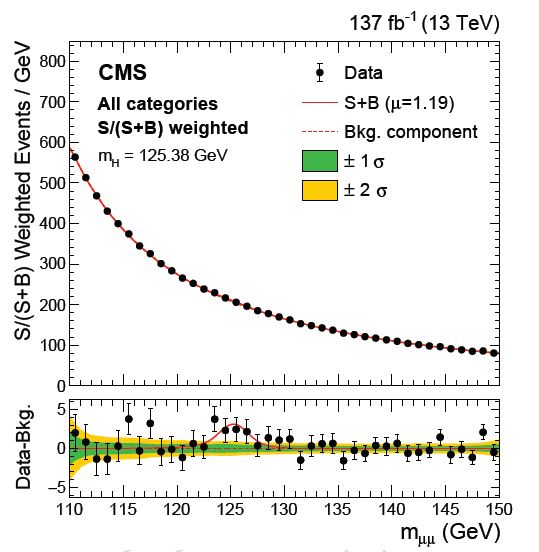
As of late we have been scratching the barrel of "straightforward" measurements of the properties of the Higgs boson, the particle discovered in 2012 by the Large Hadron Collider ATLAS and CMS experiments. But the one property determined in the measurement published yesterday by the CMS experiment was one that many of us were very interested to check.
If a particle is an elementary body, how many individual, distinct properties can it really have? For the word "elementary" means that it is intrinsically simple! But things are not so clear-cut in the subnuclear world. An elementary particle, while devoid of inner structure and dimensions, still has a number of measurable attributes. For the Higgs boson we may size up:
- mass (of course!)
Experimental physics is about investigating the world in a quantitative manner, by exploiting our technology to carefully map the wealth of phenomena that make planets turn around stars, atoms stick together, and hearts to beat. All of that can be understood by creating models of the underlying physics processes. These models need to be fed with input parameters which we must measure.
On July 6th, at 7PM CET (1PM in NY, 10AM in California) I will be chatting online with
David Orban on his show
Searching For The Question Live (#sftql) about the present and future of particle physics, artificial intelligence and its applications to research, science communication, and the whereabouts. I hope you will be
joining us, it should be fun!
For those of you who do not know who David Orban is:

It is not a secret that I love chess, and that whenever I have the chance to play some online blitz -in the absence of better competitions or tournaments- I plunge happily into it. However, my results vary, as sometimes my mind cannot be taken away from the program that won't run or this or that administrative forms still waiting to be filled.
I did not think I would need to explain here things that should be obvious to any sentient being, but the recent activity I detect on Facebook and other sites, and the misinformation spread by some science popularization sources and bloggers around the conclusions reached last week by the European Strategy Update for Particle Physics (EUSUPP), a 2-year-long process that saw the participation of hundreds of scientists and the heavy involvement of some of our leading thinkers, forced me to change my mind.


 A Research Position In Neuromorphic Computing And Nanophotonics Open In Padova, Italy