Fake Banner
A Research Position In Neuromorphic Computing And Nanophotonics Open In Padova, Italy

Five days are left to apply to a 2-year research position at INFN-Padova, to work in the context...

Apply For The USERN Prize, Win Cash, And Get A Keynote Talk In Astana

Nowadays it has become exceedingly hard to distinguish legitimate academic endeavours from scam...

A Record Of Past Activities

Every now and then, for one reason or another, an academic will have to update one's own CV. This...

Surviving Queues: 2 - On The Road

[For the first part of this two-part post, see here]...

User picture.
picture for Hank Campbellpicture for Heidi Hendersonpicture for Patrick Lockerbypicture for Bente Lilja Byepicture for Sascha Vongehrpicture for Johannes Koelman
Tommaso DorigoRSS Feed of this column.

Tommaso Dorigo is an experimental particle physicist, who works for the INFN at the University of Padova, and collaborates with a number of exxperiments in physics and astrophysics, including the... Read More »

Blogroll
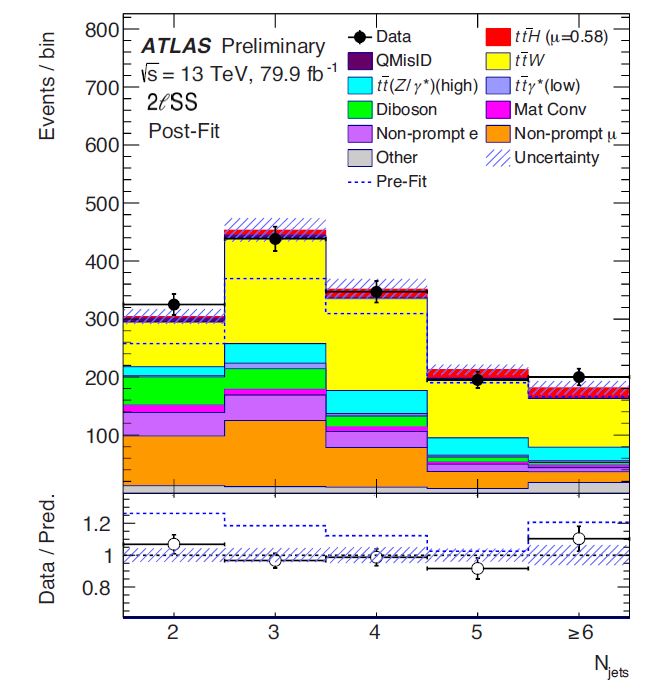
I was blissfully unaware until today of a slightly anomalous effect, which was found by the ATLAS Collaboration when performing a search for top pairs plus Higgs bosons in their Run 2 data. The anomaly I am talking about is an apparent excess of events which could be explained, as ATLAS did in this preprint article, by dialing up the cross section of some background processes producing a top pair and a W boson. 
Tomorrow - that is, November 8th, at 8AM GMT - I am chairing a session titled "Artificial Intelligence for Physics Research, and Physics Research for Artificial Intelligence" at the Vth USERN Congress. The event takes place in Tehran, and is broadcast via zoom. If you are interested in the talks, of which I give some detail below, you will be able to connect through this link.
The agenda of the workshop is as follows (those shown are are Tehran times):

11.30-11.55 Tommaso Dorigo, “Artificial intelligence and fundamental physics research
The sanitary emergency presently affecting most countries across the World is highlighting the duties that each of us, as a member of a collectivity of individuals who share commodities, services and infrastructure, is called at times to attend to. In a well-functioning society paying taxes should not be enough to earn the right to be a citizen. Indeed, the "social contract" also demands us to, e.g., abide to laws. 
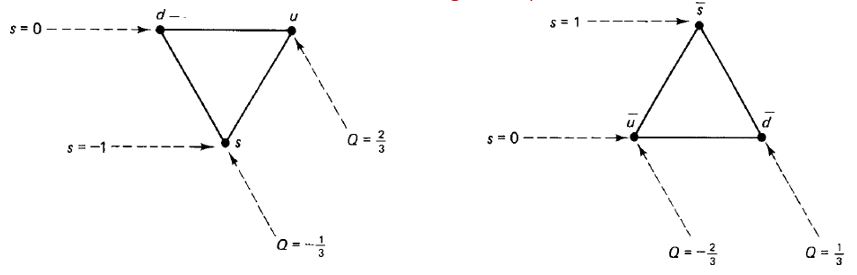
Every time I lecture my students about the static quark model I find that the construction of hadrons from their constituents is really entertaining. Probably I have more fun than my students as I explain the details, but today you get to be the judge - I am going to explain it here, and test your patience and skills as a matter builder.

Hadrons are composite particles made of quarks. The word "hadron" comes from ancient Greek αδρος, which means "thick, bulky". The two hadrons we know best are protons and neutrons, which make up atomic nuclei; but there exist literally hundreds more, which are unstable and decay very quickly after they are created, in subnuclear reactions we can produce using particle accelerators. 
For some reason today I remembered that 11 years ago (wow time flies) I wrote a two-parts piece on advices for PhD students doing a thesis in experimental particle physics. As I checked it out, I found that I mostly share the views I had back then (TBH that's not necessarily a good thing - consistency requires you to be as ignorant as you were earlier on). Since I think that stuff I posted over 10 years ago are otherwise lost in oblivion and not picked up by generic google searches, I decided it is time to recycle that text - here it is below, unamended but collated into a single longish article. Enjoy!
Marco Fulvio Barozzi (b.