Fake Banner
Living At The Polar Circle

Since 2022, when I got invited for a keynote talk at a Deep Learning school, I have been visiting...

Conferences Good And Bad, In A Profit-Driven Society

Nowadays researchers and scholars of all ages and specialization find themselves struggling with...

USERN: 10 Years Of Non-Profit Action Supporting Science Education And Research

The 10th congress of the USERN organization was held on November 8-10 in Campinas, Brazil. Some...

Baby Steps In The Reinforcement Learning World

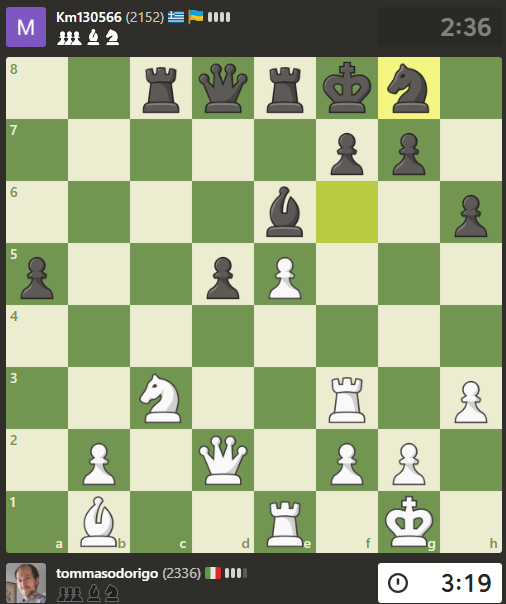
I am moving some baby steps in the direction of Reinforcement Learning (RL) these days. In machine...

User picture.
picture for Hank Campbellpicture for Patrick Lockerbypicture for Heidi Hendersonpicture for Bente Lilja Byepicture for Sascha Vongehrpicture for Johannes Koelman
Tommaso DorigoRSS Feed of this column.

Tommaso Dorigo is an experimental particle physicist, who works for the INFN at the University of Padova, and collaborates with the CMS and the SWGO experiments. He is the president of the Read More »

Blogroll
It's been a while since the last time I talked about myself in this column. I think that a blog must contain personal information to be interesting - otherwise why sticking around, when there's tons of good (yes, also bad) information in the web ? But here you can get some particle physics information mixed in with things that, although you need not know or care about, it's fun to share and comment on. Or at least I hope it's so, for the few of you who read this.
Long-time readers of this blog know that one of the recurrent topics has always been the precision measurement of the top quark mass. The reason for this is at least three-fold. 
One, I started my career in experimental HEP with searches and measurements of the top quark properties, and the mass was one of the parameters I spent quite some time working on. 
Technically it also creates a diboson final state - two photons - but no, here I am not going to talk about the tentative new particle of which ATLAS and CMS continue to see hints in their data, at a mass of 750 GeV and with characteristics that increasingly resemble those of a heavy higgs boson. Oh, see - I am doing precisely that. It is admittedly hard not to speak of that thing nowadays, but I will insist, as I think it is too good to be true, and so it must be false. 

UPDATE: Tiziano tells me that he has been misquoted by the Guardian - he was quoting himself a colleague when he mentioned the 20:1 bet. Sorry to say this bet is not on, at least until the person who offered the bet in the first place will manifest him- or herself....

I bet most of you, who are interested in Physics, know what I mean when I talk about "the 750 GeV particle". Last December, the ATLAS and CMS experiments released information about a tantalizing hint of a new particle with a mass in the 750 GeV ballpark. The resonance was seen in the decay to pairs of energetic photons. Since both experiments see more or less the same thing, this may be a fluctuation, but if it is, it is a really rare one. 
I am very happy to report that Professor Giorgio Parisi won another prize. Parisi is an Italian theoretical physicist who is very well known for his decisive contribution to QCD, with the DGLAP equations (the P stands for his last name) that govern the dynamics of gluons. However his work did not stop there - after that result Parisi continued excellent research and it is not by chance that he collected prizes and acknowledgements along the way for the more recent contributions he has given to theoretical physics. 
The 2016 prize called after Lars Onsager is given to Giorgio by the APS
I think it is due time that I point out a few interesting articles that have appeared in the past couple of months in the blog of the AMVA4NewPhysics network, a consortium of 16 among universities, research institutes, and industries that has the goal of studying Higgs physics and new Physics with the LHC, using advanced statistical learning methods.